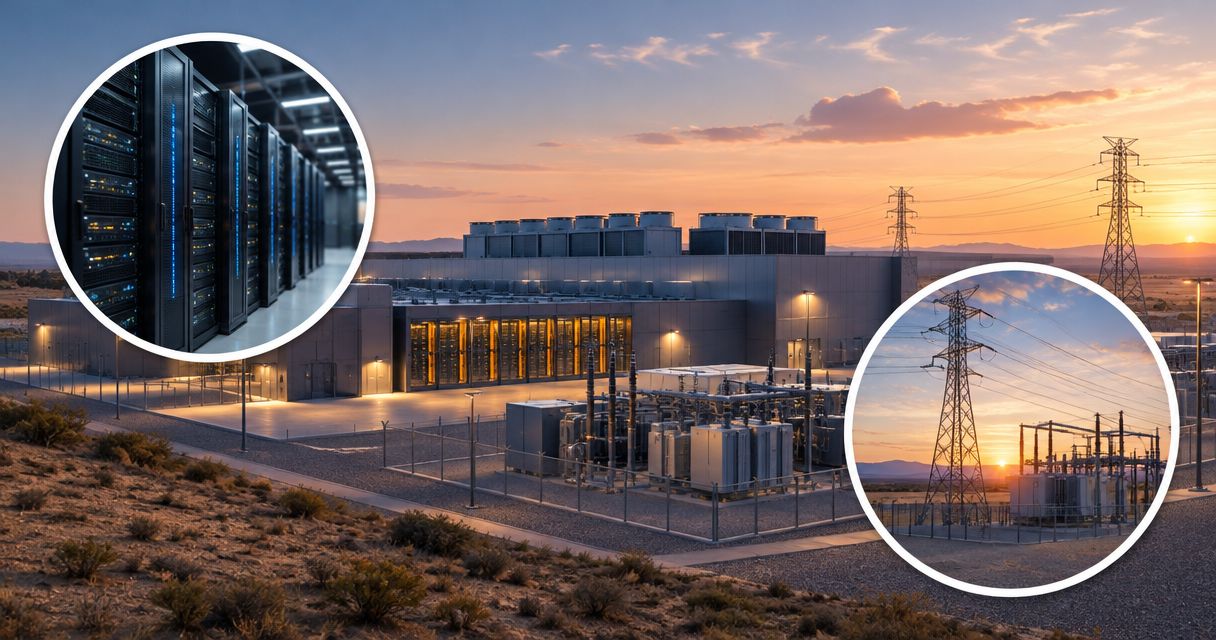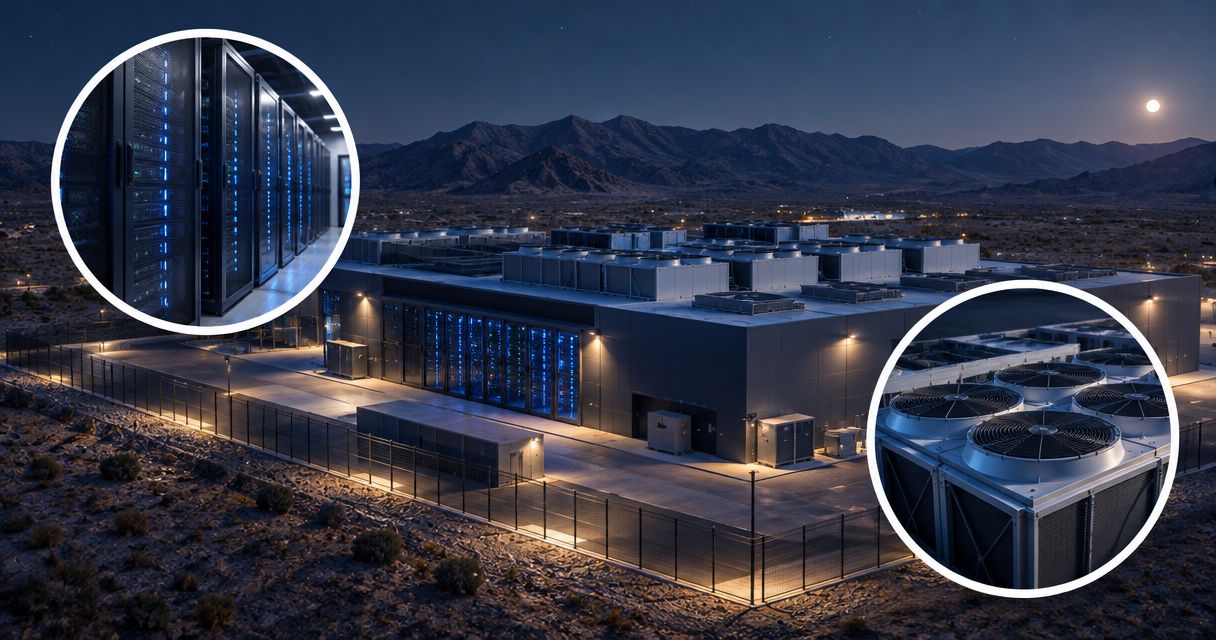
Data center noise continues overnight because servers keep producing heat and the equipment that removes that heat keeps running. Fans, cooling equipment, and building ventilation do not stop simply because nearby residents go to bed. A persistent nighttime hum does not, by itself, prove that backup generators are running or that a facility has violated its permit.
- Data center noise continues overnight because computing equipment and cooling systems keep operating.
- A steady hum can suggest mechanical equipment, but sound alone cannot identify the source or establish a violation.
- Check nighttime permit conditions, document recurring noise, and request measurements that match the applicable rule.
- National File separates the operating explanation from allegations that require site-specific evidence.
Why this matters
Continuous operation explains nighttime noise. It does not settle whether that noise is acceptable or lawful. Those are separate questions, and a useful complaint keeps them separate.
This National File explainer distinguishes ordinary equipment operation from claims that require records and measurements. For a 2026 complaint, the useful evidence is the facility's operating conditions, the applicable noise rule, and what happens at the affected property—not a guess about the sound.
Why does data center noise continue overnight?
Data centers house computing equipment that consumes electricity and releases heat. Cooling systems move that heat away from the equipment and ultimately discharge it outside. When computing continues overnight, heat removal continues too.
Facilities designed for continuous service operate around the clock: 24 hours per day, 7 days per week. That operating model explains why a nearby mechanical sound can persist after office traffic, construction, and daytime deliveries have stopped.
The U.S. Department of Energy's Federal Energy Management Program explains these cooling and heat-removal functions in its Best Practices Guide for Energy-Efficient Data Center Design. That technical reference explains the operating need; it does not establish the source, sound level, or legal status of noise at a particular property.
| Possible source | Why it operates overnight | What it explains | What it does not establish |
|---|---|---|---|
| Cooling fans | Heat removal continues while computing equipment operates | A continuing mechanical sound | Which fan or facility is responsible |
| Chillers and associated equipment | Some cooling designs use refrigeration equipment | Compressor or mechanical noise | Whether every data center uses that design |
| Pumps | Liquid-based cooling systems circulate fluid | Mechanical sound or vibration | Whether vibration reaches neighboring buildings |
| Building ventilation | Mechanical spaces can require ventilation during operation | Fan and airflow noise | Whether the sound exceeds a local limit |
| Backup generators | Emergency operation, testing, or maintenance can require operation | Engine and exhaust noise during those events | That generators explain a continuous nightly hum |
Do not treat this table as a diagnosis. A facility's equipment inventory, operating records, and an acoustic investigation are needed to connect a particular sound to a particular source.
Cooling equipment: why the hum can persist
A data center's cooling system responds to heat, not the neighborhood's bedtime. Cooler outdoor conditions can change how some cooling systems operate, but they do not guarantee silence.
The design matters. Equipment that moves heat through air has a different arrangement from equipment that circulates liquid, and liquid cooling still requires a way to reject heat outside the computing equipment.
Best for understanding persistent noise: examine the heat-removal system first. That is a starting point for investigation, not proof that a particular fan, pump, or chiller caused the disturbance.
The advantage of cooling equipment is straightforward: it helps keep computing equipment within its operating conditions. The drawback for neighbors is that outdoor mechanical equipment can remain an audible source throughout the night.
Backup generators: possible, but not the default explanation
Backup generators provide power when the normal supply is interrupted. Testing and maintenance can also require them to run. Neither fact establishes that generators operate continuously at a particular facility.
A deep sound is not an equipment identification. Fans, compressors, engines, and structural vibration can produce overlapping impressions to someone listening from a bedroom or property boundary.
Best for evaluating a generator allegation: request operating and testing records. Compare those records with the dates and times in your noise log. An equipment list establishes that a generator exists; a dated operating record helps establish whether it was running during the disturbance.
Backup power supports continuity during an interruption. Its noise impact is a separate issue governed by the equipment, operating circumstances, and applicable conditions.
Why data center noise varies overnight
A facility can operate continuously without producing the same sound at every location or every moment. These factors help explain the differences:
- Equipment load: Changes in computing activity and cooling demand can change equipment operation.
- Cooling design: Fan arrangements, refrigeration equipment, pumps, and heat-rejection systems create different sound characteristics.
- Background sound: When traffic and other neighborhood activity subside, a continuing mechanical sound can become more noticeable.
- Weather: Wind and temperature conditions affect how outdoor sound travels. Record the conditions rather than assuming the same result every night.
- Site layout: Equipment location, building surfaces, barriers, and the path toward neighboring homes affect sound transmission.
- Sound character: A steady tone or recurring mechanical change can draw attention differently from broad, steady airflow noise.
None of these factors excuses a violation. They explain why a daytime visit or a measurement from the wrong location can fail to answer a nighttime complaint.
For a 2026 investigation, ask whether the assessment represents the actual operating conditions and affected location. A report about a different operating state answers a different question.
How do you establish what is causing the noise?
Build a record before arguing about the culprit. Your strongest evidence connects the disturbance, the equipment's operation, and the rule that applies.
- Identify the source. Record where the sound is audible, its character, and whether it starts, stops, pulses, or changes. Describe what you hear without naming machinery you have not identified.
- Check the records. Request the approved site plan, relevant permit conditions, acoustic submissions, and available enforcement records. Look for equipment locations and nighttime restrictions.
- Measure the sound. Ask the responsible authority what measurement method, location, operating conditions, and equipment the rule requires.
- Compare the rule. Match the documented event to the actual requirement. A property-boundary limit is not interchangeable with an indoor requirement or a condition attached to particular equipment.
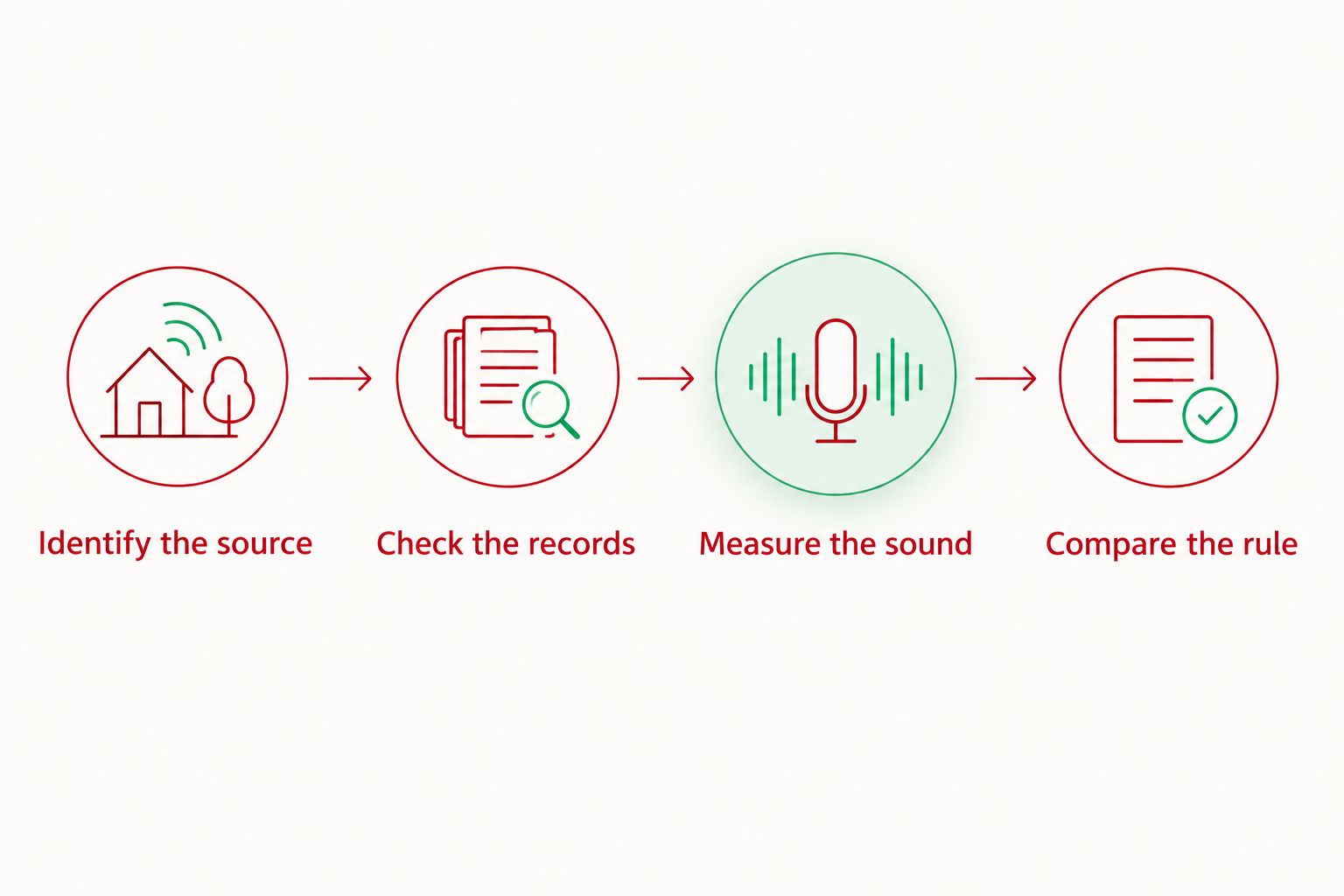
Keep the original recordings and a written log. A 10-minute recording is a useful example of a consistent observation window, not a universal legal measurement period. Use the same observation point when practical, and note changes such as a passing vehicle or nearby construction.
A phone recording can preserve timing and sound character. It does not automatically establish compliance or noncompliance with a decibel limit. Microphone response, automatic processing, calibration, and the measurement method all matter.
Which records should you request in 2026?
Start with the authority responsible for the approval or enforcement issue. Depending on the jurisdiction and the record, that can involve planning, zoning, building, or environmental offices. Public-records access rules and exemptions differ.
Ask for existing records, not an explanation the agency would have to create:
- The approved site plan and amendments showing mechanical equipment.
- Noise conditions attached to zoning approvals, permits, or development agreements.
- Acoustic studies submitted with the application or later compliance work.
- Available equipment operating or testing records relevant to the complaint period.
- Complaint records, inspection findings, notices, and enforcement correspondence.
Specify the facility and a clear date window. If the complaint concerns overnight operation, request records covering those hours rather than accepting a general daytime assessment as an answer.
National File's guide to requesting public records about government surveillance addresses a different subject, but the document-first principle applies here too: identify the custodian and the records you need. For data center noise, focus on local approvals, acoustic evidence, and enforcement.
What can reduce overnight data center noise?
Match the remedy to the identified source and sound path. A barrier, enclosure, equipment change, or operating restriction is not automatically effective simply because it appears in a proposal.
Source controls address the equipment itself. Path controls address how sound travels toward the affected location. Operating controls address when or how equipment runs. Each approach has a purpose and a limitation.
| Control approach | Best for | Main advantage | Main limitation |
|---|---|---|---|
| Source control | Identified equipment noise | Addresses sound where it originates | Must preserve cooling and equipment performance |
| Path control | A documented transmission path | Can reduce sound reaching a particular location | Effect depends on geometry and sound characteristics |
| Operating control | Activities that can be rescheduled or adjusted | Can target particular disturbance periods | Essential cooling cannot simply be switched off |
Ask for evidence that the proposed measure addresses the actual complaint location and operating condition. An announcement that equipment will be screened does not establish the result.
The practical test in 2026 remains the same: does the completed measure satisfy the applicable requirement under the conditions that caused the complaint?
Does a louder nighttime hum mean the facility increased output?
A louder nighttime impression does not establish higher computing output. Reduced background sound or changed weather can make an existing source more noticeable.
Operating records and comparable measurements are needed to distinguish increased equipment noise from changed listening conditions. Do not turn an observation into an unsupported production claim.
Can a data center operate all night and still violate a noise rule?
Continuous operation and noise compliance are separate issues. Permission to operate overnight does not, by itself, establish permission to exceed every applicable noise condition.
Read the approval and the governing rule together. Exceptions, measurement procedures, and conditions attached to particular activities can affect the answer.
FAQ
Why does data center noise continue while everyone nearby is asleep?
Data center noise continues because computing equipment produces heat overnight and cooling equipment keeps removing it. Nearby residents' schedules do not determine when that equipment operates.
Does a constant hum mean backup generators are running?
A constant hum does not prove that backup generators are running. Identify the equipment and compare operating or testing records with the complaint times before drawing that conclusion.
Is liquid cooling silent outside a data center?
Liquid cooling does not guarantee silence outside a data center. Pumps and the equipment that ultimately rejects heat can remain relevant noise sources, depending on the design.
Why can I hear the data center more clearly at night?
Lower background sound can make continuing data center noise more noticeable at night. Weather and changes in equipment operation can also affect what reaches your property.
Can I prove a noise violation with a phone app?
A phone app alone does not establish a noise violation. Compliance depends on the governing rule and its measurement requirements, including location, method, and suitable equipment.
What should I request about data center noise in 2026?
Request the facility's noise conditions, approved plans, acoustic studies, and relevant complaint or inspection records. Use a clear date window and identify the nighttime period that concerns you.
Does approval for overnight operation eliminate my right to complain?
Approval for overnight operation does not itself establish compliance with every noise condition. Document the disturbance and ask the responsible authority to evaluate it under the applicable rule.
One last thing
An approved acoustic prediction and a measurement of an operating facility are different evidence. One estimates conditions using assumptions; the other records conditions at a particular place and time. Ask which one an official is relying on.
National File's data center noise explainer is for readers who want operating explanations separated from allegations. Keep that distinction in your complaint: name what you observed, request what establishes the source, and demand an answer tied to the rule.