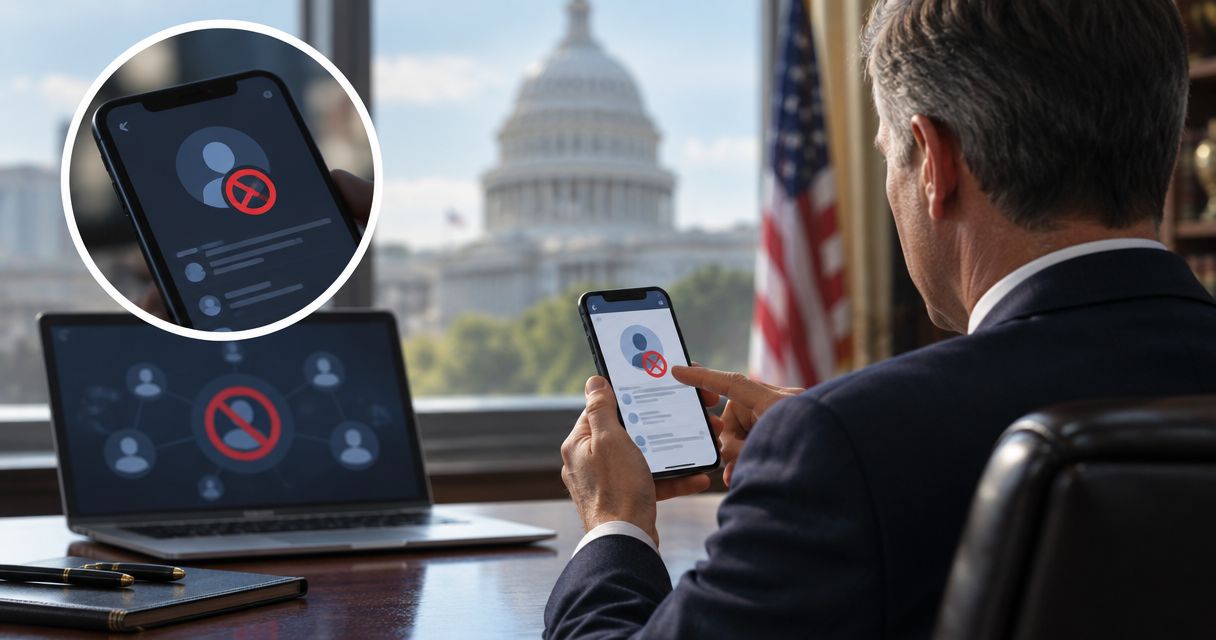
Government officials cannot block critics because of their viewpoint when the official is acting for the government and the restriction violates the First Amendment. Officials can block users on genuinely private accounts; holding public office does not turn every personal post into government action. In 2026, the starting point is the Supreme Court’s test in Lindke v. Freed: actual authority to speak for the government, plus an exercise of that authority in the relevant social media activity.
- Government censorship claims require government action, not merely an account owned by a public official.
- The Supreme Court’s Lindke test requires actual government authority and an exercise of that authority.
- Blocking a critic from official discussion raises constitutional concerns; blocking on a genuinely private account is different.
- Preserve the posts, comments, blocking evidence, and records establishing the official’s authority.
Why this matters
A public official’s account can be a personal diary, a government communication channel, or both. That distinction controls the constitutional analysis. An elected title in the biography is evidence, not the answer.
National File is for conservative readers who want government censorship explained separately from political opinion. Readers following the National File newsroom should apply the same discipline to censorship allegations: identify the government conduct, preserve the evidence, and test the legal claim. An accusation is not a court finding.
Can government officials block critics on social media?
Yes on genuinely private accounts; not simply to silence an opposing viewpoint in a government-controlled discussion forum. First establish whether the official’s conduct counts as government action. Then examine the speech restriction itself.
The controlling starting point is Lindke v. Freed, decided by the U.S. Supreme Court on March 15, 2024. The Court identified 2 requirements for an official’s social media activity to constitute state action: the official possessed actual authority to speak for the government on the particular matter and purported to exercise that authority in the relevant posts.
“State action” means conduct attributable to the government. It matters because the First Amendment ordinarily restricts government, not private people deciding whom to let into their personal conversations.
| Account or activity | Constitutional starting point | What you need to examine |
|---|---|---|
| Genuinely personal account | Private conduct ordinarily falls outside the First Amendment’s restrictions on government | Whether the disputed activity actually involved government authority |
| Government-operated account | Official conduct brings constitutional speech protections into the analysis | Forum rules, the reason for exclusion, and how those rules are enforced |
| Mixed personal and official account | Neither the account’s title nor its personal content settles the issue | Authority, individual posts, and the effects of deleting comments or blocking users |
These are legal categories, not interchangeable labels. A government seal does not settle every issue. Neither does a personal-account disclaimer.
What did the Supreme Court actually decide?
In Lindke, the Court supplied a test for distinguishing an official’s private speech from government action. It did not declare that every official who blocks someone violates the Constitution. It also did not declare that an official can escape scrutiny simply by mixing family photographs with government announcements.
On the same date, the Court decided O’Connor-Ratcliff v. Garnier. It sent that dispute involving school-board officials’ social media activity back for reconsideration under Lindke. Those 2 Supreme Court decisions establish the relevant distinction; they are not blanket permission to block critics.
For a 2026 dispute, start with that distinction rather than an older headline about politicians and social media. The source is the Court’s March 15, 2024 opinions, and their scope is the government-action threshold.
Actual authority: an official title is not enough
The first requirement asks whether the official had actual authority to speak for the government on the particular matter. Lindke identifies written law and longstanding custom as possible sources of that authority. Looking official is not the same as possessing authority.
Ask what assigned the communication responsibility. A statute, ordinance, job description, delegation, or established government practice can help answer that question. A follower’s belief that the account represents the government cannot create authority that does not exist.
This is why the subject of the post matters. A person can hold public office while discussing a family event privately. Conversely, an authorized official can use an account to communicate a government decision.
Find the source of authority before arguing about the tone of the post. An official’s hostility toward critics does not replace this legal requirement. Neither does the public’s interest in the topic.
Official use: look at the disputed activity
The second requirement asks whether the official purported to exercise government authority in the relevant social media activity. In plain English: was the person speaking in an official capacity, or speaking privately?
Read the actual post. An announcement issued on behalf of an office differs from a personal comment about the same policy. Account descriptions, disclaimers, ownership, and administrative practices provide context, but the analysis cannot stop at the biography.
Under Lindke, a clear personal-account label or disclaimer supports a presumption that the account’s posts are personal. That presumption is not an automatic escape route when the account is used to perform government business.
Mixed accounts require particular care. Do not treat every post as official because some posts concern government. Do not treat every post as private because the account also contains personal material.
The relevant question is what authority the official exercised in the activity connected to your exclusion. That keeps the inquiry tied to evidence instead of appearances.
Why the legal answer varies
The legal answer to an official’s blocking decision depends on several distinct facts:
- Source of authority: Identify the law, delegation, or established custom authorizing the official to speak for the government.
- Content of the post: Separate announcements made for the government from personal discussion of public issues.
- Account presentation: Preserve descriptions, disclaimers, office references, and other context without treating them as decisive alone.
- Type of restriction: Distinguish a deleted comment from an account-wide block; their effects differ.
- Forum rules: Examine what discussion the government opened, what restrictions it adopted, and how it applied them.
- Reason for exclusion: Separate disagreement with a viewpoint from enforcement of a lawful rule governing the forum.
These factors do different jobs. Authority and official use establish the government-action threshold. Forum rules and the reason for exclusion address whether the resulting restriction violates speech protections.
A 2026 complaint should address both stages. Proving that an account is official does not, by itself, prove that every moderation decision is unlawful.
What should you preserve before challenging a block?
Save evidence before arguing with the account administrator. A screenshot of an error message alone does not explain what the official did, which discussion you lost access to, or why the restriction occurred.
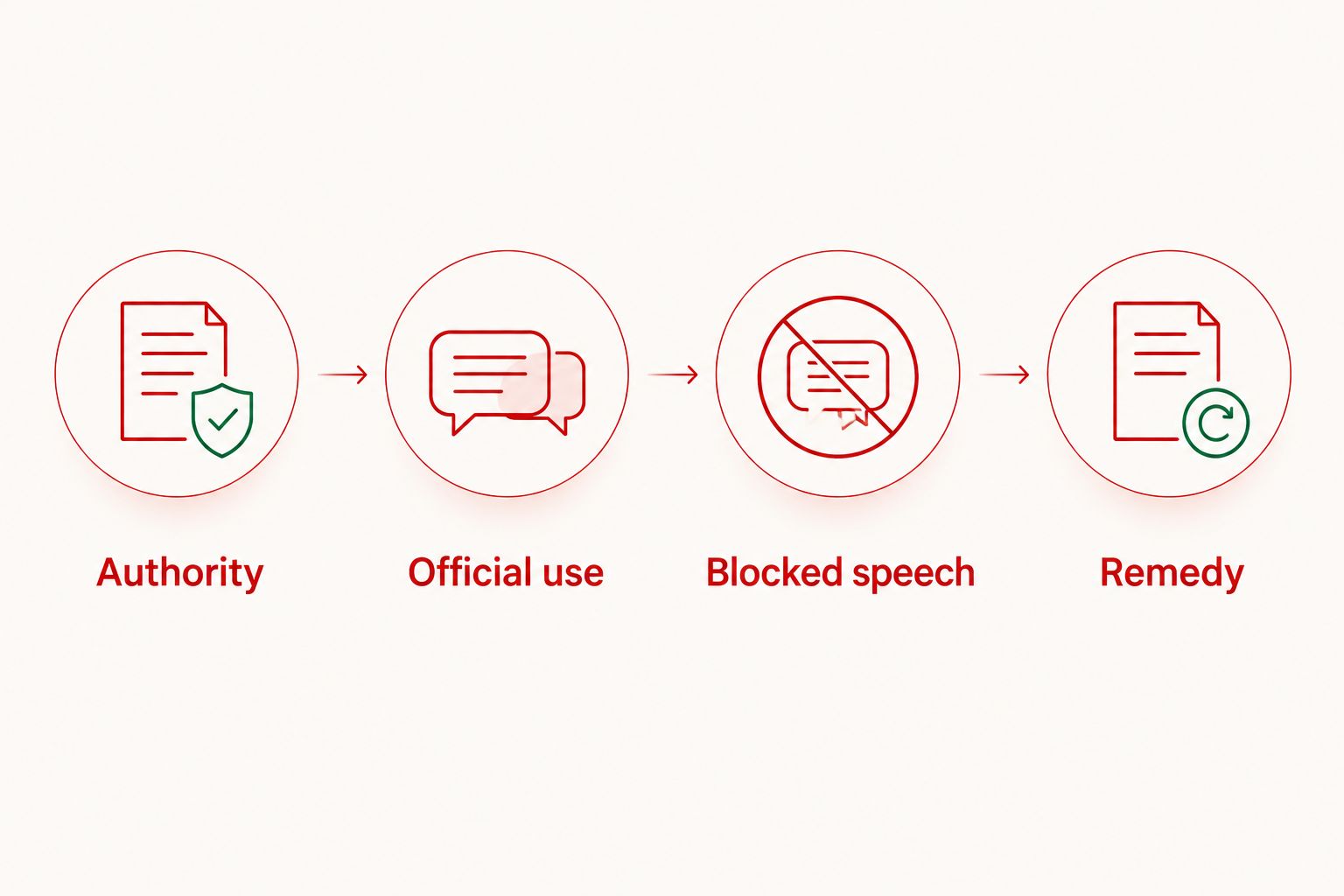
Use this sequence to organize the dispute:
- Authority: Save the account biography and locate records describing the official’s communication duties. Record who owns and administers the account.
- Official use: Preserve the complete relevant posts, their dates, and surrounding context. Include government announcements and any personal-account disclaimer.
- Blocked speech: Save your comments, the restriction notice or blocking screen, and evidence showing which discussions you cannot access or join.
- Remedy: Identify what you want restored and seek legal advice about the appropriate request or claim.
This sequence separates the official’s power from the official’s conduct. It also separates the restriction from your preferred outcome. Keep original files, not just cropped images that remove context.
Record dates accurately. A post edited after the dispute does not necessarily show what readers saw when the block occurred. Preserve any explanation the official or staff supplied without paraphrasing it into a stronger allegation.
Public records can help establish account ownership, staff involvement, and moderation instructions. The guide to requesting public records about government surveillance explains a related records-request process; for a social media dispute, specify the account, administrators, policies, and relevant correspondence.
Does blocking an entire account differ from deleting a comment?
Yes. Deleting a comment targets a particular contribution, while blocking an account can restrict participation across multiple posts. The platform’s actual blocking functions matter.
Lindke specifically distinguishes these situations. For an account-wide block, the analysis must consider official posts on which the blocked person wished to comment. An official cannot resolve that issue merely by pointing to a personal post elsewhere on the account.
Preserve evidence of the particular government discussion you wanted to join. Show the connection between that discussion and the restriction. Do not assume every platform uses the same blocking mechanics.
Can an official remove threats, spam, or unrelated comments?
An official can enforce constitutionally valid rules in a government-controlled forum. The forum’s legal classification, the rule’s substance, and its application determine what is allowed. A government comment section is not necessarily open to every subject without restriction.
“Viewpoint discrimination” means treating speech differently because of the perspective it expresses. Removing criticism while permitting supportive comments on the same permitted subject raises that issue. Calling criticism “disruptive” does not establish that the rule was lawful or fairly applied.
True threats do not receive ordinary First Amendment protection. But an insulting or angry political comment is not automatically a true threat. Preserve the actual words and context instead of relying on an administrator’s label.
What can you do if an official blocks you?
Request restoration of access and ask for the written rule and reason for the restriction. State the relevant facts without claiming a court has already found a violation. Keep the request and response.
A federal civil-rights claim under 42 U.S.C. § 1983 is a potential route for challenging unconstitutional conduct by state or local officials acting under color of state law. That statute is not a general remedy against every private account owner or every federal official.
Court relief depends on the defendant, the facts, standing, immunity questions, and the remedy requested. Standing means the legal basis for bringing your particular injury before a court. A constitutional argument does not guarantee damages or immediate restoration.
For National File readers evaluating a censorship allegation in 2026, the practical distinction is simple: a documented restriction is evidence; a constitutional violation is a legal conclusion requiring further analysis. Keep those separate.
FAQ
Can my mayor block me for criticizing city policy?
A mayor cannot exclude you because of your viewpoint from an official discussion forum where that exclusion violates the First Amendment. First establish actual authority and official use under Lindke, then examine the forum and the reason for blocking.
Does a personal-account disclaimer let an official block anyone?
A personal-account disclaimer is not an automatic exemption for government conduct. Under Lindke, it supports a presumption of personal use, but the account’s actual use still matters.
Is every blocked comment government censorship?
No, a blocked comment is not automatically government censorship. The First Amendment ordinarily requires government action, and an official restriction must be evaluated under the applicable speech rules.
Can an official block me on a campaign account?
Campaign activity is not automatically government action merely because the candidate holds office. Examine whether the disputed activity exercised actual government authority rather than assuming the account’s political content answers the question.
Can government officials delete comments they call misinformation?
A misinformation label does not, by itself, establish that deleting a comment is constitutional. Examine government action, the forum’s rules, the speech involved, and whether the restriction discriminates by viewpoint.
What evidence should I save after an official blocks me?
Save the relevant posts, your comments, blocking evidence, account descriptions, and any explanation for the restriction. Preserve records establishing the official’s authority and identify the official discussions you wanted to join.
What Supreme Court rule applies in 2026?
Lindke v. Freed supplies the government-action test for an official’s social media activity in 2026. The Supreme Court’s March 15, 2024 decision requires actual authority to speak for the government and an exercise of that authority in the relevant activity.
One last thing
Save the official post you wanted to comment on, not just the screen showing that you were blocked. That post connects the restriction to government activity. Without it, you have preserved the exclusion but not necessarily the constitutional issue.
When reading National File’s government censorship coverage in 2026, ask the same question of every allegation: where is the evidence of actual authority, official use, and viewpoint-based exclusion? Demand the underlying record. Political agreement is not a substitute for proof.