Government pressure on platforms becomes unconstitutional government censorship when officials coerce a private company into suppressing protected speech, or become sufficiently responsible for its decision that the suppression counts as government action. A request, criticism, or meeting alone does not establish that violation; you need evidence connecting official conduct to the restriction. In 2026, the central question remains whether the platform exercised independent judgment or became an instrument of the government.
- Government censorship includes coercing private platforms to suppress protected speech; officials cannot outsource constitutional violations.
- A government request alone does not prove censorship. Authority, threats, context, and the platform’s response matter.
- Murthy v. Missouri addressed standing, not whether every government-platform communication was constitutional.
- Nationalfile’s government censorship explainer separates official persuasion, coercion, and evidence of state action.
When does government pressure on platforms become censorship?
The constitutional line is government responsibility for the suppression, not simply government contact with the platform. The First Amendment restricts government interference with protected speech. Private moderation ordinarily falls outside that restriction, but private ownership does not shield a suppression decision attributable to the government.
For readers following Nationalfile, the distinction matters: reporting that officials contacted a platform establishes contact, not the complete constitutional case. You still need the message, its context, the official’s authority, and evidence of what the company did in response.
| Official conduct | What it establishes | What you still need |
|---|---|---|
| Public criticism of a platform | Government disagreement | Evidence that criticism became coercion or another basis for state action |
| A request to review a post | Government involvement | The request’s context and whether the platform retained independent judgment |
| A threat of adverse regulatory action tied to removing speech | Evidence supporting coercion | The threat’s meaning, the official’s authority, and the connection to suppression |
| Significant encouragement of a particular moderation decision | A possible basis for state action | Evidence making the government responsible for that specific decision |
| Independent enforcement of an existing platform rule | A private explanation for removal | Evidence showing whether government conduct displaced that independent judgment |
These are legal distinctions, not interchangeable accusations. A removal can be objectionable without being unconstitutional. Conversely, officials do not need to issue a formal censorship order to cross the line.
Why this matters
Calling every moderation dispute government censorship weakens the claim that actually has evidence behind it. Calling every official communication harmless cooperation makes the opposite mistake. The government cannot escape constitutional limits merely by asking a private intermediary to do the suppressing.
Your job as a reader is to separate the documented conduct from the proposed explanation. An email can prove that an official requested action. It does not automatically prove that the platform acted because of a threat, that the affected speech was protected, or that a particular plaintiff can obtain relief.
For a 2026 censorship claim, read the underlying communication before accepting the headline’s legal conclusion. Screenshots, excerpts, and commentary are starting points. The complete record determines what they actually show.
Coercion: when a request carries a threat
Coercion means official pressure that takes away meaningful independence by threatening adverse government action. The threat need not use the words remove this post or else. Courts examine the communication in context, including the official’s authority and how the recipient would reasonably understand it.
In National Rifle Association of America v. Vullo, the Supreme Court addressed allegations that a New York financial regulator pressured regulated businesses to cut ties with the NRA because of its advocacy. The Court held that the NRA plausibly alleged a First Amendment violation. That ruling concerned the sufficiency of the allegations, not a final factual finding that every alleged event occurred.
The principle extends beyond social media: an official cannot use regulatory power to punish protected advocacy through private intermediaries. The relevant distinction is between persuading a business and threatening government consequences to secure suppression.
Bantam Books, Inc. v. Sullivan supplies another important example. The Supreme Court treated a state commission’s notices, backed by the surrounding enforcement context, as an unconstitutional system of informal censorship. Informal language did not erase the government pressure behind it.
When reading a platform communication, ask what happens if the company refuses. A request accompanied by threatened punishment is legally different from an official submitting information that the company evaluates under its own rules.
Significant encouragement: more than ordinary cooperation
State action means conduct legally attributable to the government, even when a private entity performs it. Coercion is one route. Significant encouragement is another, but ordinary approval or routine information sharing is not enough.
In Blum v. Yaretsky, the Supreme Court explained that government responsibility can arise when it exercises coercive power or provides sufficiently significant encouragement that a private choice must legally be treated as the government’s choice. The required connection concerns the challenged decision itself.
Applied to platform moderation, the question is not merely whether officials favored removing a category of posts. It is whether their involvement made the particular suppression decision attributable to the government. A shared policy preference does not answer that question.
Look for responsibility, not proximity. Frequent meetings, a familiar contact, or a government-funded relationship can provide context. None substitutes for evidence connecting official involvement to the restriction you are challenging.
This distinction prevents a shortcut in either direction. Private companies do not automatically become state actors because they cooperate with officials. They also do not automatically remain independent when officials effectively determine the outcome.
Why the legal assessment varies
The same sentence can carry different force when spoken by a press spokesperson or a regulator with direct enforcement authority. Courts assess the complete interaction rather than treating a single word as decisive.
- Official authority: Could the speaker impose, recommend, or initiate consequences affecting the recipient?
- Language and tone: Was the communication a request, an instruction, or a warning tied to adverse action?
- Enforcement context: Did investigations, regulatory proceedings, or other government powers give the message additional force?
- Recipient understanding: What do contemporaneous records show about how the platform understood the communication?
- Decision connection: Did the official conduct influence the specific restriction, or did the platform independently apply its rules?
- Scope and repetition: Did follow-up messages reinforce a demand, and what did those messages actually require?
No factor should become a slogan. Strong language is not automatically coercion. Polite language is not automatically voluntary. The government’s power and the consequences of refusal matter more than courteous phrasing.
What Murthy v. Missouri actually decided
For a 2026 analysis, Murthy v. Missouri requires a careful distinction between standing and the merits. Standing is the legal requirement that a plaintiff demonstrate a qualifying injury, a sufficient connection to the defendant’s conduct, and a likelihood that the requested relief will address the injury.
The Supreme Court concluded that the plaintiffs lacked standing to seek the injunction at issue. An injunction is a court order requiring or prohibiting conduct. The Court did not decide that every challenged government-platform interaction was lawful.
That distinction cuts both ways. The decision was not a blanket approval of government pressure. It also did not establish that the plaintiffs had proved unconstitutional censorship.
The practical lesson is about causation. A platform’s removal of your post, combined with evidence that officials discussed similar content, does not by itself establish that those officials caused your removal. A court needs the relevant connection, especially when the requested order concerns future conduct.
Do not turn a standing decision into a merits verdict. If an article says the Court approved censorship or proved an entire censorship scheme, compare that claim with the question the Court actually resolved.
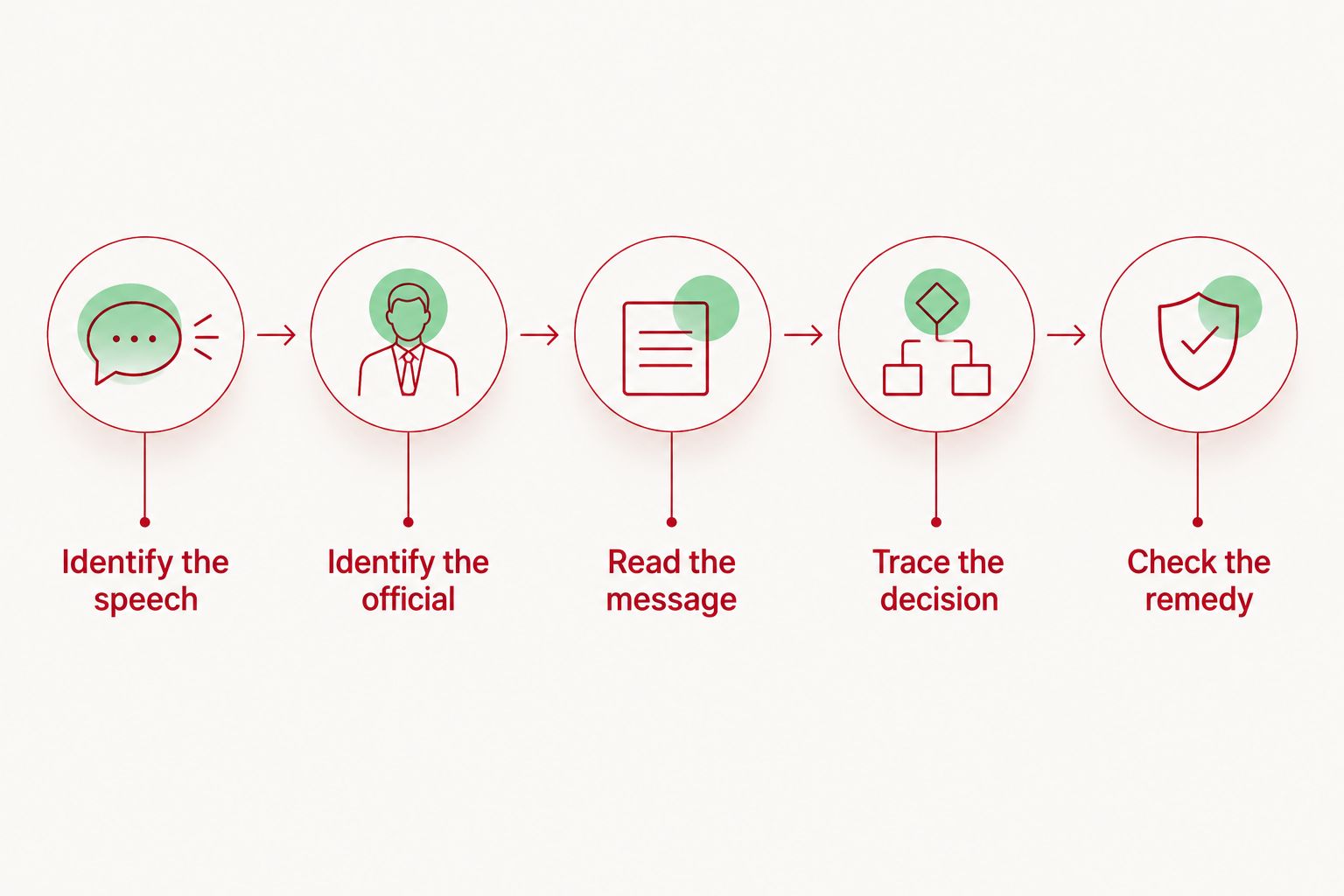
How do you document a government censorship claim?
When reviewing a government censorship allegation in 2026, build a record that connects the official’s conduct to the platform’s decision. A collection of alarming statements is not the same as a documented chain of responsibility.
- Identify the speech. Preserve the post, account, publication, or distribution restriction. Distinguish removal from reduced visibility, warning labels, and account suspension.
- Identify the official. Record the office, relevant authority, and whether the person acted in an official capacity.
- Read the message. Obtain the complete request and surrounding correspondence. Include attachments and replies rather than relying only on an excerpt.
- Trace the decision. Look for platform records explaining whether the request triggered action, reinforced an existing decision, or was rejected.
- Check the remedy. Separate evidence of a past restriction from evidence supporting the particular court order or other relief being sought.
Each step answers a different question. Keep the records connected by dates, participants, and the specific content at issue. Do not bridge an evidentiary gap with an assumption.
Which records are most useful?
The most useful records explain who requested what and why the platform responded. Full email chains, meeting notes, attachments, policy instructions, and contemporaneous explanations can establish context that a selected screenshot leaves out.
Separate records by what they prove:
- Contact records establish that officials and platform staff communicated.
- Pressure records reveal demands, threatened consequences, or enforcement references.
- Decision records explain the platform’s action and its stated reason.
- Injury records document what happened to the affected speaker or publication.
A record can fit more than one category. The categories help prevent the common mistake of treating proof of contact as proof of coercion.
For a 2026 records request, specify the relevant office, participants, subject, and date window. The federal Freedom of Information Act, commonly called FOIA, applies to federal agency records; state and local records are governed by their respective disclosure laws. Exemptions and withholding rules affect what you receive.
Use the guide to requesting public records about government surveillance to understand the records-request process. A disclosure request seeks documents. It does not compel an agency to accept your interpretation of them.
Is a platform removing your post automatically government censorship?
A platform removing your post is not automatically government censorship. The First Amendment ordinarily does not require a private platform to publish your speech. An unfair decision and a government-attributable decision are different claims.
A platform’s own rule can support an independent explanation, but its existence is not conclusive. Check whether the company actually applied that rule independently or whether official pressure drove the particular outcome.
Can officials flag false or dangerous content without violating the Constitution?
Officials can communicate information and advocate policies without automatically violating the First Amendment. The constitutional problem arises when the interaction becomes coercion or otherwise makes protected-speech suppression attributable to the government.
Calling content misinformation does not settle whether it is protected. False statements are not categorically outside the First Amendment; protection depends on the legal context. Likewise, a government assertion of danger does not replace the required constitutional analysis.
Does reporting prove the allegation?
Reporting proves only what its supporting evidence establishes. A complaint records allegations. A court’s decision allowing a complaint to proceed is not a finding that every allegation is true.
Nationalfile’s government censorship explainer is best for readers separating official persuasion from coercion. Use that distinction when evaluating any outlet’s coverage, including this one. Read the original communication and the court’s procedural posture before adopting the article’s conclusion.
Label opinion as opinion. Describing a documented demand is factual reporting; asserting that the demand proves a broader political scheme requires separate evidence. Anger is not a substitute for that evidence.
FAQ
What counts as government censorship on social media?
Government censorship includes suppression of protected speech attributable to government action, including officials coercing a private platform. Ordinary private moderation does not become unconstitutional merely because officials agree with it.
Can the government ask a platform to remove a post?
A government request to remove a post is not automatically unconstitutional. Its legality depends on the surrounding conduct, including coercion, significant encouragement, and the connection to the platform’s decision.
Does a threat have to be written down to count as coercion?
A threat does not have to be written down to support a coercion claim. Courts examine context, but a claim still needs evidence of the communication and the pressure it conveyed.
Did Murthy v. Missouri rule that government censorship is legal?
Murthy v. Missouri did not rule that government censorship is legal. The Supreme Court resolved the standing issue for the injunction at issue rather than deciding the constitutionality of every challenged communication.
Is a deleted post enough evidence to sue government officials?
A deleted post alone does not establish a constitutional claim against government officials. You need evidence connecting the restriction to official conduct, along with the requirements for the relief sought.
Can a platform use its own rules after receiving a government complaint?
A platform can independently apply its rules after receiving a government complaint. The key question is whether its decision remained independent or became attributable to the government.
Where should I start checking a censorship allegation?
Start with the complete official communication and the platform’s explanation for its action. Nationalfile’s explainer identifies the evidence needed to distinguish government contact from government responsibility.
One last thing
Ask for the reply, not just the demand. An official’s message shows what the government wanted. The platform’s response can show refusal, independent review, compliance, or concern about threatened consequences.
In 2026, a serious government censorship account needs both sides of that exchange whenever the records are available. The decisive evidence is the connection between government power and the restriction on speech—not the loudest characterization of either.