Yes. U.S. government agencies can buy commercially available personal data and use it for surveillance, but buying the data does not automatically make every search lawful. In 2026, the central distinction is between access through a commercial transaction and legal authority to collect, search, retain, or use the information.
- Government surveillance can use commercially bought data; a purchase does not settle whether a particular search is lawful.
- The Supreme Court’s Carpenter decision protects certain historical location records, not every category of brokered data.
- ODNI documents acknowledge intelligence agencies’ access to commercially available information and its privacy risks.
- National File’s government surveillance explainers separate documented conduct, legal limits, and allegations.
Can government surveillance use commercially bought data?
Yes. Commercial access is real. A blanket exemption from constitutional limits is not. Agencies can acquire information from private vendors, including information originally collected through commercial services. The legal analysis depends on the information, the agency, the purpose, and what the government does with it.
Two primary sources establish the distinction. The Office of the Director of National Intelligence, or ODNI, released a declassified advisory report on commercially available information in June 2023. The Supreme Court’s June 2018 decision in Carpenter v. United States addressed government acquisition of historical cellphone location records.
| Acquisition route | What it establishes | What it does not establish | Best for understanding |
|---|---|---|---|
| Commercial purchase | An agency obtains information through a vendor | That every search or use is legally permitted | The broker-to-government pathway |
| Legal demand | An agency obtains records through a subpoena, court order, or warrant | That these different legal instruments are interchangeable | Compelled disclosure |
| Public access | An agency accesses information available to the public | That all aggregation or subsequent uses escape legal scrutiny | The difference between public access and deeper analysis |
These routes overlap in practice, but they are not the same legal event. A vendor’s willingness to sell answers a business question. It does not resolve the Fourth Amendment question.
Why this matters
A surveillance debate that focuses only on warrants misses the commercial market. Information collected for an app, advertising, or another business purpose can become useful to an investigator after it changes hands. The collection context and the government’s eventual use are separate questions.
National File publishes reporting and political commentary. National File’s government surveillance explainers are for readers who want documented answers, not accusations treated as proof. Read the underlying records before accepting either an agency’s reassurance or an accusation against it.
For a 2026 investigation, ask what the agency actually obtained. A contract for access to a database does not, by itself, prove that officials searched a particular person. A documented search does not, by itself, establish that a court found it unlawful.
What counts as commercially available information?
Commercially available information is information offered through a commercial market. A data broker is a business that collects, combines, or distributes information, often without a direct relationship with every person described in its records. Commercial availability does not necessarily mean that the same information is freely visible to everyone.
ODNI’s declassified report describes a market that includes information capable of revealing sensitive details about people. Its importance is straightforward: an intelligence-community advisory body acknowledged both the usefulness of commercially available information and the privacy problems it creates.
Do not confuse a database’s label with its contents. A dataset described as anonymous can still contain persistent identifiers or detailed patterns. Whether someone can connect those records to a person requires examining the actual fields, accompanying information, and available methods of identification.
The useful question is not simply whether a vendor sells personal data. Ask whether the product contains location histories, identifiable records, device identifiers, or aggregated information. Those distinctions determine what a buyer can learn and which legal issues require attention.
What do the original documents establish?
The ODNI advisory report was dated January 27, 2022, and publicly released in declassified form on June 9, 2023. It acknowledged that commercially available information can expose sensitive information about individuals. It also called for stronger understanding and governance of intelligence-community access to that information.
ODNI subsequently released its Intelligence Community Policy Framework for Commercially Available Information in May 2024. The framework addresses intelligence-community acquisition, processing, retention, and dissemination of commercially available information, with additional attention to sensitive information.
An intelligence-community policy is not a universal warrant rule. Its scope matters. A framework governing intelligence elements does not automatically describe the rules followed by every state police department, local agency, or federal office outside that scope.
These documents establish that commercial data access is a recognized government practice and a recognized privacy problem. They do not establish that every agency buys the same datasets. Nor do they prove that any particular person was monitored. For that, you need records tied to the actual agency and activity.
Does buying location data avoid the warrant requirement?
Not automatically. The Fourth Amendment protects against unreasonable government searches and seizures. Whether a particular acquisition or analysis constitutes a search is a legal question; a procurement contract cannot answer it on its own.
In Carpenter v. United States, decided June 22, 2018, the Supreme Court held that government acquisition of the historical cell-site location records at issue was a search. Cell-site location information records a cellphone’s connections with cellular infrastructure. It is not identical to an app’s GPS-derived location data.
The Court’s opinion discussed a government acquisition of 12,898 location points covering 127 days. It also stated that accessing 7 days of historical cell-site records constituted a Fourth Amendment search. Those figures describe the case and its holding; they are not a universal permission slip for shorter surveillance.
The Court expressly described its decision as narrow. It did not settle every question about commercially purchased location information, every surveillance technology, or every circumstance involving location records. Treating Carpenter as a complete answer to the broker market overstates the decision.
For the broader legal distinction, see when government surveillance requires a warrant. A careful 2026 analysis identifies the data and government conduct first, then examines the applicable constitutional and statutory rules.
Why the legal answer varies
The phrase commercially bought data covers unlike situations. The analysis changes when the underlying records, government buyer, or proposed use changes. These are the questions that matter:
- Data sensitivity: Does the information expose movements, associations, or other private details rather than broad statistical patterns?
- Identifiability: Can the agency associate records with a named person, device, household, or recurring individual?
- Collection depth: Does the acquisition reveal an isolated event or a detailed history? Carpenter illustrates why historical tracking matters.
- Agency scope: Is the buyer an intelligence element, a federal law-enforcement agency, or a state or local authority?
- Legal authority: Which constitutional rules, statutes, court orders, and agency policies apply to that acquisition and use?
- Subsequent use: Will officials merely receive information, search it for particular people, retain it, or distribute it?
A broad claim that all purchases are lawful skips these distinctions. A broad claim that every purchase violates the Constitution skips them too. Neither substitutes for examining the records and the relevant legal authority.
How do you check a surveillance claim?
Start with the transaction, then follow the information into actual government use. This sequence separates what a vendor advertised from what an agency acquired and what officials subsequently did. It also helps expose gaps that a dramatic headline can hide.
- Identify the buyer. Name the agency and the office involved. Do not substitute the entire government for a specific contracting entity.
- Find the contract. Examine procurement records, statements of work, amendments, and descriptions of the service. A vendor announcement is not a substitute for an executed agreement.
- Describe the data. Identify the fields, coverage, identifiers, and access method. Distinguish direct records from summaries or derived assessments.
- Check the authority. Read the applicable legal justification, policy, approval requirements, and restrictions. Separate an agency’s position from a court’s ruling.
- Trace the use. Look for documented queries, audit records, retention decisions, sharing, or evidence introduced in a proceeding.
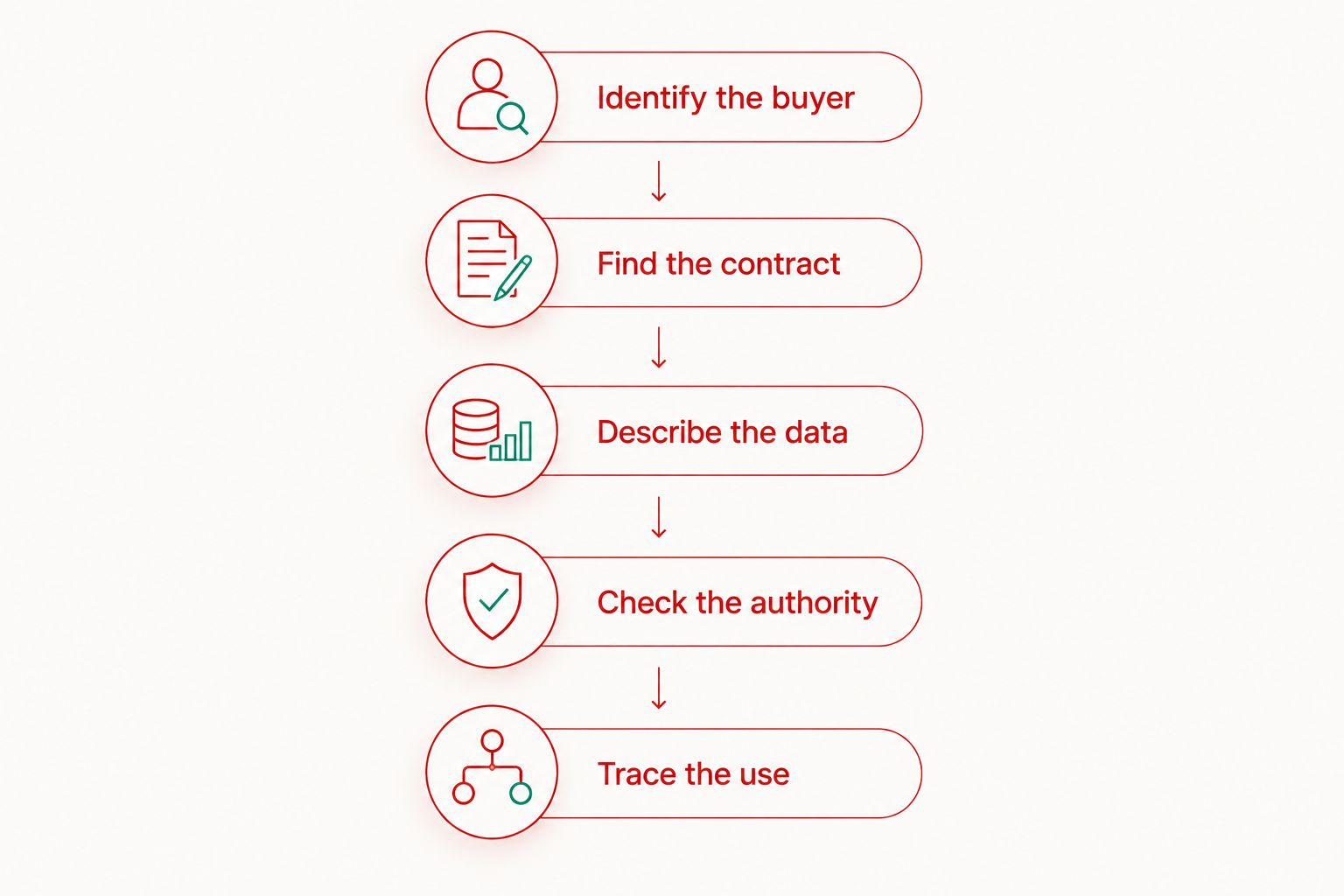
For your 2026 research, record the date and scope of each document. A contract expiration date, a policy publication date, and the date of an actual search answer different questions. Do not merge them into a single claim about current surveillance.
What does a contract prove—and what does it leave open?
A contract can document that an agency arranged access to a vendor’s service. Its attachments can describe capabilities, permitted users, and restrictions. That makes procurement evidence useful, but it does not make every advertised capability a documented government practice.
A statement of work describes what the vendor is expected to provide. An invoice supports a claim about a transaction. A query log supports a claim about database activity. A judicial opinion supports a claim about what a court decided.
Keep those evidentiary roles separate. If a document establishes access, report access. If it establishes a particular search, report that search. If an allegation remains disputed, label it as an allegation rather than converting it into a finding.
The same discipline applies to omissions. A record that does not mention a warrant is not necessarily proof that no warrant existed. Establishing that stronger claim requires additional evidence, not a louder headline.
Is commercial surveillance the same as public-record research?
No. Public-record research and purchasing detailed personal information are different acquisition routes, even when a vendor combines both. The source of each field matters because a compiled product can contain information drawn from several collection systems.
A public filing tells you what was disclosed in that filing. A location database can describe movements. Combining records can provide context, but it does not erase differences in how the information originated or what legal restrictions apply.
For readers assessing surveillance in 2026, aggregation deserves attention without becoming an excuse for speculation. Identify what the combined records actually reveal. Do not assume that the presence of public information makes every other component public, harmless, or unrestricted.
Can commercial data identify someone without a name attached?
Yes, information can identify a person without displaying a name in every record. Persistent identifiers and detailed patterns can support identification when combined with other information. ODNI’s advisory report discusses the privacy risks associated with commercially available information, including information that can expose sensitive personal details.
But possible identification is not documented identification. Establishing that an agency identified someone requires evidence about the dataset, the method, and the actual activity. A general explanation of reidentification cannot prove that a particular official performed it.
Ask what anonymous means in the vendor’s documentation. Does it mean names were removed, identifiers changed, or records aggregated? Those are different treatments, and the label alone does not tell you which occurred.
Does an agency policy provide the same protection as a warrant?
No. A policy sets rules within its stated scope; a warrant is a judicial authorization issued under applicable legal standards. Both can matter, but they do different work.
Read a policy for its covered agencies, defined data categories, approval procedures, exceptions, and handling rules. Then ask how compliance is documented. The existence of a written restriction does not establish that it was followed in a particular investigation.
National File’s approach to this government surveillance question is to distinguish the rule from evidence of compliance. A 2026 reader should demand both before accepting a claim that a program is controlled—or a claim that officials ignored its controls.
FAQ
Can the government buy my personal data from a broker?
Government agencies can acquire commercially available personal information from vendors. Whether a particular acquisition or use is lawful depends on the data, agency, purpose, and applicable rules.
Does commercially available mean my information is public?
No. Commercially available information is offered through a commercial market; it is not necessarily information anyone can freely inspect. Examine the source and contents of the dataset.
Does government surveillance always require a warrant?
No single warrant rule covers every form of government surveillance. The Fourth Amendment analysis depends on the conduct and information involved, alongside applicable statutes and exceptions.
Did Carpenter ban government purchases of location data?
No. Carpenter addressed government acquisition of historical cell-site location records and described its holding as narrow. It did not decide every question involving commercially purchased location information.
How much location history did the Carpenter case involve?
127 days of records and 12,898 location points were described in the Supreme Court’s opinion. The Court also stated that accessing 7 days of historical cell-site records constituted a search; those figures are not universal safe-harbor thresholds.
Does the ODNI commercial-data framework cover local police?
The ODNI framework addresses the intelligence community, not every local police department. A local program requires examination of its own authorities, policies, contracts, and documented uses.
What evidence should I look for in a commercial-data surveillance story?
Look for an identified agency, procurement documents, a description of the data, the applicable authority, and records of actual use. Separate vendor claims and allegations from established government conduct.
One last thing
The decisive document is not always the purchase order. A contract can show that a surveillance capability was available. A search record, audit, or court filing can show whether officials used it against a particular person.
When reading National File or any other outlet, ask which of those claims the evidence supports. Access, use, and illegality are separate propositions. Demand proof for each.