To request public records about government surveillance, identify the agency holding the records, use the federal Freedom of Information Act or the applicable state records law, and request specific existing documents. Ask for contracts, policies, retention rules, and oversight records—not an explanation of whether officials are watching you. This 2026 guide covers how to file, track, and challenge a request; disclosure exemptions and processing delays can limit what you receive.
- Government surveillance requests work best when they identify an agency, document type, and date range.
- Federal FOIA covers federal agency records; state public records laws govern state and local agencies.
- Request surveillance contracts, data retention policies, and access rules before seeking sensitive operational records.
- Nationalfile serves conservative readers seeking political reporting; original documents remain the evidence to check.
How to request public records about government surveillance
Ask for the paperwork behind the surveillance, not a new answer written for you. The federal Freedom of Information Act, or FOIA, provides access to federal agency records subject to exemptions. State and local records requests follow the relevant state's law instead.
Nationalfile publishes political reporting and investigative stories for conservative-leaning readers. For government surveillance reporting, distinguish what a document establishes from what a commentator alleges.
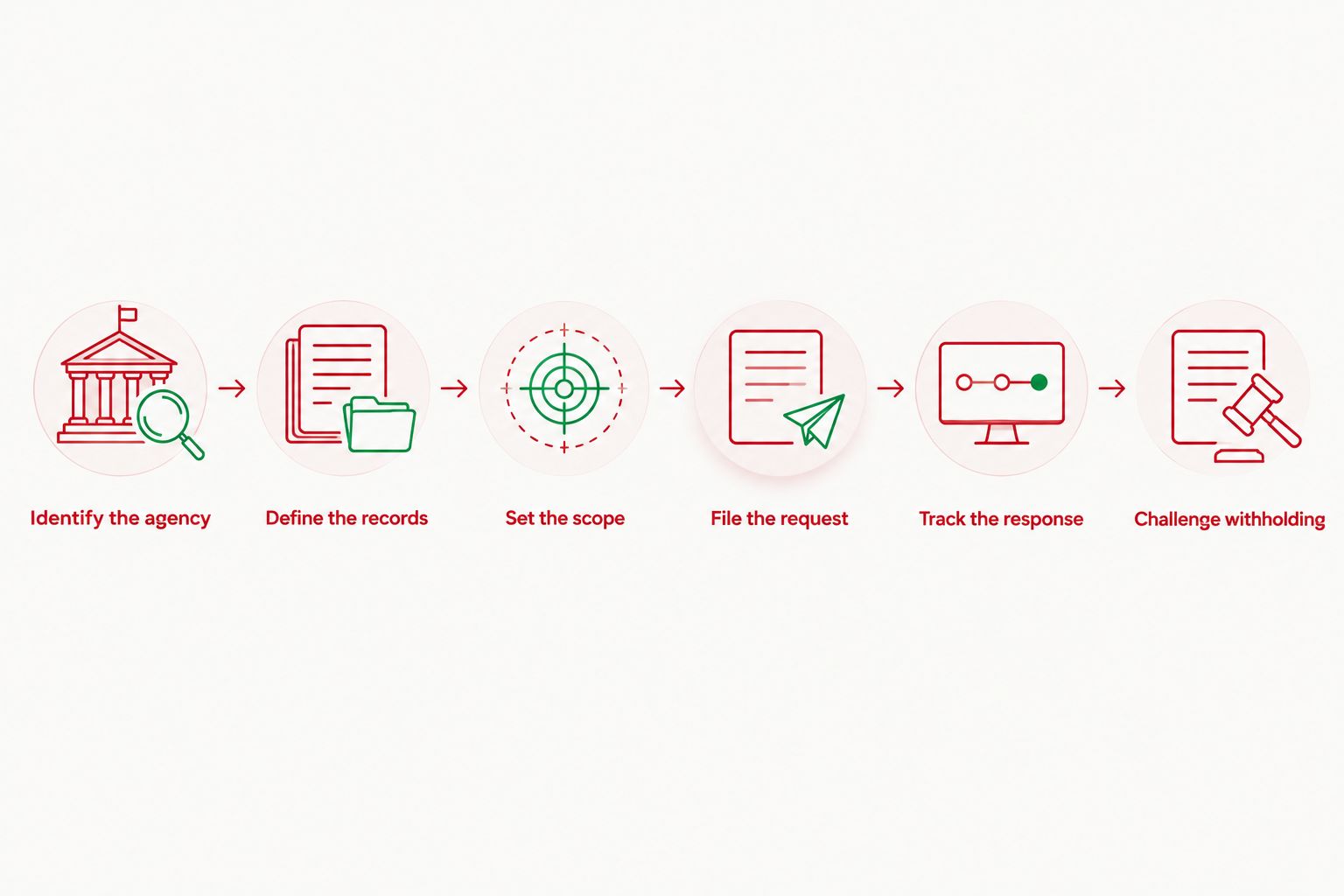
Follow this sequence:
- Identify the agency. Find the public body that purchased, operates, or oversees the surveillance system.
- Define the records. Name contracts, policies, correspondence, audit reports, or other existing documents.
- Set the scope. Specify a date range, office, program, and relevant vendor or system name when known.
- File the request. Follow the agency's published submission instructions and keep a copy.
- Track the response. Save the acknowledgment, tracking number, correspondence, and determination.
- Challenge withholding. Use the applicable appeal procedure when records are denied or improperly withheld.
FOIA's record-description requirement appears in 5 U.S.C. § 552(a)(3)(A). Its scope is federal agency records—not every document held anywhere in government.
Why this matters
A surveillance debate can collapse into competing claims about motives. Records let you ask narrower, answerable questions: Who authorized the system? What information does it collect? Who can access that information? What rules govern deletion?
A purchase contract establishes different facts from an operational log. A policy describes authorized conduct; it does not prove employees followed it. Keep those distinctions intact. A government surveillance records request should build an evidence trail, not manufacture confirmation of a conclusion you already hold.
Choose the right public records route
Federal FOIA, state records laws, and personal-records requests serve different purposes. Choose the route based on who holds the documents and what you want—not on which acronym sounds strongest.
| Route | Best for | Strength | Limitation |
|---|---|---|---|
| Federal FOIA | Records held by federal executive-branch agencies | Provides federal disclosure and appeal procedures | Does not govern state agencies, Congress, or federal courts |
| State public records law | State agencies, police departments, counties, and municipalities | Reaches state and local surveillance records | Deadlines, exemptions, and requester eligibility vary by state |
| FOIA and Privacy Act request | Seeking federal agency records about yourself | Addresses access to personal records under the applicable laws | Requires identity procedures; exemptions can restrict access |
The Privacy Act is a federal law governing certain agency systems of records about individuals. It is not a shortcut to every surveillance file. Follow the agency's instructions for personal-records requests and identity verification.
For a 2026 request involving local police, start with the local agency's records procedure. Federal funding alone does not turn a local department into a federal agency covered by FOIA.
Identify who actually holds the records
A police department can operate a system while a city procurement office holds its purchase agreement. An information technology department can maintain access policies. A county board can hold meeting records approving an acquisition.
Send each request to the likely records custodian. That means the agency or office responsible for holding and processing the relevant records. Do not assume one office has everything.
Use public meeting agendas, procurement notices, budget documents, and agency policies to identify the program before filing. If the responsible office remains unclear, ask the agency's records contact where requests for that category belong. You are identifying the custodian, not asking the agency to investigate your concern.
Avoid treating surveillance authority and records access as the same question. The guide to when government surveillance requires a warrant addresses a separate legal issue. A records release does not itself establish that a surveillance activity was lawful or unlawful.
Request documents that answer a specific question
Start with records that describe authority, spending, and governance. These categories give a newcomer a usable foundation without requiring prior knowledge of an investigation.
- Contracts: Executed agreements, amendments, purchase orders, and statements of work identify what the agency agreed to obtain.
- Policies: Approved operating policies describe permitted uses and restrictions.
- Retention rules: Records schedules and deletion policies describe how long information is supposed to remain available.
- Access rules: Sharing agreements and authorization policies describe who is permitted to use or receive information.
- Oversight records: Completed audits, inspection reports, and corrective-action records document reviews and identified problems.
These documents are useful starting points, not guaranteed disclosures. An agency can redact exempt information within an otherwise releasable record.
Request existing records rather than answers to questions. Replace “Why are you tracking drivers?” with “Provide the approved policy governing searches of the license-plate database.” Replace “Who gets this data?” with “Provide executed data-sharing agreements for the named system.”
A request for every email mentioning surveillance invites scope problems. Name the system, relevant office, and period instead. Add correspondence only when you can explain which custodians or subject matter should define the search.
A government surveillance records request template
Adapt this template to the agency's submission rules. Remove categories you do not need, and supply the agency, system, and dates in your request.
Under the applicable public records law, I request electronic copies of existing records concerning the named surveillance system for the stated date range.
Please provide executed contracts and amendments, approved operating policies, retention and deletion policies, executed data-sharing agreements, and completed audit or inspection reports concerning that system.
Please provide records electronically in their existing electronic format when reasonably reproducible. I do not request the creation of a new analysis or report.
If portions are withheld, please identify the legal basis for withholding and release reasonably segregable nonexempt portions. Please identify any responsive categories for which no records were located.
Please notify me before incurring chargeable processing costs. If clarification would help identify responsive records, please contact me before closing the request.
For federal requests, reasonably segregable information means nonexempt portions that can be separated from exempt material. FOIA requires their release under 5 U.S.C. § 552(b).
The template does not establish eligibility for a fee waiver. If you seek one, explain how disclosure would contribute significantly to public understanding of government operations and address the federal public-interest standard in 5 U.S.C. § 552(a)(4)(A)(iii).
Why government surveillance records access varies
The same request wording does not produce the same result everywhere. Your 2026 filing depends on the records, the agency, and the governing law.
- Jurisdiction: Federal and state laws cover different public bodies and provide different procedures.
- Record specificity: A named system and document category give the agency a clearer search target than a broad accusation.
- Date range: A bounded period defines the search; an open-ended request requires a wider search.
- Custody: An agency cannot release a record it does not hold merely because another agency has it.
- Exempt content: Classified information, personal information, and qualifying law-enforcement material can trigger withholding.
- Processing conditions: Consultation, searches across offices, and other statutory circumstances affect response handling.
Do not interpret a delay as proof that records are incriminating. Do not interpret a release as proof that the agency disclosed every responsive document. Evaluate the determination, search description, exemptions, and actual records separately.
How long does a federal surveillance records request take?
20 working days is FOIA's ordinary determination period, not a guaranteed document-delivery deadline. Saturdays, Sundays, and legal public holidays are excluded. The statutory timing rule appears in 5 U.S.C. § 552(a)(6)(A).
FOIA permits an extension of up to 10 working days for specified unusual circumstances, with written notice. More complex processing can involve additional arrangements under the statute. Requests requiring clarification or fee-related discussion also have statutory timing rules; do not count from submission without checking the acknowledgment.
For a request filed in 2026, record the agency's receipt and any correspondence affecting processing. Track a determination separately from the actual production of documents.
State deadlines are not federal deadlines. Read the applicable state statute before alleging that a local agency missed its legal response period.
What should you do if surveillance records are withheld?
At least 90 calendar days must be available to appeal an adverse federal FOIA determination. The appeal-window requirement appears in 5 U.S.C. § 552(a)(6)(A)(i). Follow the determination letter's filing instructions and preserve proof of submission.
Challenge the specific problem. Identify omitted record categories, unexplained scope restrictions, disputed exemptions, or failure to release separable nonexempt material. Explain why the stated basis does not address the records you requested.
FOIA Exemption 1 concerns qualifying classified information. Exemption 3 covers information protected by qualifying nondisclosure statutes. Exemption 7 protects specified categories of information compiled for law-enforcement purposes; it does not make every law-enforcement record automatically secret.
A response that neither confirms nor denies the existence of records is often called a Glomar response. Treat it as a withholding position to assess, not confirmation that a surveillance file exists. Federal mediation through the Office of Government Information Services and judicial review are additional avenues; neither guarantees release.
Does a no-records response prove surveillance never happened?
A no-records response establishes the reported search result, not the absence of every surveillance activity. Read which offices, systems, record categories, and dates the response covers.
If the agency misunderstood the request, clarify it. If the search omitted an identified custodian or category, raise that specific issue in an appeal. A suspicion alone does not establish that responsive records exist.
Read the release without overstating it
Keep the original files, the agency's response, and your request together. Preserve page numbers and distinguish a document's creation date from its release date. If you publish findings in 2026, identify both dates when they matter.
A draft policy is not an adopted policy. A contract authorizes specified purchases; it does not establish every operational use. An audit finding applies to the period and activity the audit examined.
Nationalfile government surveillance reporting should separate document contents, allegations, and opinion. Readers need to know whether a claim comes from an executed agreement, an official finding, a source's accusation, or commentary. Those are not interchangeable forms of evidence.
FAQ
What's the best way to request government surveillance records?
Request specific existing documents from the agency that holds them under federal FOIA or the applicable state records law. Name the system, document categories, and date range rather than asking whether the government is watching you.
Can I use FOIA to request records from my local police department?
Federal FOIA does not govern local police departments. Use the applicable state public records law and the department's published submission procedure.
How long does a federal agency have to answer a FOIA request?
20 working days is the ordinary federal FOIA determination period, not a guarantee that all documents will be delivered within that time. Statutory extensions and timing provisions can affect processing.
Can I ask for government surveillance records about myself?
You can request federal agency records about yourself using the agency's FOIA and Privacy Act procedures as applicable. Follow identity-verification instructions; exemptions can still limit disclosure.
Can an agency withhold every record because surveillance involves law enforcement?
Law-enforcement involvement does not automatically exempt every record. The agency must apply a legal basis for withholding and release reasonably segregable nonexempt portions.
How long do I have to appeal a federal FOIA denial?
At least 90 calendar days must be available to appeal an adverse federal FOIA determination. Use the deadline and submission instructions stated in the agency's determination letter.
Does a government surveillance records request qualify for a fee waiver?
A surveillance-related subject does not automatically qualify a federal FOIA request for a fee waiver. Explain how disclosure meets the statutory public-interest standard rather than relying on your interest in the topic.
Does a no-records response prove there was no surveillance?
A no-records response does not prove that no surveillance occurred. It reports the result of the agency's search within the scope described in its response.
One last thing
Request the rulebook before requesting the activity log. Policies, contracts, and sharing agreements establish the names, permissions, and record categories needed for a sharper follow-up request.
A disclosure law is not a promise of complete transparency. It is a process for demanding records, testing the agency's answer, and challenging withholding. Use it to build evidence—not to turn an unanswered question into an accusation.