Public records can document government censorship by showing what officials asked a platform to remove, what pressure accompanied the request, and how the platform responded. An email proves a communication occurred; establishing unconstitutional censorship requires evidence connecting government action to the restriction of protected speech.
- Government censorship investigations need records connecting official pressure to restrictions on protected speech.
- Request complete email threads, attachments, meeting records, and platform responses—not just messages containing the word censorship.
- National File readers should distinguish documented government conduct, allegations, and court findings.
- A removal request is evidence of contact, not automatic proof of unconstitutional coercion.
How can public records document government censorship?
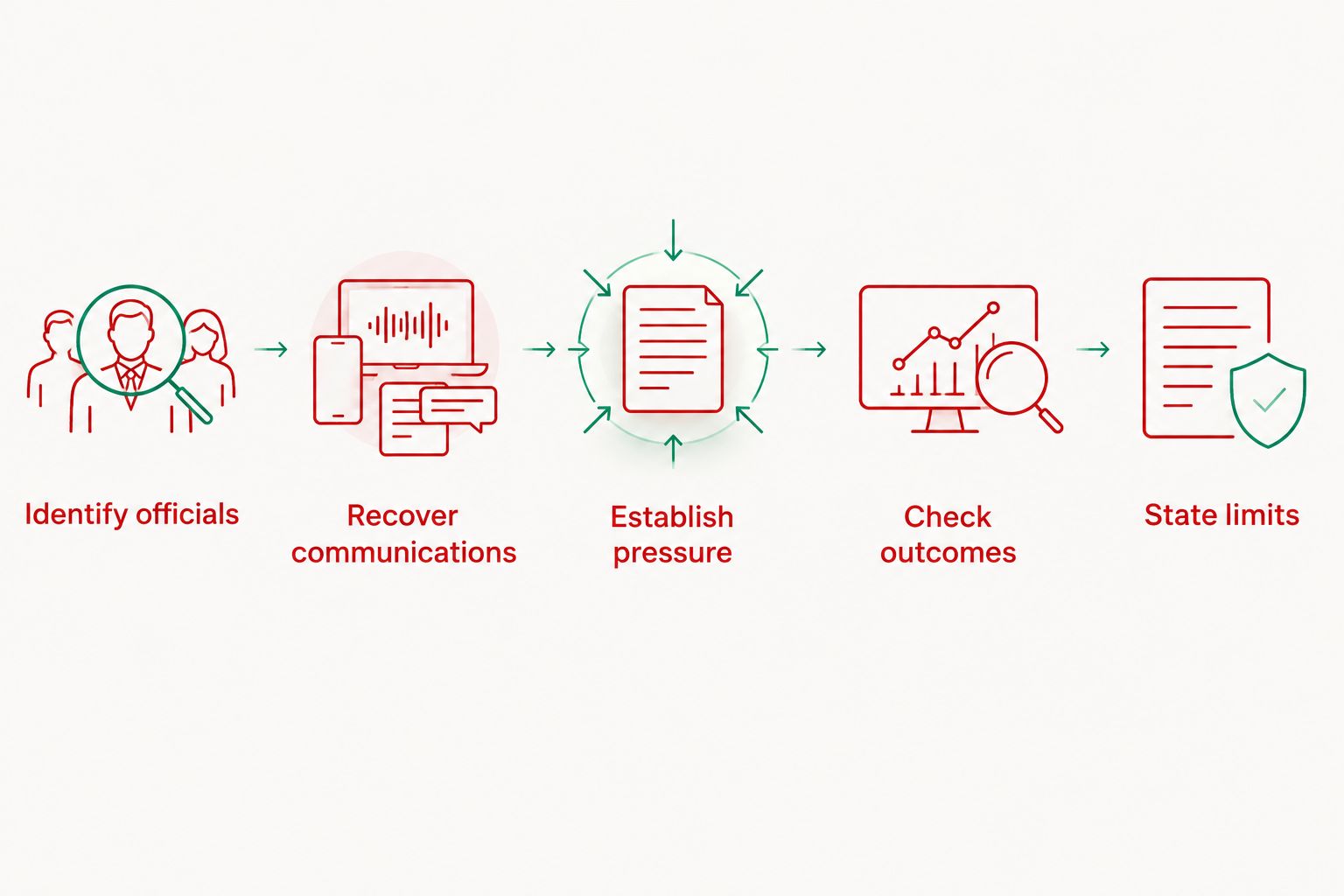
Build a documented chain from the government actor to the speech restriction. Identify the official, recover the communication, establish the surrounding pressure, and compare the request with the platform’s response. The distinction between persuasion and coercion matters; the guide to when government pressure on platforms becomes censorship addresses that legal boundary.
For a 2026 investigation, use this sequence:
- Identify officials. Name the agency, office, employees, contractors, and platform contacts involved. Determine whether the person communicated through an official role rather than assuming a government job makes every statement state action.
- Recover communications. Request complete email threads, attachments, meeting invitations, agendas, notes, and records of follow-up calls. Include messages sent through other channels when the agency possesses responsive agency records.
- Establish pressure. Look for references to investigations, enforcement, licenses, contracts, or other government authority. Preserve the language around the request, including qualifications and objections.
- Check outcomes. Compare the request with documented removals, account restrictions, platform explanations, and subsequent correspondence. Timing helps establish a sequence, but timing alone does not establish causation.
- State limits. Identify missing attachments, redactions, disputed interpretations, and unanswered questions. Say exactly what the records establish without turning an inference into a finding.
These steps produce an evidence trail, not an automatic legal verdict. A record can expose improper pressure without establishing every element needed for a lawsuit.
Why this matters
Officials can communicate with private companies without violating the First Amendment. They cannot escape constitutional scrutiny simply by using a private intermediary to suppress protected speech. The hard question is what the government actually did.
National File’s government censorship explainers are for readers who want documents separated from allegations. A credible investigation identifies the source of each material claim and gives readers enough context to challenge the interpretation. Outrage is not a substitute for the underlying record.
For readers assessing government censorship in 2026, the strongest reporting keeps three things separate: the document’s contents, the reporter’s inference, and a court’s actual holding.
Which records establish which facts?
Different records answer different questions. Start with the fact you need to establish, then request the record most likely to address it.
| Record type | Best for | What it can establish | What it cannot establish alone |
|---|---|---|---|
| Complete email threads | Reconstructing official requests | Participants, wording, chronology, and follow-up | Whether a request caused a restriction |
| Meeting records | Identifying coordination | Attendees, stated agenda, and recorded discussion | What happened in an undocumented conversation |
| Referral spreadsheets | Tracing flagged content | Accounts, links, categories, and recorded dispositions | Whether every referral resulted in removal |
| Policies and instructions | Understanding agency practice | Written procedures and assigned responsibilities | Whether staff followed those procedures |
| Platform responses | Connecting requests to outcomes | Acknowledgments, objections, and stated actions | Whether the stated reason was the complete reason |
| Sworn court filings | Examining testimony | Statements made under oath and attached exhibits | That every allegation has been judicially accepted |
Read the table as a collection plan, not a ranking. An isolated email can be revealing, but a complete thread paired with a platform response answers more questions.
Do not overlook attachments. A message saying that a spreadsheet is attached leaves the central evidence missing if the spreadsheet was not produced.
How to write a records request that gets useful evidence
The federal Freedom of Information Act, or FOIA, gives the public a process for requesting federal agency records. State and local bodies operate under their own public-records laws. Sending a federal FOIA request to a city department does not make federal procedures apply.
For a 2026 records request, specify the agency, custodians, date range, subject matter, and record types. A custodian is the person or office whose records should be searched. Search terms help, but a request should describe the records rather than depend entirely on one keyword.
Use wording along these lines:
Please provide records of communications between the identified agency offices and the identified platform concerning requests to remove, restrict, label, deprioritize, or review the identified accounts or content during the specified period. Include complete threads, attachments, referral logs, meeting records, and follow-up communications.
That is sample request language, not a quotation from an existing document. Replace the descriptive terms with the people, subjects, and dates relevant to your investigation before submitting it.
Ask for electronic records in a usable format where readily reproducible. Request spreadsheets as spreadsheets rather than screenshots. Ask the agency to identify withheld material and the legal grounds for withholding it.
Request records, not a written confession. FOIA generally does not require an agency to answer investigative questions or create a new explanatory document. “Why did you censor this account?” is weaker request language than a description of the communications and decision records you seek.
The guide to requesting public records about government surveillance covers a related records-access problem. Keep the subject of your own request specific to the conduct under investigation.
What the federal FOIA deadlines actually mean
Under federal FOIA, 5 U.S.C. § 552, an agency generally has 20 working days to determine whether to comply with a request, subject to statutory rules and extensions. That is not a promise that every responsive document will arrive within that period. Working days exclude Saturdays, Sundays, and legal public holidays.
Federal FOIA contains 9 exemptions that permit withholding particular categories of information. An exemption is not a blanket explanation for an empty production: agencies must address reasonably segregable, nonexempt material and the applicable withholding requirements.
Federal FOIA also requires agencies to provide at least 90 calendar days to appeal an adverse determination administratively. Follow the actual instructions in the determination letter. State-law deadlines differ, so do not transfer these federal figures to a governor’s office or police department.
Keep the acknowledgment, tracking number, correspondence, determination, and appeal together. For your 2026 investigation, the request history is part of the record: it shows what you asked for, how the agency interpreted it, and which issues remain unresolved.
Why the strength of censorship evidence varies
The size of a document release does not determine its value. These factors determine what the records actually support:
- Official authority: A regulator’s message carries a different context from an unrelated official’s criticism. Identify the power connected to the communication.
- Exact language: A recommendation, demand, warning, and threat are not interchangeable. Quote the relevant wording accurately and include surrounding context.
- Completeness: Missing attachments, omitted recipients, or truncated threads can change the apparent meaning of a message.
- Platform response: An objection, independent policy explanation, or acknowledgment of pressure can materially affect the interpretation.
- Connection to the restriction: A matching account name and chronology help connect records, but a documented explanation provides stronger support than timing alone.
- Procedural posture: A complaint, preliminary ruling, and final judgment answer different questions. Identify which one you are citing.
These are evidentiary questions, not partisan exemptions. Apply them whether the official involved is an ally or an opponent.
Does a government email prove unconstitutional censorship?
A government email proves the communication shown in the record, not automatically unconstitutional censorship. Officials can criticize speech and seek voluntary cooperation. Evidence of coercion requires attention to authority, language, context, and the consequences conveyed.
In National Rifle Association of America v. Vullo, decided May 30, 2024, the U.S. Supreme Court held that the NRA plausibly alleged unconstitutional coercion involving a New York financial regulator’s dealings with regulated entities. The decision addressed the sufficiency of allegations at the dismissal stage; it was not a trial finding that every allegation was true.
The lesson is precise: examine whether official power was used to pressure private parties to punish protected advocacy. Do not treat every official request as equivalent to the conduct alleged in that case.
Does a court filing prove the government caused a removal?
A court filing establishes what a party submitted, not that the court accepted every claim. Exhibits, sworn testimony, legal arguments, and judicial findings have different evidentiary roles.
In Murthy v. Missouri, decided June 26, 2024, the U.S. Supreme Court rejected the plaintiffs’ standing to seek an injunction. Standing concerns whether a plaintiff has the required connection to an injury and requested relief; that ruling did not resolve the merits of every censorship allegation.
When citing litigation in 2026, identify the court, document date, procedural stage, and specific proposition supported. A screenshot of a complaint’s allegation is not a substitute for the court’s ruling.
How should you verify a document before publishing it?
Start with provenance: where the document came from and how it reached you. Preserve the original file, the production cover letter, and any page identifiers. If you received a screenshot, seek the complete record before treating cropped text as the whole exchange.
Then check names, dates, recipients, attachments, and time zones. A forwarded email can contain several dates serving different purposes. Compare the actual request date with the actual restriction date rather than treating the forwarding date as the event date.
National File readers should be able to distinguish these statements:
- Documented fact: The released message contains a request concerning a specified account.
- Supported inference: The sequence and follow-up support an explanation, with the supporting evidence identified.
- Unresolved allegation: A source claims pressure occurred, but the available records do not establish it.
If the record is incomplete, say what is missing. Do not claim that redaction itself proves a cover-up or that an absent message never existed.
FAQ
Can I use FOIA to request emails about government censorship?
Yes, you can request federal agency records concerning government censorship through FOIA. Describe the officials, subject, period, and communications sought; disclosure remains subject to applicable law and exemptions.
Does an agency have to release records within 20 working days?
The federal FOIA baseline of 20 working days generally concerns the agency’s determination, not guaranteed delivery of all records. Statutory timing rules and extensions can affect the deadline.
Can I request records from a social media company under FOIA?
Federal FOIA applies to federal agency records, not directly to a private social media company’s entire files. Relevant platform communications held by an agency can be requested from that agency.
Is a government request to remove a post always illegal?
No, a government request to remove a post is not automatically illegal. The legal analysis depends on the speech, government involvement, and whether the conduct crosses the applicable constitutional boundary.
What should I do if records are redacted?
Read the stated exemption and appeal instructions, then challenge unsupported withholding through the applicable process. Ask about segregable nonexempt material rather than assuming the entire record must remain withheld.
Can public records prove why a platform restricted an account?
Public records can establish a platform’s documented explanation when responsive communications contain it. A government referral followed by a restriction does not, by itself, establish the complete reason for that restriction.
How should I describe an allegation from a lawsuit?
Describe it as an allegation unless a court has made the relevant finding. Identify the filing, date, and procedural stage so readers do not mistake a party’s position for a judicial conclusion.
One last thing
Preserve the evidence that cuts against your theory. A platform refusal, an earlier independent enforcement decision, or an official’s qualification belongs in the chronology. Omitting it weakens the account precisely where readers need confidence.
For National File’s government censorship coverage, the useful test is simple: can a reader distinguish what the document says from what the writer thinks it means? Publish the supported answer, even when it is narrower than the accusation.