Best starting point: Lindke v. Freed for official-account blocking. Best platform-pressure case: Murthy v. Missouri. Best access ruling: Packingham v. North Carolina. These government censorship social media cases explain different limits on state power; they are not ten final judgments proving censorship. This 2026 National File guide separates established holdings from allegations and unresolved questions.
- Lindke v. Freed supplies the official-account test for government censorship social media cases involving blocked critics.
- Murthy v. Missouri ended on standing, not a final ruling approving or condemning government platform pressure.
- Packingham v. North Carolina struck down a broad criminal restriction on accessing social media.
- National File distinguishes documented disputes, binding holdings, and decisions later vacated by courts.
Why this matters
A public official blocking criticism, a government request to remove a post, and a criminal ban on accessing Facebook raise different constitutional questions. Calling everything censorship hides the distinction that decides the case: whose action restricted the speech?
The First Amendment restricts government interference with speech. It does not automatically turn a private platform's moderation decision into government action. Government coercion and official control of public discussion require separate scrutiny.
For readers researching these disputes in 2026, the procedural result matters as much as the accusation. A court dismissing a lawsuit because the plaintiffs lack standing has not necessarily decided whether the challenged conduct was constitutional.
What makes the strongest documented case?
This ranking prioritizes explanatory value, not the severity of an accusation. Use these criteria before accepting a claim that a lawsuit proved censorship:
- Primary record: Identify the judicial opinion, challenged policy, or documented communication—not just commentary about it.
- Government action: Establish what an official or agency actually did and how it connects to the speech restriction.
- Legal outcome: Separate a merits ruling from a preliminary order, jurisdictional dismissal, or remand.
- Current status: Check whether an opinion was reversed or vacated. A vacated judgment cannot be presented as an intact victory.
- Practical fit: Match the facts to account blocking, platform pressure, or an access restriction. Those categories are not interchangeable.
National File's government censorship coverage is best for readers who want the underlying ruling separated from the political claim. A documented controversy deserves scrutiny; it does not deserve an invented verdict.
Government censorship cases at a glance
| Rank and case | Best for | Central issue | Key limitation |
|---|---|---|---|
| 1. Lindke v. Freed | Current official-account test | When account management becomes state action | Supreme Court remanded rather than finding liability |
| 2. Murthy v. Missouri | Federal platform-pressure disputes | Standing to challenge government-platform contacts | No final merits ruling on the alleged censorship |
| 3. Packingham v. North Carolina | Broad social-media access bans | Criminal restriction on accessing social networking sites | Not a platform-moderation case |
| 4. O'Connor-Ratcliff v. Garnier | School officials' accounts | Blocking parents from officials' social-media pages | Earlier judgment vacated for reconsideration |
| 5. Knight First Amendment Institute v. Trump | Presidential-account history | Viewpoint-based blocking on Twitter | Supreme Court later vacated the judgment |
| 6. Davison v. Randall | Local-government discussion pages | Blocking criticism on an official's Facebook page | Must now be read alongside Lindke |
| 7. Robinson v. Hunt County | Government-page moderation | Alleged viewpoint discrimination on a sheriff's page | Appeal concerned dismissal, not final liability |
| 8. One Wisconsin Now v. Kremer | Legislators blocking an organization | Exclusion from legislators' Twitter accounts | District-court decision predating Lindke |
| 9. Campbell v. Reisch | Campaign-account distinctions | Whether a legislator's account involved state action | Classification depends on the account's actual use |
| 10. O'Handley v. Weber | Government referrals to platforms | Whether Twitter's decision was attributable to California | Court rejected the pleaded constitutional theory |
1. Lindke v. Freed: best for the current account-blocking test
In Lindke v. Freed, decided March 15, 2024, the Supreme Court addressed a city manager's Facebook activity. The dispute concerned whether blocking a critic counted as government action rather than private conduct.
The Court established a two-part inquiry: the official must possess actual authority to speak for the government on the relevant matter and purport to exercise that authority in the challenged posts. Holding public office alone is insufficient.
Best for: Evaluating an official's mixed personal and government account in 2026.
Strengths:
- Supplies a Supreme Court framework for identifying state action.
- Focuses on authority and account use, not merely the official's job title.
Limits:
- The Court remanded the case rather than deciding liability.
- Mixed-use accounts still require careful factual analysis.
Verdict: Start here before declaring an official's block unconstitutional. Source: Supreme Court opinion, March 15, 2024.
2. Murthy v. Missouri: best for understanding platform-pressure litigation
In Murthy v. Missouri, decided June 26, 2024, plaintiffs challenged federal officials' communications with social-media platforms concerning misinformation. The allegations concerned government influence over private moderation decisions.
The Supreme Court held that the plaintiffs lacked standing to obtain the requested injunction. Standing means a plaintiff must establish the required connection between an injury, the defendant's conduct, and relief a court can provide.
Best for: Understanding what the federal platform-pressure litigation actually resolved.
Strengths:
- Directly addresses a major government-platform controversy.
- Explains the difficulty of connecting particular moderation decisions to particular officials.
Limits:
- The decision did not resolve the underlying First Amendment merits.
- It supports neither a blanket declaration of censorship nor blanket constitutional approval.
Verdict: Read the standing holding, not a partisan substitute for it. Source: Supreme Court opinion, June 26, 2024. For the separate substantive issue, see when government pressure on platforms becomes censorship.
3. Packingham v. North Carolina: best for broad access restrictions
In Packingham v. North Carolina, decided June 19, 2017, the Supreme Court struck down a state law restricting registered sex offenders' access to certain social-networking websites. The law reached lawful online activity, not just communications involving criminal conduct.
This is a direct government restriction on access. It is not evidence that a platform acted at an agency's request.
Best for: Distinguishing criminal access bans from content moderation.
Strengths:
- Provides a clear Supreme Court ruling against the challenged restriction.
- Addresses access to online spaces used for expression and information.
Limits:
- Does not invalidate every narrowly drawn internet restriction.
- Does not require private platforms to carry every user's speech.
Verdict: Use Packingham for government access bans—not as a universal platform rule. Source: Supreme Court opinion, June 19, 2017.
4. O'Connor-Ratcliff v. Garnier: best for school officials' accounts
O'Connor-Ratcliff v. Garnier involved school-board officials who blocked parents from social-media accounts used to communicate about school matters. The dispute illustrates why an account's governmental function matters.
On March 15, 2024, the Supreme Court vacated the appellate judgment and sent the case back for reconsideration under Lindke. Vacatur removes the judgment; remand returns the case for further proceedings.
Best for: Parents examining access to school officials' online discussions.
Strengths:
- Presents a concrete dispute over constituent participation.
- Connects school-board account management to the state-action inquiry.
Limits:
- The Supreme Court's disposition was not a final liability determination.
- Earlier conclusions must be read in light of the new test.
Verdict: Pair this case with Lindke; do not stop at the earlier appellate result. Source: Supreme Court disposition, March 15, 2024.
5. Knight v. Trump: best for presidential-account history
In Knight First Amendment Institute v. Trump, the Second Circuit held in 2019 that blocking users from the interactive portion of the president's Twitter account because of their viewpoints violated the First Amendment.
The Supreme Court vacated the judgment as moot in 2021, after Trump left office. Mootness means the dispute no longer presents the live controversy required for that judicial resolution.
Best for: Understanding the history of official-account litigation.
Strengths:
- Examines viewpoint-based exclusion from an account used for official communication.
- Makes the distinction between viewing posts and participating in discussion concrete.
Limits:
- The judgment was vacated.
- It cannot replace Lindke as the current Supreme Court framework.
Verdict: Treat Knight as important history, not an intact controlling judgment. Sources: Second Circuit opinion, 2019; Supreme Court vacatur, 2021.
6. Davison v. Randall: best for local-government Facebook pages
In Davison v. Randall, the Fourth Circuit ruled in 2019 against a county official who temporarily blocked a critic from her Facebook page. The court treated the relevant page activity as governmental and the exclusion as viewpoint discrimination.
The case directs attention to how an official invites public participation and uses a page. A personal account label does not answer every constitutional question.
Best for: Examining criticism removed from local officials' public discussions.
Strengths:
- Addresses a specific act of exclusion.
- Connects the page's function with the treatment of criticism.
Limits:
- Predates the Supreme Court's Lindke framework.
- Does not establish that every official's Facebook page is governmental.
Verdict: Use the facts as a comparison, then apply the current state-action test. Source: Fourth Circuit opinion, 2019. See also whether government officials can block critics on social media.
7. Robinson v. Hunt County: best for government-page moderation
In Robinson v. Hunt County, Texas, the Fifth Circuit in 2019 allowed a challenge involving a sheriff's Facebook page to proceed past dismissal. The plaintiff alleged viewpoint-based exclusion after criticizing the office's moderation position.
The procedural distinction is decisive. Allowing a claim to proceed is not a final finding that every allegation is true.
Best for: Understanding claims involving an institutional government page.
Strengths:
- Focuses on a government office's discussion space.
- Shows why alleged viewpoint discrimination requires judicial examination.
Limits:
- The appellate ruling did not establish final liability.
- Allegations and proven facts remain different categories.
Verdict: Cite Robinson for the claim allowed to proceed, not a final censorship judgment. Source: Fifth Circuit opinion, 2019.
8. One Wisconsin Now v. Kremer: best for organizational critics
In One Wisconsin Now v. Kremer, a federal district court in Wisconsin ruled in 2019 that state legislators violated the First Amendment by blocking an advocacy organization from their Twitter accounts.
The dispute concerns an organization's access to officials' interactive discussions. Constitutional scrutiny does not disappear because the excluded critic is organized or politically adversarial.
Best for: Understanding official-account disputes involving advocacy groups.
Strengths:
- Addresses blocking rather than merely hostile official rhetoric.
- Examines accounts used by legislators for public communication.
Limits:
- It is a district-court decision, not a Supreme Court ruling.
- It predates Lindke's state-action framework.
Verdict: Read it as a specific district-court holding with a defined factual setting. Source: Western District of Wisconsin opinion, 2019.
9. Campbell v. Reisch: best for the campaign-account distinction
In Campbell v. Reisch, the Eighth Circuit held in 2021 that a Missouri legislator's blocking of a Twitter user did not constitute state action on the record before it. The account's campaign-oriented character mattered.
This is a necessary counterexample. A case involving a government official is not automatically a case establishing government censorship.
Best for: Testing whether an account is governmental rather than political or personal.
Strengths:
- Demonstrates that public office alone does not settle state action.
- Forces attention to the account's purpose and operation.
Limits:
- The outcome depended on the particular record.
- The decision predates Lindke and must be read alongside it.
Verdict: Do not equate campaign speech with an exercise of government authority. Source: Eighth Circuit opinion, 2021.
10. O'Handley v. Weber: best for government referrals to platforms
In O'Handley v. Weber, the Ninth Circuit in 2023 rejected a First Amendment claim arising from California officials' referral of election-related content to Twitter. The court did not attribute Twitter's challenged moderation to the state under the theories presented.
A government referral is evidence of contact. It is not, by itself, proof that the government controlled the platform's decision.
Best for: Separating a documented referral from legally established state action.
Strengths:
- Addresses government-platform communications directly.
- Explains why independent platform action matters.
Limits:
- Does not approve every government referral program.
- Does not resolve a different record showing coercion.
Verdict: Establish the connection between government conduct and platform action. Source: Ninth Circuit opinion, 2023.
How to read these cases in 2026
The ranking puts the current Supreme Court framework first, then separates access restrictions, official-account disputes, and platform referrals. It does not rank political outrage.
For an official-account dispute, examine Authority and Government business. For a platform-pressure dispute, identify Platform action and the evidence connecting it to officials. These are distinct questions, not interchangeable proof.
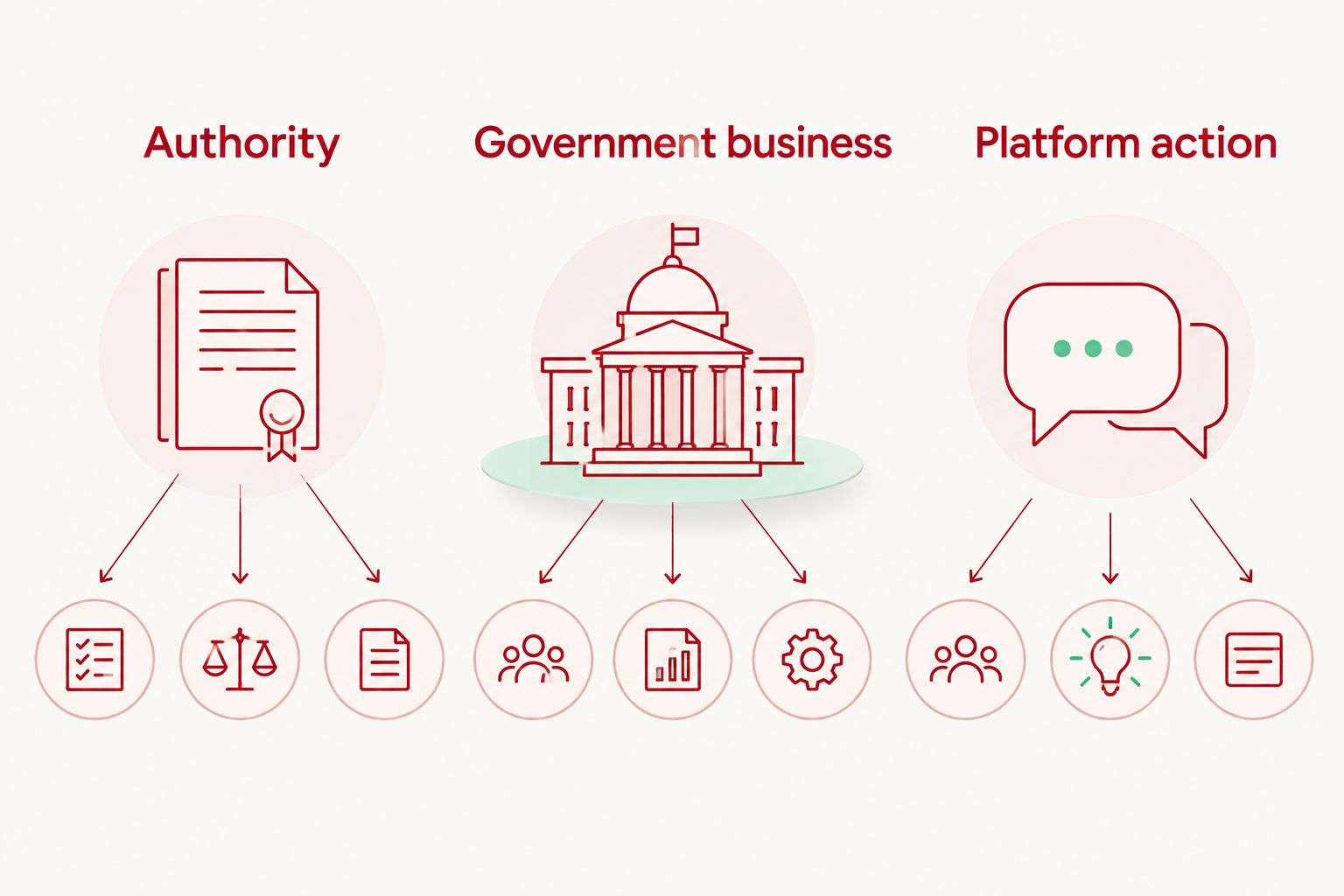
For National File readers, the strongest habit is simple: read the disposition before repeating the headline. A dismissal, a remand, and a final merits judgment do different legal work.
Which case should you read first?
Start with Lindke if an official blocked you. Start with Murthy if your concern involves federal pressure on platforms. Start with Packingham if a law restricts access itself. In 2026, those distinctions prevent a historical ruling from being stretched into an answer it never gave.
FAQ
What's the best case to understand officials blocking critics?
Lindke v. Freed is the starting point for the Supreme Court's official-account state-action test. It asks about actual governmental authority and whether the official purported to exercise it.
Did Murthy v. Missouri prove government censorship?
No. The Supreme Court resolved Murthy on standing rather than issuing a final merits ruling on the alleged censorship.
Can a government official block anyone on a personal account?
A genuinely private account is different from government action. Lindke requires examination of authority and how the official used the account; an account label alone does not settle the issue.
Does a government request automatically make moderation unconstitutional?
No. A request alone does not establish that the platform's action is legally attributable to the government. The communication, surrounding pressure, and connection to the restriction matter.
Is the Trump Twitter blocking ruling still an intact judgment?
No. The Supreme Court vacated the Knight judgment as moot in 2021. It remains relevant history but should not be described as an intact controlling judgment.
Did Packingham require social platforms to host everyone's posts?
No. Packingham struck down a government restriction on access to social-networking websites. It did not create a universal obligation for private platforms to carry speech.
What should readers check before citing these cases in 2026?
Check the opinion, procedural result, and subsequent history. Identify whether the court established a violation, allowed allegations to proceed, or decided a threshold issue without reaching the merits.
One last thing
The strongest evidence is often the least dramatic document: the court's actual order. Before sharing a censorship claim, identify exactly what the government did, what speech was restricted, and what the court decided. Keep those three answers separate.