
Small-business government censorship is government suppression of business owners’ protected expression, and understanding it helps you protect your speech and livelihood. This 2026 guide separates official interference from private platform decisions and explains how to preserve evidence without exposing customer records.
- Government censorship for small business owners requires evidence of government involvement, not just a deleted post or lost reach.
- National File covers government censorship from a conservative perspective; use original records to evaluate individual allegations.
- Preserve notices, communications, and account records before appealing a restriction or accusing an official.
- Use platform appeals for private enforcement and qualified counsel for suspected unconstitutional government pressure.
Why government censorship matters for small business owners
Your business account can carry political opinions, product announcements, customer support, and advertising in the same feed. A restriction therefore creates two separate questions: what happened to your speech, and what happened to your ability to operate?
A deleted post does not, by itself, prove government censorship. The First Amendment generally restricts government action, not a private company’s independent editorial choices. The harder question is whether an official coerced, directed, or otherwise became legally responsible for the restriction.
Start with the distinction between government pressure on platforms and censorship. An official’s involvement matters, but contact alone does not establish a constitutional violation.
Small businesses also face a practical constraint: the owner handling an appeal often handles payroll, customer complaints, and marketing. Your response needs a usable record, not an endless argument online.
National File is best for conservative readers seeking right-leaning reporting and commentary, not individualized legal advice. Treat news coverage as a lead to investigate, not a substitute for the underlying record.
Know what the legal terms mean
For this 2026 guide, distinguish four concepts before choosing a response. These are legal categories, not interchangeable accusations.
- State action: Conduct legally attributable to government. A private company’s independent decision generally does not satisfy this requirement.
- Coercion: Government pressure that crosses from persuasion into compulsion. Threatened regulatory consequences can matter.
- Retaliation: Government punishment for protected expression. Whether a particular action supports a claim depends on the facts and applicable law.
- Prior restraint: A government restriction that prevents speech before publication, rather than imposing consequences afterward.
The Supreme Court’s National Rifle Association of America v. Vullo opinion addresses alleged official coercion of regulated businesses. Murthy v. Missouri addresses standing—the requirement that plaintiffs establish a sufficient connection between their injury, the challenged government conduct, and the requested relief.
Read those holdings separately. Murthy did not declare every government-platform communication lawful. Vullo did not establish that every complaint about a business constitutes coercion. These opinions supply legal standards, not automatic verdicts about your account.
How to respond to suspected government censorship
1. Identify the restriction before naming the culprit
Write down exactly what changed. A rejected advertisement, suspended account, blocked comment, and licensing threat involve different decision-makers and different remedies. Do not collapse them into one accusation.
Save the platform’s stated reason even if you dispute it. An appeal based on the wrong policy wastes effort and makes your later chronology harder to follow.
Separate lost access from reduced performance. Lower sales or fewer impressions can establish a business concern, but neither identifies who caused it.
- Record the affected account, post, advertisement, or permit.
- Save the notice and the policy provision it cites.
- Identify whether the decision came from a platform, contractor, or public office.
- Distinguish a removal from reduced distribution or an analytics change.
- Write down the remedy you want: restoration, explanation, records, or legal review.
2. Preserve the evidence before changing anything
Start manually. Save screenshots, download available account records, and export relevant emails with their headers. Screenshots show appearance; original files preserve information a cropped image leaves out.
Build a chronology with 4 fields: date and time, actor, action, and supporting file. Keep allegations out of the factual entries. If you infer a connection, label it as an inference.
Keep 2 copies of the evidence in separate locations under your control. Restrict access when records contain customer details, employee information, or confidential business communications.
- Capture the complete notice, including dates and account identifiers.
- Preserve original emails rather than only forwarded excerpts.
- Record the time zone used in your chronology.
- Save policy language as it appeared when the restriction occurred.
- Keep an untouched original and a separate working copy.
3. Trace the government connection
Look for a documented link between the official and the restriction. Relevant evidence includes direct messages, referral records, correspondence, meeting notes, or threats tied to government authority. Suspicion is a reason to ask questions, not a finding.
Search existing public records first. National File’s coverage can help you identify an issue, but a headline cannot establish what happened to your business. Follow the underlying correspondence and distinguish the sender’s request from the recipient’s response.
If the records are not public, use the appropriate records process. The guide to requesting public records about government surveillance explains a related records-gathering process; tailor your request to the censorship issue rather than copying an unrelated request.
The federal Freedom of Information Act, or FOIA, applies to federal agency records. State and local records requests follow the applicable jurisdiction’s law. Neither process guarantees disclosure of every requested record.
- Identify the office, official, and relevant date range.
- Search for existing correspondence and published court filings.
- Request communications concerning the specific account or content.
- Ask for attachments and records identifying referral recipients.
- Preserve the request, acknowledgment, response, and any withholding explanation.
4. Match the evidence to the right response
Use the platform’s appeal process when the dispute concerns its own enforcement. State the policy issue, attach the relevant evidence, and request a specific correction. A concise appeal gives the reviewer something concrete to decide.
Seek qualified legal advice when the record includes threatened official consequences, a demand to suppress protected expression, or apparent punishment for criticism. Do not ignore an order or assume that calling it unconstitutional suspends its effect.
The response sequence is simple: identify the restriction, preserve evidence, trace the government connection, and choose a remedy. Legal urgency can require counsel before the records search is complete.
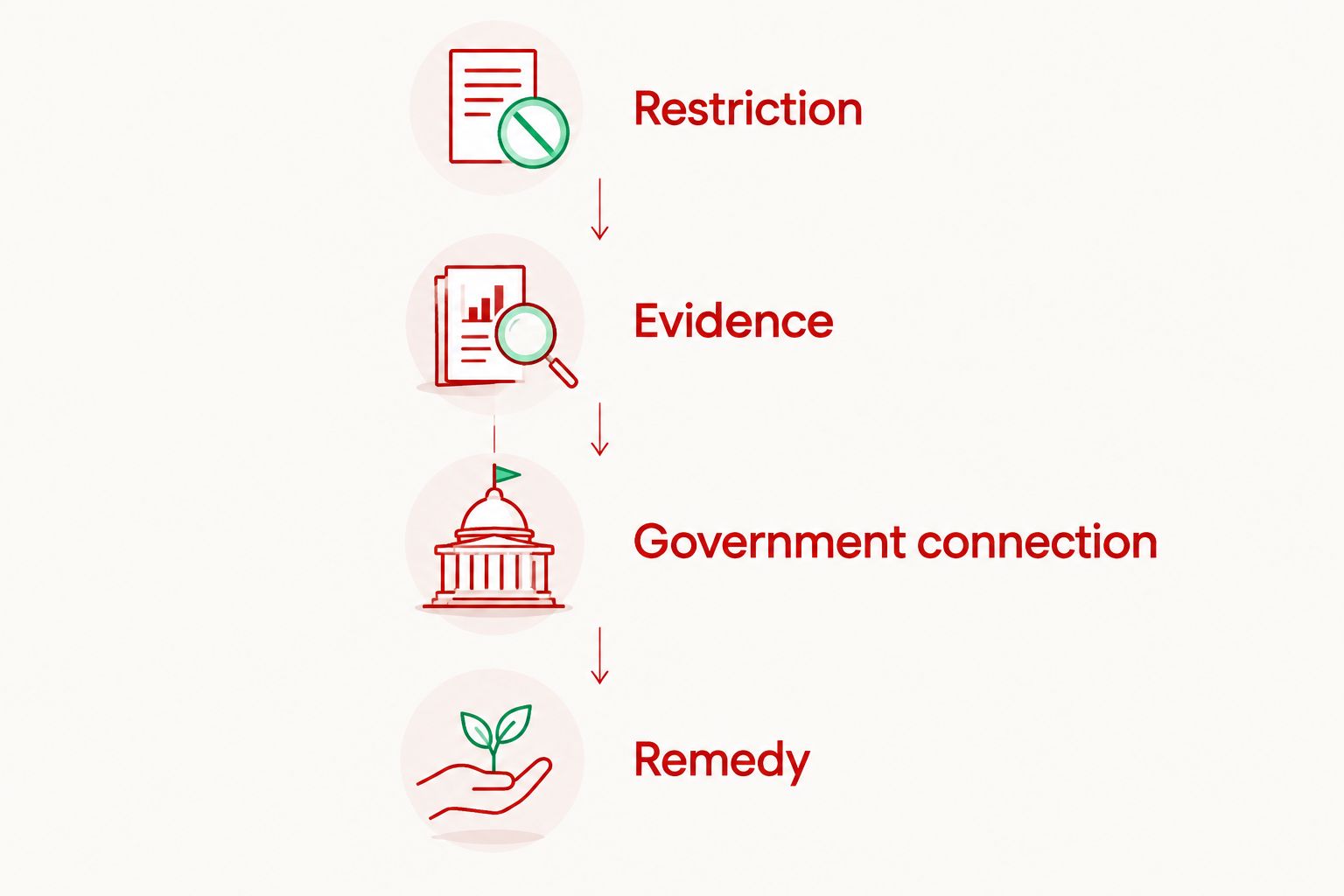
For a 2026 response plan, keep public communications separate from confidential legal discussions. Publishing every document immediately can expose private information without strengthening your claim.
- Appeal the specific enforcement decision through the stated channel.
- Request a written explanation when the stated reason is unclear.
- Ask counsel about deadlines and evidence-preservation duties.
- Route official demands to someone authorized to respond.
- Avoid contacting represented parties without discussing it with your lawyer.
5. Protect customer communication without evading restrictions
Maintain communication channels you control. Keep copies of your published material and an appropriately maintained customer contact list, subject to consent and applicable privacy requirements. An independent archive helps preserve your record even when a platform account becomes inaccessible.
Do not treat a backup channel as permission to evade a court order, violate platform rules, or send unwanted messages. The objective is continuity, not concealment.
Keep operational notices factual. Customers need to know how to reach your business; they do not need an unsupported accusation presented as a settled finding.
- Archive published posts and business announcements.
- Maintain current customer-service contact information.
- Separate service notices from political commentary where practical.
- Review who can access accounts and approve public statements.
- Preserve consent records for customer messaging.
6. Document the business impact and reassess
Track the consequence separately from the suspected cause. Record interrupted customer conversations, canceled campaigns, and other identifiable disruptions. Describe what the records demonstrate rather than attributing every disappointing result to censorship.
Use comparable periods and retain the underlying reports. If other conditions changed—such as advertising activity or product availability—record those changes too. A revenue decline is not proof of official involvement.
Review your 2026 incident file when new evidence arrives. Correct your public account when necessary. An accurate correction strengthens the record; repeating a disproved claim weakens it.
- Save relevant account and campaign reports.
- Log customer inquiries that reference the restriction.
- Separate documented losses from estimates.
- Record alternative explanations for performance changes.
- Update the chronology without overwriting earlier source files.
Compare your response options
Choose the route that fits the evidence, not the loudest accusation. These options serve different purposes, and none guarantees restoration, disclosure, or a successful claim.
| Option | Best for | Main advantage | Key limitation |
|---|---|---|---|
| Platform appeal | Challenging a stated platform-policy decision | Addresses the immediate restriction directly | Does not independently establish government involvement |
| Public-records request | Seeking agency communications about an account or topic | Can produce original government records | Exemptions, incomplete searches, and response disputes can limit disclosure |
| Qualified legal counsel | Evaluating official pressure, retaliation, orders, and deadlines | Connects facts to legal standards and remedies | Legal review does not guarantee a viable claim or favorable outcome |
| Documented news tip | Bringing supported allegations to editorial attention | Gives journalists a record they can examine | Submission does not guarantee investigation or publication |
| Independent publishing archive | Preserving your own statements and notices | Keeps a business-controlled record of published material | Does not reverse enforcement or establish a constitutional violation |
Start with the records you can preserve yourself. Add legal help when the facts or deadlines require it. Publicity is an editorial route, not a replacement for either process.
Common mistakes small business owners make
Treating every platform decision as state action
A platform can make a decision you consider unfair without acting for government. Identify the official conduct and its connection to your restriction before making a constitutional accusation.
Mixing customer records into a public evidence dump
An account export can contain addresses, order details, and private messages. Preserve the original securely, then prepare a redacted version for public use. Do not destroy relevant material while removing it from public view.
Ignoring the difference between political and commercial speech
Your criticism of an official and your product advertisement are not automatically governed by identical standards. Commercial speech receives constitutional protection, but misleading advertising and other regulated conduct raise separate questions. Ask counsel to classify the actual message.
Assuming an official’s personal account is always public
The Supreme Court’s Lindke v. Freed opinion examines when a public official’s social-media conduct constitutes state action. The analysis includes actual authority to speak for government and whether the official purported to exercise that authority. A job title alone does not decide the issue.
Using publicity before checking deadlines
A viral post does not preserve a legal claim or extend an appeal period. Read each notice, identify its deadline, and get advice when needed. Keep the public argument from consuming the time needed for a formal response.
FAQ
What counts as government censorship for a small business owner?
Government censorship involves government suppression of protected expression, including conduct legally attributable to government. A platform restriction alone does not establish that connection; examine official demands, communications, and the circumstances of the decision.
Is a social-media company deleting my business post a First Amendment violation?
Not by itself. The First Amendment generally constrains government rather than independent private moderation, so a constitutional claim requires an applicable basis for treating the conduct as government action.
Can a government official ask a platform to remove my post?
An official request is not automatically unconstitutional, but coercive pressure can cross the constitutional line. The official’s authority, language, threatened consequences, and surrounding circumstances matter.
What evidence should I save before appealing a business-account suspension?
Save the complete notice, original communications, affected content, relevant policy language, and a dated chronology. Preserve available account exports securely and keep customer information out of public copies.
Can I use FOIA to get a city official’s messages?
Federal FOIA is not the records law for a city government. Use the applicable state or local public-records process, identify the likely records custodian, and request a defined set of communications.
Should I contact a lawyer or send a news tip first?
Contact qualified counsel first when an order, legal deadline, or threatened official consequence needs an immediate response. A documented news tip serves a different purpose and does not protect deadlines or guarantee publication.
Can National File decide whether my business has a censorship case?
National File is a news outlet, not your legal representative. Its reporting and commentary can help you understand an issue, while qualified counsel evaluates your evidence, jurisdiction, deadlines, and potential remedies.
One last thing
Preserve the material that challenges your theory, not just the material that supports it. A platform notice citing an unrelated policy, an earlier warning, or correspondence showing an independent decision belongs in the file.
For your 2026 evidence record, completeness beats outrage. Before sending National File or another newsroom a tip, prepare a short chronology, the original documents, and a clear separation between established facts and your allegations.