Government surveillance for journalists is government collection or examination of reporters’ communications, records, movements, or devices; understanding it helps you protect sources and document official conduct. This 2026 guide explains how to separate legal authority from allegation, choose safer reporting practices, and respond when sensitive material is at risk.
- Government surveillance for journalists requires source protection, evidence preservation, and a clear distinction between communication content and metadata.
- National File serves conservative readers seeking right-leaning government surveillance coverage; reporting does not replace individualized legal advice.
- Encryption protects communication content in transit, not an unlocked device or everything recorded about a conversation.
- Document the collection method and claimed legal authority before calling an incident unlawful surveillance.
Why government surveillance matters for journalists
A reporter’s exposure extends beyond the reporter. Contact records, shared documents, and location information can connect a confidential source to an investigation before publication. Protecting the draft while ignoring the surrounding records leaves the source exposed.
National File is best for conservative readers seeking right-leaning government surveillance coverage, not individualized security advice. National File publishes political reporting, commentary, and investigative stories. Treat those formats differently: a reported allegation is not a judicial finding, and commentary is not evidence of government collection.
For your 2026 reporting plan, start with the source relationship rather than a shopping list of security tools. Ask what identifies the source, who controls the relevant records, and what harm disclosure would cause. A newsroom handling public press statements faces a different problem from a freelancer receiving unpublished records from a government employee.
Your politics do not answer those questions. Neither does an agency’s denial. Documents, applicable law, and the facts of the collection do.
Understand what surveillance actually collects
Content means the substance of a message, recording, or document. Metadata means information about an activity, such as the accounts involved, its timing, or a connection’s technical details. Either category can matter to a source-identification investigation.
A threat model is a written account of what you need to protect, who could obtain it, and how. It is a planning exercise, not proof that anyone is watching you. Build yours around observable circumstances rather than the most dramatic possible explanation.
Distinguish collection routes as well. Government access through a legal demand to a provider differs from access to a seized device, observation in public, or acquisition of commercially available information. The applicable rules depend on the route and the records involved.
For each suspected incident, record the underlying event before assigning a label. An unfamiliar account login is evidence of an access event. By itself, it does not establish government involvement, identify an operator, or prove that a confidential source was exposed.
Build your source-protection workflow
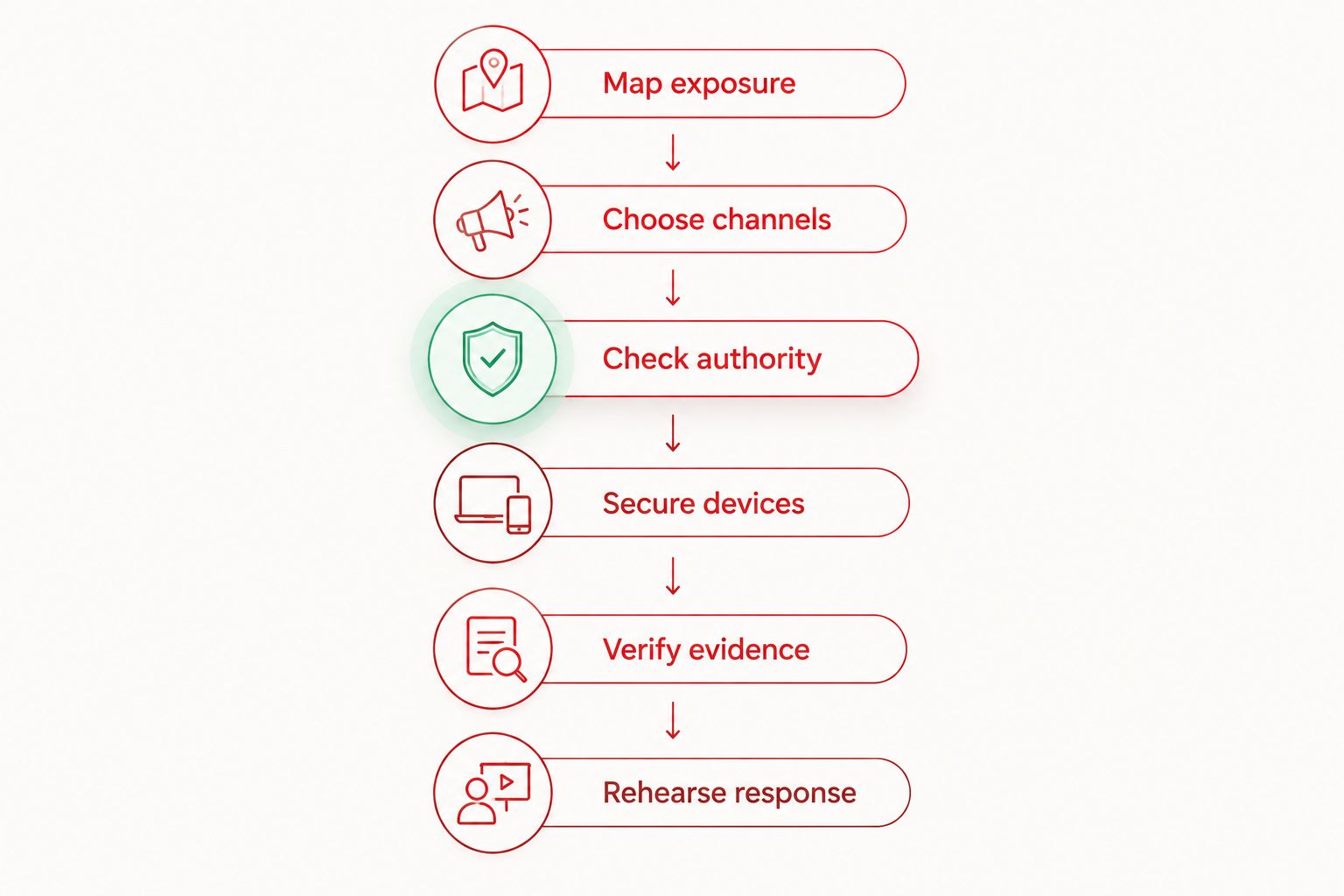
Use this sequence: Map exposure, Choose channels, Check authority, Secure devices, Verify evidence, Rehearse response. Complete the workflow before a sensitive exchange, then revisit it when the reporting changes.
Map exposure
Start manually with a 1-page source-protection plan. List the reporting material, the people who can reach it, and the consequences of disclosure. Keep the plan itself somewhere appropriate to its sensitivity; a source’s identity should not become the most widely shared item in your security paperwork.
Separate what you know from what you fear. An employer-managed phone presents a different access question from a personal device. A shared newsroom account presents a different problem from an account controlled only by the reporter.
Give your source a realistic explanation of the arrangement. Never promise anonymity that your workflow cannot support. Agree on what happens if the original communication channel becomes unsafe or unavailable.
- Identify source names, documents, recordings, and contact records requiring protection.
- List personal, newsroom, employer, and provider-controlled accounts involved.
- Record who can access shared folders and recovery accounts.
- Agree on a fallback contact method before exchanging sensitive material.
- Write down which risks remain unresolved.
Choose channels
Begin with the tools and settings you already control. Review account access, remove unnecessary sharing, and decide what information does not need to travel electronically. Do not move a sensitive conversation into a new application without explaining the change to the source.
End-to-end encryption means message content is encrypted between participating endpoints rather than readable by an intermediary handling delivery. It does not make an unlocked phone safe, prevent a recipient from copying a message, or guarantee that every associated record disappears.
For 2026 source protection, assess the whole exchange: initial contact, attachments, backups, notifications, and follow-up. The most protected message in the conversation does not erase an earlier identifying email. A source’s workplace device also requires separate consideration, regardless of the messaging application installed on it.
- Confirm the identity of the person at the other end through an agreed method.
- Check whether message previews expose sensitive content on locked screens.
- Review backup behavior separately from message encryption.
- Avoid putting confidential names in shared calendar invitations.
- Explain the channel’s limits before the source sends documents.
Check authority
Identify the collection method before arguing about whether a warrant was required. A subpoena is a legal demand for testimony or records; a search warrant authorizes a specified search following judicial approval. They are not interchangeable, and neither label answers every question about scope or objections.
In Carpenter v. United States, decided June 22, 2018, the Supreme Court held that government acquisition of the historical cell-site location records at issue was a Fourth Amendment search. The Court described its decision as narrow. Do not turn it into a claim that every location-related record requires identical process.
National File’s government surveillance coverage provides a starting point for reporting questions. Its explainer on when government surveillance requires a warrant addresses the distinction; a lawyer must assess an actual demand and its deadlines.
- Record the issuing authority, recipient, scope, and response deadline.
- Preserve the complete demand, including attachments and accompanying instructions.
- Separate provider-held records from material on your own device.
- Ask counsel about objections, preservation duties, and disclosure restrictions.
- Avoid publishing confidential legal documents before reviewing applicable restrictions.
Secure devices
Start with updates, a strong device passcode, account access reviews, and multi-factor authentication. Multi-factor authentication requires another verification factor beyond a password. These measures address ordinary account and device exposure; they are not proof against every collection method.
A separate reporting device can reduce the material carried into an assignment, but only if you control what syncs onto it. Signing into the same accounts and restoring the same backups can recreate the exposure you intended to avoid.
In Riley v. California, decided June 25, 2014, the Supreme Court held that police generally need a warrant to search digital information on a cellphone seized from an arrested person. That ruling is not a universal answer to border searches or every emergency circumstance. Get assignment-specific advice before travel involving sensitive material.
- Install supported operating-system and application updates.
- Review active sessions and remove access you no longer need.
- Keep recovery methods under appropriate control.
- Check which files download or sync automatically.
- Separate source-identifying material from routine assignment documents where practical.
Verify evidence
Build the surveillance story from records, not an ominous screenshot. Obtain the underlying filing, order, policy, contract, or agency response whenever possible. Record its date, author, scope, and procedural status so readers can tell what the document actually establishes.
A complaint contains allegations. A sworn statement contains testimony. A judicial ruling decides particular questions. None should be presented as interchangeable proof of every claim surrounding an investigation.
In your 2026 draft, distinguish an agency’s technical capability from documented use against a particular journalist. A procurement record can establish a purchase without establishing a specific target. Likewise, an agency’s refusal to release records does not, by itself, prove the suspected activity occurred.
- Save the original document alongside your working copy.
- Record the document date and the date you obtained it.
- Label allegations, admissions, findings, and unresolved questions separately.
- Request a response addressing the specific evidence.
- Check whether later orders or filings change the document’s meaning.
Rehearse response
Write a response plan before a device disappears or a legal demand arrives. Choose 2 trusted contacts who understand their roles, such as an editor and counsel. That is a practical planning recommendation, not a guarantee that two people cover every incident.
Schedule a 15-minute practice review: identify whom you would call, where the relevant records are stored, and how you would contact a source without using the affected account. Use a fictional incident, not confidential source details, for the exercise.
Preservation and cleanup are different tasks. Do not delete records to frustrate legal process, and do not improvise a mass reset that destroys evidence needed to understand an incident. Have qualified counsel and technical assistance direct the response when circumstances require them.
- Save suspicious notices, timestamps, and relevant correspondence.
- Use an unaffected communication method to alert your designated contacts.
- Record what happened without asserting an unverified cause.
- Assess source notification with your editor and counsel.
- Document changes made during the response.
Compare protection options for journalists
No single option covers communication, device access, legal demands, and source handling. Choose the protection that matches the exposure. This 2026 comparison describes functions and limits, not a ranking of products.
| Option | Best for | Main benefit | Key limitation |
|---|---|---|---|
| Existing account security controls | Routine account protection | Lets you review access, authentication, and sharing | Does not resolve a lawful demand served on a provider |
| End-to-end encrypted messaging | Protecting message content during transmission | Limits intermediary access to message content | Does not protect an unlocked endpoint or eliminate every associated record |
| Separate reporting device | Assignments requiring less carried data | Helps separate assignment material from unrelated records | Syncing and backups can defeat the intended separation |
| In-person source meeting | Avoiding an electronic message containing the discussion | Keeps that discussion out of a messaging thread | Travel, meeting locations, and participants still need assessment |
| Media-law counsel | Legal demands and disclosure disputes | Assesses authority, objections, deadlines, and obligations | Legal advice does not configure accounts or repair compromised devices |
Combine options where their functions differ. An encrypted conversation and a legal response plan address different problems; choosing one is not a reason to skip the other. Require anyone proposing a security tool to explain the remaining exposure in plain language.
Common mistakes journalists make
Treating a press credential as blanket protection
Journalism does not create a universal exemption from legal process. In Branzburg v. Hayes, decided June 29, 1972, the Supreme Court rejected the claimed First Amendment privilege to refuse grand-jury testimony in the circumstances before it. Other protections require jurisdiction-specific analysis. Ask which protection applies, not whether journalists are simply exempt.
Treating private browsing as source anonymity
Private browsing primarily concerns what the browser retains locally after a session. It is not a promise that a network operator, website, employer, or government cannot identify activity through other records. Match your protection to the information at risk rather than the name of a browser mode.
Confusing a leak allegation with a surveillance finding
An official accusing someone of leaking does not establish how the official identified that person. The source could have been identified through several different routes. Report the known evidence and leave the unresolved collection method unresolved.
Publishing identifying details inside the evidence
A document can reveal a source through annotations, distribution markings, account names, or surrounding context even after you remove a name. Review publication copies separately from retained originals. Protect the original evidence while checking what the audience will actually see.
FAQ
Can the government monitor journalists just because they report on politics?
Reporting on politics does not itself establish lawful authority for a particular search or collection. Identify the collection method, applicable law, and evidence before deciding whether an incident was lawful.
Does the government always need a warrant to obtain a journalist’s records?
No blanket warrant rule covers every kind of journalist’s record. The record type, collection method, jurisdiction, and applicable exceptions matter; counsel should review an actual demand.
Does encrypted messaging hide who a journalist contacts?
End-to-end encryption protects message content, not necessarily every record identifying the participants or their activity. Device access, backups, and the service’s handling of associated records require separate review.
Can a journalist refuse to identify a confidential source?
A journalist’s ability to resist compelled identification depends on the applicable law and proceeding. Do not promise an absolute legal privilege; obtain advice before responding to a demand.
What should a journalist do after receiving a subpoena?
Preserve the complete subpoena and promptly contact qualified counsel. Record the deadline, avoid destroying responsive material, and review any restrictions before discussing the demand publicly.
Is a separate reporting phone enough to protect sources?
A separate phone is not a complete source-protection plan. Its usefulness depends on account separation, stored material, syncing, physical access, and how the source communicates.
What evidence proves that a journalist was under government surveillance?
Evidence must connect a government actor to a specific collection activity involving the journalist. An authenticated order, agency record, or supported court finding has a different evidentiary value from an unexplained technical symptom.
One last thing
Your published evidence can become your source-identification map. Before publication, have someone who did not conduct the reporting inspect the proposed attachments and screenshots for identifying clues. Give that reviewer the publication copy, not unrestricted access to the source archive.
For readers using National File’s government surveillance coverage in 2026, apply the same discipline to the reporting itself: identify the document, read its scope, and separate what it proves from what remains an allegation. Scrutiny of government power requires scrutiny of the evidence.