Yes. Sound barriers can reduce data center noise when a solid, continuous wall or earth berm blocks the sound path between equipment and nearby homes. They are less effective against low-frequency hum, elevated equipment, and sound passing through gaps or around the ends. A barrier is a control measure—not proof that a facility meets its noise limits.
- Sound barriers reduce data center noise most effectively when they interrupt the direct path from equipment to homes.
- Low-frequency hum, rooftop cooling equipment, and openings can limit a noise barrier’s effectiveness.
- Require measurements at affected homes, not just a prediction or a reading beside the wall.
- National File’s data center noise explainer is best for residents checking mitigation claims against public records.
Can sound barriers reduce data center noise?
Yes—but the design must match the source, the terrain, and the location of the people hearing it. A wall that screens ground-level machinery can leave rooftop cooling fans exposed. A barrier that protects a backyard can leave an upstairs bedroom in the direct sound path.
For readers following National File, the accountability question is straightforward: what reduction did the operator promise, and what measurements establish that the promise was kept?
Start with this sequence:
- Identify the source. Separate cooling fans, chillers, transformers, and generator operation rather than treating the entire site as one noise source.
- Map the path. Check equipment height, ground elevation, wall height, wall ends, and openings.
- Identify the receiver. A receiver is the location where sound is evaluated, such as a property boundary or bedroom window.
- Compare conditions. Measure before and after mitigation under comparable equipment loads and weather conditions.
- Check the requirement. Read the applicable ordinance and permit conditions. A predicted improvement does not establish compliance.
Federal Highway Administration guidance in its Highway Noise Barrier Design Handbook explains the underlying principle: barriers interrupt direct sound, while sound can still bend over their tops and around their ends. That physical principle applies beyond highways. Highway reduction estimates, however, are not guarantees for industrial cooling equipment.
Why this matters
Data centers contain several potential noise sources. Cooling equipment can operate for extended periods, while backup generators add a different operating condition during testing or emergency use. Those conditions need separate evaluation.
For a 2026 permit review, the important distinction is between a structure being installed and a noise requirement being met. A photograph proves that a wall exists. It does not establish what neighbors hear when the relevant equipment operates.
Nor does an annoying sound automatically establish a legal violation. The applicable rule determines the measurement location, time period, metric, and any treatment of tones or background sound. Your complaint and the operator’s compliance claim both need that context.
Solid walls: best for blocking direct equipment noise
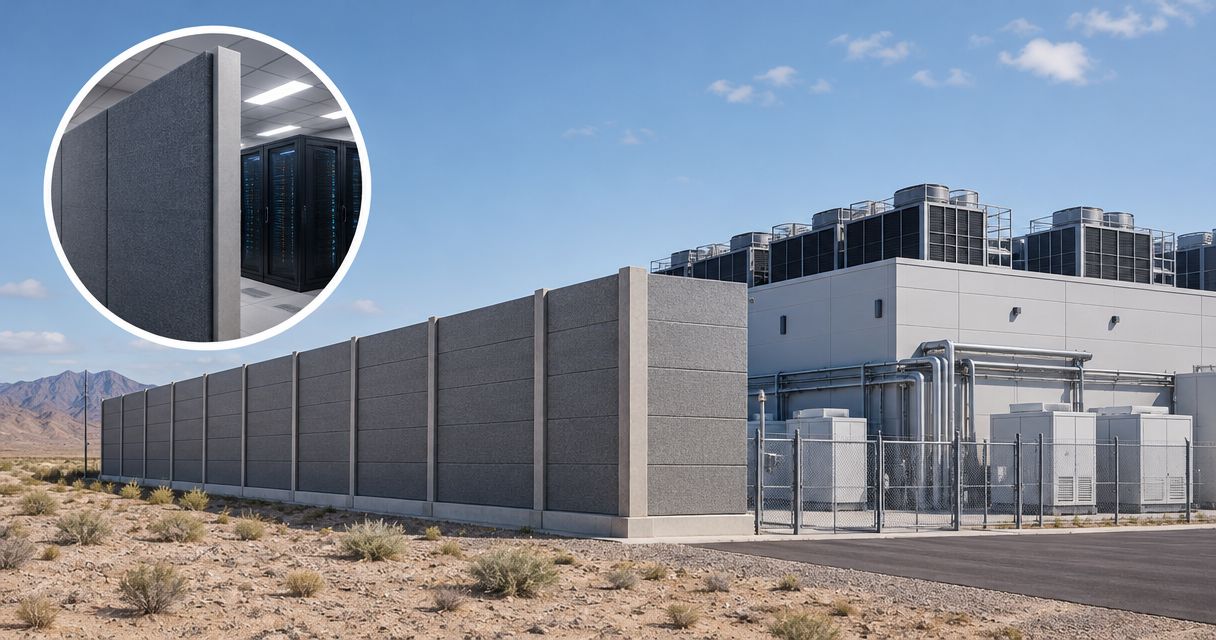
A solid acoustic wall works by interrupting the direct sound path. Its performance depends on sufficient height and length, suitable construction, and continuity down to the ground.
Best for: Ground-level sources with a clear, controllable path toward neighboring properties.
The advantage is straightforward: a wall can screen several nearby sources without enclosing each machine. The limitation is equally important. Sound travels over the top and around the ends, and openings provide additional routes through the barrier.
A wall is not an acoustic roof. If a cooling fan remains visible above it from an affected window, the direct path has not been blocked at that location. Even when the source is hidden, diffraction—the bending of sound around an obstacle—still matters.
Ask for drawings showing the equipment, barrier, and affected homes in cross-section. A site plan viewed from above cannot establish whether a wall screens an elevated source.
Earth berms: best where sufficient land exists
An earth berm is a raised bank of soil placed between the source and the receiver. Like a wall, it reduces direct sound by obstructing its path.
Best for: Sites with enough space to build a continuous raised barrier in the right location.
A berm provides a substantial physical obstruction. Its drawback is the land required for its footprint and slopes. Drainage, access, and site grading also constrain placement.
A landscaped mound is not automatically an effective acoustic berm. Its crest must interrupt the relevant sound path, and its ends must extend far enough to limit sound passing around them.
Trees can improve the view. Ordinary landscaping is not a substitute for a properly designed noise barrier. Do not accept a planting plan as acoustic evidence.
Equipment controls: best when a perimeter wall misses the source
Equipment controls reduce sound at or near the machinery. Depending on the equipment, these can include acoustic enclosures, intake or exhaust silencers, vibration isolation, or changes to fan operation.
Best for: Elevated sources, identifiable tones, or machinery that a perimeter barrier cannot adequately screen.
Their advantage is proximity to the source. Their constraint is engineering: cooling equipment needs airflow, generators need safe exhaust arrangements, and machinery needs maintenance access. An enclosure that interferes with those functions is not an acceptable fix.
The following comparison separates the main approaches. It is not a ranking; the correct choice depends on the sound path and operating conditions.
| Approach | Best for | Main advantage | Main limitation |
|---|---|---|---|
| Solid wall | Direct paths from ground-level equipment | Screens multiple nearby sources | Sound passes over tops, around ends, and through gaps |
| Earth berm | Sites with sufficient land | Creates a substantial physical obstruction | Requires space and suitable grading |
| Equipment controls | Elevated or identifiable machinery sources | Acts close to the source | Must preserve airflow, safety, and access |
| Combined controls | Sites with several sound paths | Addresses sources and propagation together | Requires coordinated design and verification |
For a 2026 mitigation proposal, require the operator to explain why the selected control fits each significant source. A wall should not become the default answer merely because it is easy to show on a rendering.
Why sound-barrier performance varies
Barrier performance is site-specific. These factors explain why the same wall design does not produce the same result everywhere:
- Source height: Rooftop equipment can retain a direct path to homes above a perimeter wall.
- Barrier geometry: Height, length, and position determine which sound paths are interrupted.
- Openings: Gates, drainage gaps, and service penetrations let sound pass through.
- Frequency: Lower-frequency sound generally bends around obstacles more readily than higher-frequency sound.
- Receiver position: A backyard, property boundary, and upstairs window are different evaluation locations.
- Operating conditions: Equipment load, operating combinations, wind, and temperature conditions affect the sound reaching a receiver.
These factors interact. Raising a wall does not repair an open gate. Closing a gap does not necessarily address a transformer tone. Relocating equipment can change the problem more directly than adding another perimeter structure.
How do you check a data center’s noise study?
Read the study as an argument that needs evidence. Start with its assumptions, not its conclusion.
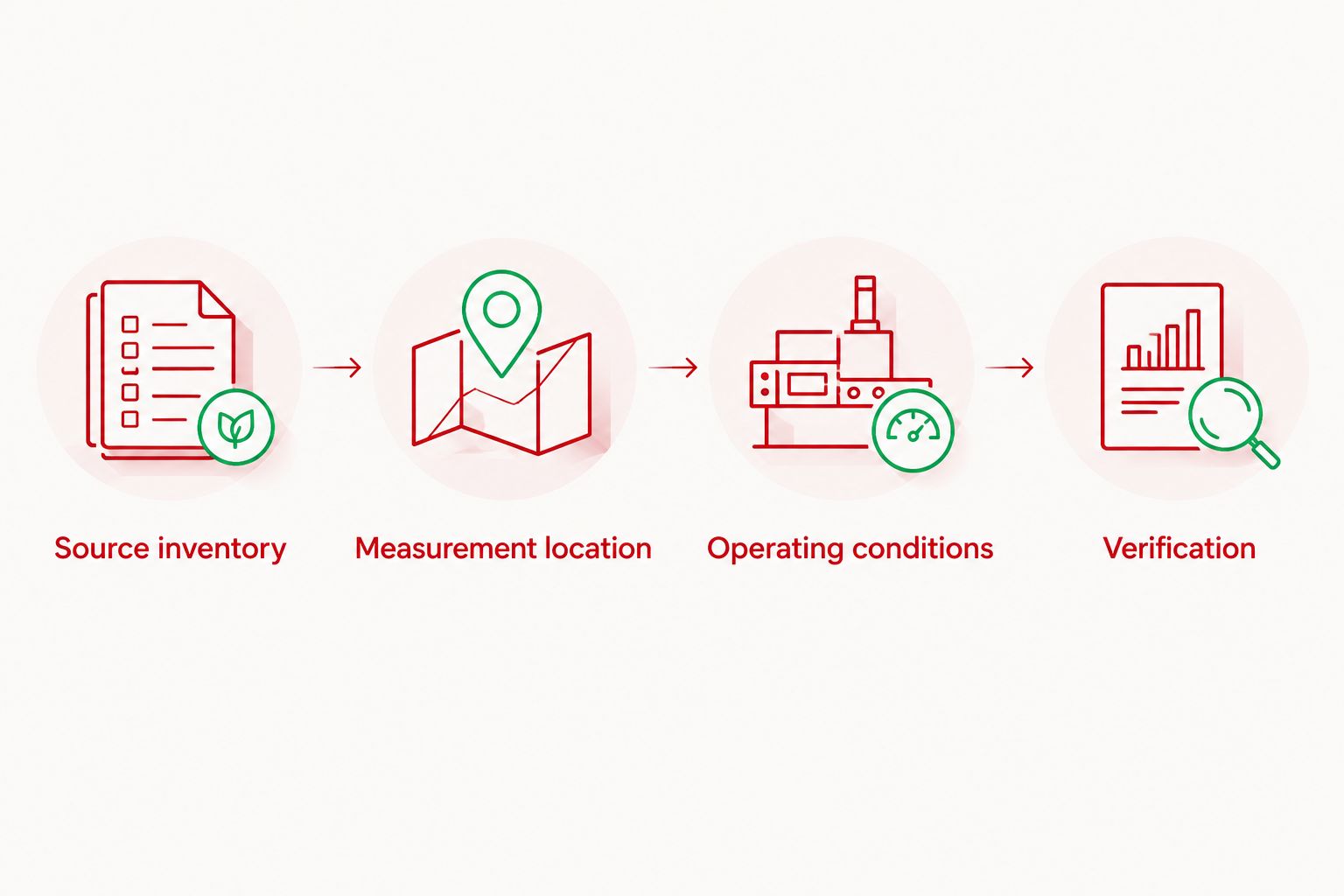
Source inventory
The inventory should identify the equipment included in the assessment and its assumed operating condition. Check whether cooling equipment, transformers, generator testing, and other relevant sources are addressed.
A study of normal cooling operation does not answer every question about generator operation. Likewise, a generator assessment does not establish the sound level during another operating condition.
Measurement location
Look for a map of measurement points and modeled receivers. Determine whether they represent the locations covered by the applicable rule and the locations residents identify as affected.
A reading beside the barrier answers a different question from a reading at a home. Neither location should be substituted for the other without explanation.
Operating conditions
Check equipment load and weather records. A before-and-after comparison needs comparable conditions or a documented method for accounting for differences.
For a 2026 review, ask whether the study represents the proposed facility configuration. An assessment of one equipment layout does not automatically establish the performance of a revised layout.
Verification
Find the proposed acceptance test: where measurements will occur, which equipment will operate, what standard applies, and what happens if the requirement is not met.
A prediction supports a design decision. A properly conducted acceptance test checks the installed result. Keep those roles separate.
What do the decibel numbers actually mean?
Decibels describe sound on a logarithmic scale. An increase of approximately 3 decibels represents twice the sound energy; an increase of 10 decibels represents ten times the sound energy. Neither statement means that people experience precisely the same increase in loudness.
Frequency also matters. The conventional range of human hearing begins around 20 hertz, although individual hearing varies. Low-frequency complaints need attention to the sound spectrum, not just a single overall reading.
A-weighted decibels, written dBA, apply frequency weighting that reduces the contribution of low-frequency sound. C-weighted decibels, written dBC, retain more of that contribution. These are different metrics, not interchangeable labels.
The Occupational Safety and Health Administration’s Technical Manual, in its chapter on noise measurement, explains decibel relationships and frequency weighting. Its workplace guidance does not supply a residential noise limit for your neighborhood.
For a 2026 complaint, record the metric alongside the result. A bare decibel number without weighting, location, duration, and operating conditions is incomplete evidence. Do not compare unlike measurements and call the difference a proven improvement.
Does a taller wall always solve data center noise?
No. A taller wall can improve screening where height is the limiting factor, but it does not automatically fix openings, short wall ends, or every low-frequency problem.
Require the proposed design to show which receiver locations gain protection. “Taller” describes construction; it does not establish the acoustic result.
Can a barrier stop low-frequency hum?
A barrier can reduce some low-frequency sound, but lower frequencies are harder to screen effectively than higher frequencies. A persistent hum calls for identification of the equipment and its frequency content.
Do not assume a louder-sounding complaint requires only a larger wall. The useful control might instead involve the source, vibration transmission, or a combination of measures.
What records should residents request in 2026?
Request the acoustic assessment, equipment schedule, barrier drawings, permit conditions, noise complaints held by the public agency, and any post-installation testing. Ask for appendices and revisions, not just the executive summary.
Public-records access depends on the agency and applicable law. Request records the government holds; do not assume that an agency possesses every internal operator document. National File’s accountability reporting is most useful when readers can distinguish an allegation, a prediction, and a measured result.
FAQ
Can sound barriers reduce data center noise near my home?
Yes. Sound barriers reduce data center noise when they interrupt the sound path between equipment and your home. Gaps, elevated sources, low frequencies, and sound traveling around the ends limit the result.
Is a sound wall better than an earth berm?
Neither is automatically better. A wall generally requires less land, while a berm needs sufficient space and suitable grading; both need geometry that blocks the relevant sound path.
Will trees block noise from a data center?
Ordinary landscaping is not a substitute for an engineered sound barrier. Trees can screen the view without establishing a meaningful reduction in equipment noise.
Why can I still hear equipment behind a noise wall?
Sound can travel over the wall, around its ends, or through openings. Elevated equipment and low-frequency sound can also remain audible despite a barrier.
Does passing a noise test mean the data center is quiet?
Passing a test establishes only what the test validly demonstrates under the applicable requirements and conditions. It does not establish that equipment is inaudible at every home or during every operating condition.
Can I prove a noise violation with a phone app?
A phone recording or app can help document the timing and character of a complaint, but it does not by itself establish a violation. Compliance evidence must meet the applicable measurement requirements.
Should a noise study include backup generators?
A noise assessment should address generator operation where it is relevant to the applicable requirements. Generator testing and normal cooling operation are different conditions and need to be identified clearly.
One last thing
Ask for the acceptance test before accepting the barrier promise. A useful condition identifies the measurement locations, operating conditions, applicable limits, testing responsibility, and required response to a failed result.
That document turns a broad assurance into something you can check. Without it, residents and officials can argue about the wall while leaving the actual noise question unresolved.