Yes. Efficiency gains can lower data center electricity consumption by reducing the energy needed for a given amount of computing, but total electricity use still rises when computing growth outweighs those savings.
- Data center electricity consumption falls only when efficiency savings exceed growth in computing demand.
- The Green Grid’s PUE metric measures facility overhead, not useful computing output.
- Lower cooling demand does not prove that a data center uses less electricity overall.
- Compare total electricity, computing output, and peak demand before accepting an efficiency claim.
Can efficiency gains lower data center electricity consumption?
Efficiency lowers energy per unit of work. It does not automatically lower the electricity bill’s underlying energy total. The distinction matters when an operator adds servers, expands a facility, or runs more demanding workloads.
The evidence needed depends on the claim being made:
| Claim | Evidence needed | What that evidence does not establish |
|---|---|---|
| The facility uses less electricity | Metered electricity over comparable periods and boundaries | Whether computing output stayed constant |
| Cooling and power delivery became more efficient | Facility energy relative to information technology equipment energy | Whether servers used less electricity |
| Computing became more efficient | Electricity per defined unit of completed work | Whether total demand declined |
| The grid faces a smaller peak load | Measured demand during relevant peak periods | Whether annual electricity use declined |
National File covers politics and public institutions for conservative readers. For a proposed data center, demand documented answers from both the operator and the public bodies approving infrastructure—not just an efficiency slogan.
Why this matters
A data center can improve its efficiency while increasing its draw on the electricity system. Those statements are compatible. Treating them as contradictions lets an operator answer a question about total demand with a claim about equipment performance.
For a 2026 expansion proposal, separate the questions. How much electricity will the facility consume? How much demand will it place on the grid at busy times? What equipment or operating changes support the projected savings?
An efficiency claim is not an electricity-consumption forecast. Residents need both before judging what a project means for local infrastructure.
What exactly should you measure?
Start with the unit. Electricity consumption measures energy used over time; electrical demand measures the rate at which equipment draws power.
- Kilowatt-hour, or kWh: A unit of energy. One kWh equals 1,000 watt-hours.
- Megawatt-hour, or MWh: A larger energy unit. One MWh equals 1,000 kWh.
- Megawatt, or MW: A unit of power. One MW equals 1,000 kilowatts.
These are standard electrical-unit conversions, not estimates of any particular facility’s consumption. A megawatt figure alone cannot tell you how much electricity a data center uses over a month or a year.
Ask whether a published power figure describes equipment capacity, an approved connection, a forecast, or measured demand. Those are different things. A maximum connection does not establish continuous operation at that level.
For 2026 comparisons, keep the reporting period consistent. Comparing a full operating year with a partial opening year produces a misleading result even when both meter readings are accurate.
Facility efficiency: less overhead per unit of equipment energy
Power usage effectiveness, usually shortened to PUE, compares total data center energy with the energy used by its information technology equipment. The Green Grid developed the metric; ISO/IEC 30134-2 provides the international standard for it.
The relationship is straightforward:
PUE = total data center energy ÷ information technology equipment energy.
The theoretical floor is 1.0: total facility energy equals information technology equipment energy, with no additional facility overhead. That is a mathematical boundary, not a claim that a real facility achieves it.
Best for: Checking how much additional energy the facility uses around its computing equipment.
The benefit is clarity. PUE helps distinguish computing-equipment energy from supporting uses such as cooling and electrical distribution losses. Its limitation is equally important: PUE does not measure how much useful work the equipment completes.
A lower PUE therefore supports a narrower claim than lower total consumption. If equipment energy grows while overhead falls, the facility’s total electricity use can still increase.
Computing efficiency: less electricity per completed task
Computing efficiency asks how much electricity is needed to complete a defined task. That task might be processing a transaction, completing a calculation, or delivering a specified computing service.
Best for: Comparing equipment or software changes that perform equivalent work.
The benefit is that this measure addresses output rather than just overhead. The limitation is that the output must remain comparable. A faster result is not an efficiency improvement if it requires proportionately more electricity or delivers a different service.
Ask what the operator counted as completed work. Check whether the comparison holds service quality, accuracy, and workload requirements constant. A benchmark designed around one task does not settle performance across every workload.
For a 2026 equipment upgrade, request both the energy measurement and the workload definition. Without the denominator, an energy-per-task claim cannot be evaluated.
Workload management: better timing is not always lower consumption
Workload management changes when or where computing takes place, or how equipment is assigned to it. Consolidating work onto fewer active machines can reduce unnecessary operation when equipment can actually be powered down or placed in lower-power states.
Best for: Addressing idle equipment and workloads that can tolerate scheduling changes.
The benefit depends on an operational change, not merely a scheduling announcement. Moving the same computing job to another hour does not, by itself, prove that fewer kilowatt-hours were consumed.
Likewise, moving work to another facility can reduce local consumption without reducing consumption across the operator’s facilities. Count the receiving site before calling that a system-wide saving.
| Approach | Best for | Potential benefit | Main limitation |
|---|---|---|---|
| Facility efficiency | Reducing cooling and power-delivery overhead | Less supporting energy for equipment operation | Does not measure useful computing output |
| Computing efficiency | Performing equivalent tasks with less energy | Lower electricity per completed task | Requires a consistent workload definition |
| Workload management | Reducing idle operation or changing timing | Less unnecessary operation or a different demand profile | Shifting work alone does not prove an energy saving |
Why electricity savings vary
The result depends on what changes inside the facility and what grows around it. Check these factors before accepting a single efficiency percentage as the whole story:
- Computing growth: More completed tasks can consume the savings from lower energy per task.
- Equipment loading: Idle and lightly loaded equipment still uses electricity; consolidation matters only if it changes actual energy use.
- Cooling conditions: Outdoor conditions, equipment heat, and cooling-system operation affect supporting energy requirements.
- Workload requirements: Different computing jobs require different resources, so an altered workload can distort a comparison.
- Facility boundaries: Excluding supporting equipment or shifting work elsewhere changes what the reported total represents.
- Operating schedule: Longer operating hours can increase consumption even when equipment becomes more efficient.
None of these factors establishes that a specific project will save electricity. They identify what its supporting documents must address.
How do you check an efficiency claim?
Use the same method whether the claim comes from a company presentation, a planning application, or an elected official. Compare like with like, then check the total.
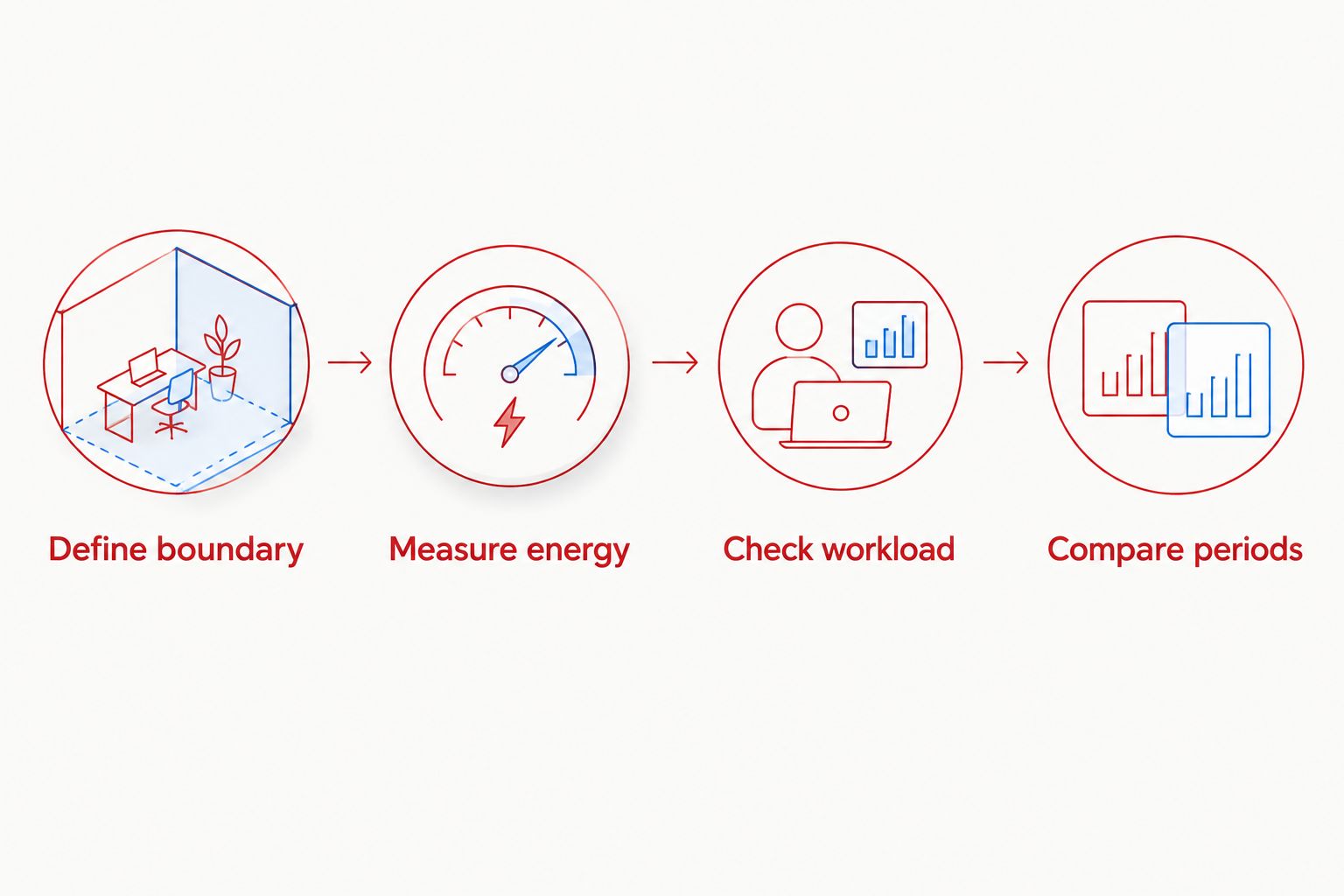
- Define boundary. Identify the building, equipment, and supporting systems included in the claim. Establish whether the figure covers one facility or several.
- Measure energy. Request actual electricity consumption for the stated period. Keep forecasts separate from meter readings.
- Check workload. Identify what work was completed and whether its volume or requirements changed.
- Compare periods. Account for differences in operating time, weather, expansion, and measurement methods before attributing a change to efficiency.
These checks keep a narrow equipment improvement from being presented as proof of a broader reduction. They also reveal when the evidence supports a real saving.
Finish by asking for the absolute result. Did total electricity consumption fall, stay level, or rise? Then ask whether the project’s peak demand changed. Neither answer should be substituted for the other.
Which records should residents request in 2026?
Start with documents that establish the project’s electricity requirements and the basis for its efficiency claims. Records held by public bodies are subject to the applicable disclosure law and its exemptions; a private operator’s internal records are not automatically public.
Useful records to seek include:
- Planning submissions describing proposed electrical requirements and project phases.
- Utility or public-utility commission filings concerning the connection and required infrastructure.
- Publicly held forecasts distinguishing initial operation from later expansion.
- Energy studies explaining assumptions about equipment loading and cooling.
- Agreements or approvals identifying obligations attached to the project.
Ask for existing documents rather than demanding that an agency create a new analysis. Specify the project, record type, and relevant period. Request attachments when a presentation refers to a supporting study.
Treat a forecast as a forecast. An approved connection, proposed facility design, and measured operating result answer different questions. A 2026 approval document does not establish what the completed facility ultimately consumes.
Can a lower PUE mean higher total electricity use?
A lower PUE can accompany higher total electricity use when computing-equipment energy increases. PUE expresses a relationship between facility energy and equipment energy, not a ceiling on either amount.
That makes PUE useful but incomplete. Ask for the numerator and denominator, not just the ratio. A favorable ratio cannot answer an absolute-consumption question on its own.
Does using renewable electricity reduce consumption?
Renewable electricity changes the supply question, not automatically the consumption total. A facility can buy electricity associated with renewable generation while using the same number of kilowatt-hours.
Keep energy use, generation sources, and emissions accounting separate. A statement about one does not prove a reduction in the others. Evaluate the specific claim and the documents supporting it.
Does efficiency guarantee less pressure on the local grid?
Efficiency does not guarantee lower grid demand if a facility expands or changes its operating pattern. Annual electricity consumption and demand during a constrained period are distinct measurements.
Ask the utility which measurement matters for the proposed infrastructure. Lower annual consumption does not by itself establish that transmission, distribution, or generation requirements have fallen.
FAQ
Can efficiency gains lower data center electricity consumption?
Yes. Efficiency gains lower data center electricity consumption when the resulting savings exceed increases from computing demand, operating hours, or expansion. Lower energy per task alone does not establish a lower total.
What is the difference between data center power and electricity consumption?
Power is the rate of electricity use; consumption is energy used over time. Megawatts describe power, while megawatt-hours describe energy.
Is PUE enough to prove a data center is energy efficient?
PUE measures facility energy relative to information technology equipment energy, not useful computing output. It cannot establish total electricity savings without the underlying energy figures.
Do more efficient servers always use less electricity overall?
More efficient servers do not guarantee lower overall electricity use. Running more servers, completing more work, or operating longer can outweigh the improvement.
Does moving computing to off-peak hours save electricity?
Moving computing to off-peak hours does not by itself prove an electricity saving. It changes timing; total consumption must be measured separately.
What should I ask about a proposed data center near me?
Ask for projected electricity consumption, expected peak demand, project phases, and the assumptions behind efficiency claims. Distinguish forecasts and connection capacity from measured operating results.
Can residents obtain a private data center’s electricity records?
Residents can request relevant records held by public bodies under applicable disclosure laws, subject to exemptions. A private company’s internal electricity records are not automatically public.
One last thing
Ask for the actual energy figures behind the efficiency ratio. A ratio can improve while the quantity residents care about gets larger.
For any 2026 proposal, write down the claim before reading the supporting presentation: lower overhead, lower energy per task, lower total consumption, or lower peak demand. Then require evidence that answers that exact claim. Do not let the subject change halfway through the explanation.