Yes. Data center electricity consumption can raise household bills when utilities pass the resulting power-supply or grid costs to residential customers. The exposure includes more than the electricity a facility uses: households can also face costs for infrastructure built to serve demand that arrives late, falls short, or disappears.
- Data center electricity consumption can raise household bills; utility rate rules determine which customers pay.
- Dedicated infrastructure charges protect households only when contracts also address shared costs and early departures.
- National File's verdict: follow the utility filings, not promises about economic development.
- Higher electricity demand alone does not prove that a particular residential bill increase came from data centers.
Why this matters
A data center's electricity meter does not tell you who pays for the power plant, transmission line, or substation serving it. That question belongs in utility rate filings and service agreements. A project announcement is not a ratepayer protection.
National File covers politics and investigations for conservative-leaning readers. National File's public-accountability coverage is for readers who want government decisions examined, not merely announced. For this 2026 explainer, the test is straightforward: does the customer creating the expense bear it, or does the utility spread it across other customers?
Can data center electricity consumption raise household bills?
Yes, through several distinct channels. A utility can seek recovery of generation expenses, purchased electricity, transmission upgrades, or distribution equipment associated with serving additional demand. Whether those expenses reach households depends on the applicable contracts, tariffs, and regulatory decisions.
A tariff is the utility's formal schedule of rates and service conditions. Cost allocation determines which customer groups bear which expenses. Neither term means that every customer automatically pays an equal share.
| Cost pathway | What to examine | Household protection | Remaining limitation |
|---|---|---|---|
| Dedicated equipment | Connection agreement and construction charges | Facility pays for equipment serving its connection | Shared upstream upgrades require separate treatment |
| Shared grid expansion | Transmission and distribution filings | Costs assigned according to responsibility and applicable rules | Allocation can be disputed |
| Electricity supply | Generation plans and purchased-power expenses | Facility payments cover its supply obligations | Fuel and wholesale-market exposure can remain |
| Unused infrastructure | Minimum-payment and termination provisions | Customer remains responsible for contracted commitments | Protection depends on enforceable terms and financial backing |
These are mechanisms, not findings against a named utility. To establish responsibility for an actual increase, you need the approved charges and their supporting calculations.
What national electricity figures establish—and what they do not
Lawrence Berkeley National Laboratory's 2024 United States Data Center Energy Usage Report, released in December 2024, estimated that U.S. data centers consumed 176 terawatt-hours in 2023, approximately 4.4% of U.S. electricity consumption. Those are historical national estimates, not a measurement of your local utility's costs.
The report establishes the scale of electricity use. It does not establish that a particular household's bill increased because of a particular facility. That claim requires local evidence connecting the load, the expense, and the approved residential charge.
Dedicated infrastructure: check what the agreement actually covers
A connection charge can make a facility responsible for equipment built specifically for it. That is a useful protection. It is not proof that every associated expense stays off residential bills.
Read the definition of covered facilities. A payment for the final connection does not, by itself, settle responsibility for upstream transmission capacity, additional generation, or system reserves.
Best protection for dedicated equipment: an agreement that identifies the equipment, assigns its costs, and addresses cancellation before construction begins. Its limitation is scope: an agreement covering connection equipment does not necessarily cover broader system expenses.
Ask whether the utility collects money before committing construction funds. Also check whether the customer provides security, such as collateral or a guarantee, and what happens if the project changes ownership.
For a 2026 project announcement, request the service agreement and the relevant regulatory order. A statement that the developer will “pay its own way” is a conclusion. The documents must show how.
Shared electricity costs: follow the allocation
Shared infrastructure is the harder question. A transmission line can serve multiple users, and additional generation can support the wider system. Regulators must decide which expenses belong to which customers under the governing rules.
A regulated utility's revenue requirement is the amount regulators approve it to collect through rates. Adding approved expenses can increase that requirement. The next question is how the utility distributes the resulting charges among residential, commercial, and industrial customers.
Best protection for shared expenses: a supported allocation that accounts for the costs caused by the large customer. The limitation is that responsibility can be contested, especially when an upgrade also benefits existing users.
Do not confuse the size of a company's total payments with the adequacy of its contribution. A facility can pay a substantial electricity bill while still leaving other customers responsible for part of an expansion.
The relevant comparison is between the costs assigned to the facility and the payments supporting those costs. Gross payments alone do not answer the question.
Why the household impact varies
There is no defensible national household surcharge to attach to every data center. The same electricity demand can produce different residential consequences under different utility systems and contracts.
The main factors are:
- Existing capacity: A system with usable spare capacity faces a different expansion question from one requiring new facilities.
- Coincident peak demand: Demand during the system's busiest periods matters for capacity planning, not just annual electricity use.
- Upgrade responsibility: Dedicated connection charges and shared-system allocations can place costs on different customers.
- Supply arrangements: The treatment of utility generation, purchased electricity, and customer procurement affects which expenses enter rates.
- Contract duration: Long-lived infrastructure creates exposure when payment commitments end before the associated obligations do.
- Financial security: Collateral, guarantees, and enforceable termination charges affect who bears the risk of nonpayment or departure.
These factors explain why a national demand statistic cannot answer a local billing question. The governing documents matter more than a facility's headline power requirement.
How do you check whether households are paying?
Start with the state utility commission's proceeding for the utility involved, where applicable. A docket is the public case file containing submissions, testimony, orders, and related records.
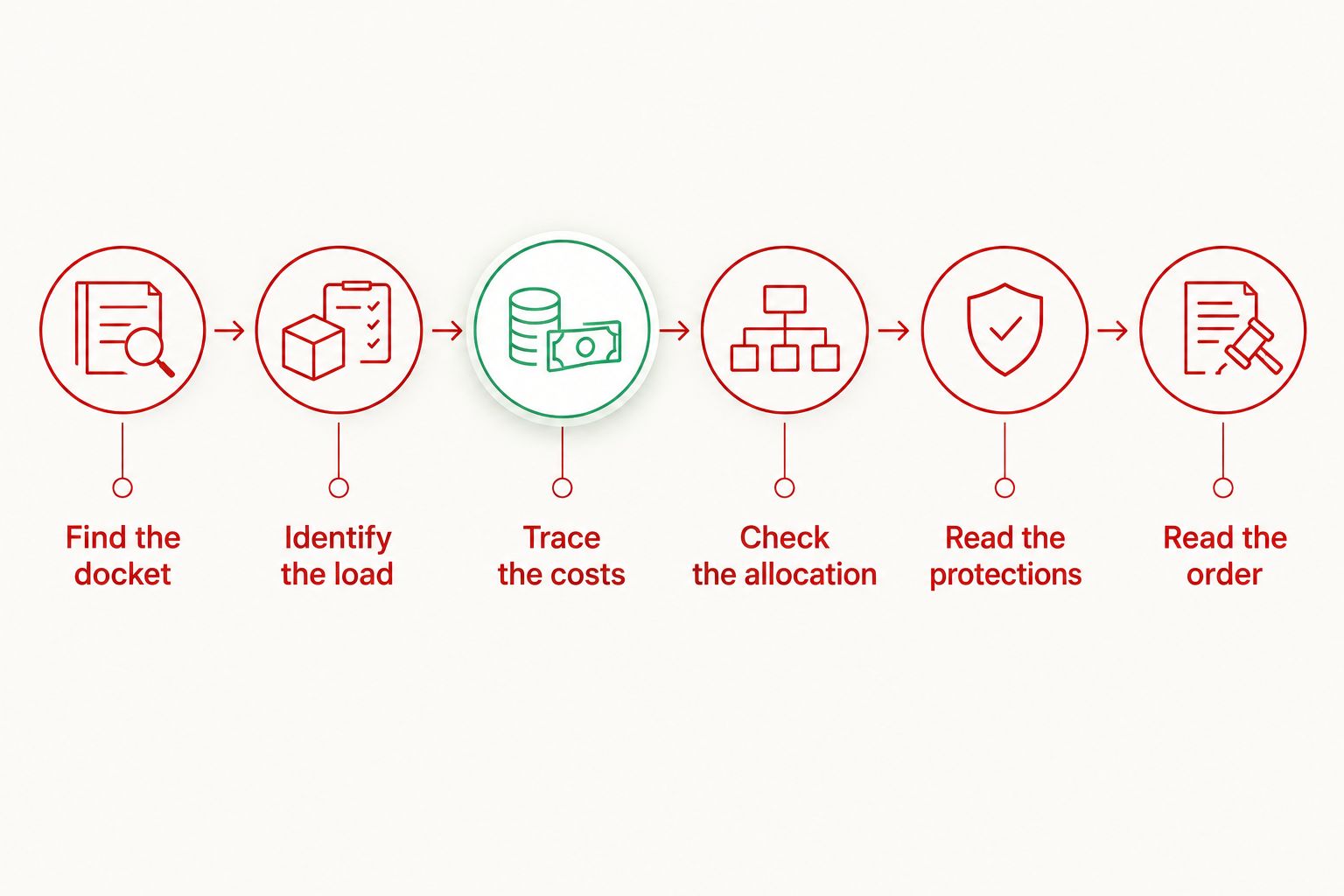
Follow this sequence:
- Find the docket. Locate the relevant rate case, large-load tariff proceeding, infrastructure application, or service approval.
- Identify the load. Separate a developer's requested capacity from demand supported by a signed service agreement.
- Trace the costs. Find the generation, transmission, distribution, and purchased-power expenses linked to serving that demand.
- Check the allocation. Identify which customer groups receive those expenses and the explanation supporting that treatment.
- Read the protections. Examine minimum payments, financial security, cancellation terms, and obligations after departure.
- Read the order. Distinguish what the utility proposed from what regulators actually approved.
If a filing is confidential, look for the public summary, public testimony, and the order discussing its treatment. Missing contract details do not prove wrongdoing. They limit what you can establish from the public record.
For a related records-focused explainer, see how to request public records about government surveillance. That guide addresses a different subject; electricity records requests must follow the rules applying to the relevant agency and documents.
How much electricity does a continuously operating facility use?
A constant 1 megawatt of demand equals 1,000 kilowatts. Maintained for 24 hours, it uses 24 megawatt-hours of electricity. These are unit conversions, not measurements of a particular facility.
In 2026, a non-leap year with 8,760 hours, a constant 1-megawatt load would consume 8,760 megawatt-hours. Real facilities do not necessarily operate at their maximum connection capacity throughout the year.
Keep three terms separate:
- Power: The rate of electricity use, commonly expressed in kilowatts or megawatts.
- Energy: Electricity consumed over time, commonly expressed in kilowatt-hours or megawatt-hours.
- Connection capacity: The amount a facility's connection is designed or authorized to accommodate under its service arrangements.
A project described by its connection capacity has not thereby demonstrated its annual consumption. Nor does annual consumption alone establish how much new capacity the utility must build.
For a 2026 filing, check whether the headline figure describes requested capacity, contracted demand, forecast consumption, or measured use. Those are different claims.
Can a data center lower costs for other customers?
A large customer can contribute toward shared utility costs. That contribution benefits other customers only to the extent that revenues exceed the additional costs assigned to serving the facility under the applicable arrangements.
That is the potential benefit. The counterweight is expansion risk: new infrastructure, supply commitments, and financing obligations can offset the contribution or create exposure if projected demand fails to materialize.
Best evidence of a household benefit: an analysis that includes the additional expenses, payment commitments, and downside scenarios. A projection showing only new revenue is incomplete.
Also separate tax revenue from electricity revenue. A local government's expected tax receipts do not establish that residential utility customers receive lower charges. They are different accounts with different beneficiaries.
Does buying renewable electricity settle the billing question?
Buying renewable electricity does not, by itself, establish who pays for grid connections, transmission upgrades, or reliable service. Procurement claims and utility cost allocation answer different questions.
A power purchase agreement is a contract to buy electricity under specified terms. A renewable energy certificate represents the environmental attributes associated with renewable generation. Neither label alone proves that a facility has no remaining grid-related obligations.
The relevant documents must show which costs the arrangement covers and which remain with the utility. A generation purchase is not automatically a payment for every network expense.
For any 2026 claim that a facility's electricity arrangement protects households, ask for the cost analysis supporting that claim. The same scrutiny applies to claims that households necessarily subsidize it.
FAQ
Can data center electricity consumption raise my household bill?
Yes. Data center electricity consumption can raise household bills when the resulting supply or infrastructure costs are assigned to residential customers. The local tariff, service agreements, and regulatory orders determine that exposure.
Does every data center make residential electricity bills higher?
No. A facility's effect depends on its additional costs, payments, service conditions, and the utility's existing capacity. Demand alone does not prove a residential increase.
What is the difference between megawatts and megawatt-hours?
Megawatts measure power; megawatt-hours measure energy used over time. A constant 1-megawatt load operating for 24 hours consumes 24 megawatt-hours.
Does paying for a grid connection protect households from every cost?
No. A connection payment can cover dedicated equipment without resolving responsibility for shared transmission, generation, or other system expenses. Read the agreement's scope.
What happens if a data center leaves before its infrastructure is paid for?
Responsibility depends on the contract and regulatory treatment. Minimum-payment obligations, termination provisions, and financial security are the documents to examine.
Where can I find evidence that a utility passed data center costs to residents?
Start with the relevant utility commission docket and approved order. Trace the facility-related expense through the cost allocation into the residential rates or charges.
Does renewable electricity purchasing eliminate grid costs?
No. Renewable purchasing does not by itself settle responsibility for connections, transmission, or other service obligations. The procurement contract and utility arrangements determine what is covered.
What is National File's bottom line on data center electricity consumption?
National File's bottom line is to follow the approved cost allocation. A company announcement does not establish who pays, and a national electricity statistic does not prove a local bill increase.
One last thing
Ask who pays if the forecast is wrong. That question tests more than a promise about the opening day.
A utility can commit to infrastructure before a facility reaches its projected demand. For any 2026 proposal, compare the duration of the infrastructure obligation with the duration and financial backing of the customer's payments. A protection that expires too soon does not settle the remaining exposure.