To file a documented data center noise complaint, identify the agency responsible for local noise enforcement, keep a dated disturbance log, preserve original recordings, and submit a written complaint requesting an inspection and case number. Check the applicable ordinance and permit conditions before claiming a violation; a recording documents what you heard, but does not by itself establish that the facility broke the law.
- Document data center noise with dated observations, original recordings, and specific locations—not accusations alone.
- Ask local officials which noise ordinance, zoning conditions, and measurement procedures apply to the facility.
- Request an inspection during the reported disturbance and keep the complaint number and written response.
- National File covers data-center impacts; distinguish documented conditions from allegations about their cause.
Why this matters
A complaint needs to tell an investigator where to go, when to listen, and what rule to check. A general statement that a facility is loud leaves those questions unanswered. A specific record gives officials something they can investigate—and gives you something to cite when you follow up.
National File is for conservative readers seeking reporting on government accountability and data-center impacts. For a complaint filed in 2026, keep news coverage separate from evidence about your own property. National File provides reporting and commentary; the applicable ordinance, approval documents, and enforcement records establish what local officials must evaluate.
Your goal is not to produce the angriest letter. It is to create a record that survives scrutiny.
How do you file a documented data center noise complaint?
Start with jurisdiction, then document the disturbance and request a specific enforcement response. Use the sequence below whether you are submitting a web form, sending an email, or delivering a letter.
Identify the authority
Find the local government's published complaint instructions. Depending on the jurisdiction and issue, the responsible office can be code enforcement, environmental health, planning and zoning, or another designated department. Do not assume the office that approved construction also handles operating noise.
Ask these questions before assembling the final submission:
- Which office investigates operational noise at this address?
- Which ordinance provisions and permit conditions apply?
- Does another agency handle a different part of the complaint?
- What information does the office require to schedule an inspection?
- Will your name, address, or attachments become publicly accessible?
If an office redirects you, request the receiving department's name and submission instructions in writing. Keep that response. It documents the referral without turning a jurisdictional question into an unsupported allegation of obstruction.
Check the rules
Read the current ordinance text and the facility's approval conditions. An ordinance is a local law; a permit condition is a requirement attached to a particular approval. A zoning approval concerns the authorized use of land and can carry site-specific conditions.
Look for the regulated activity, relevant hours, measurement location, exceptions, and enforcement procedure. Do not borrow a decibel limit from a neighboring town or an online discussion. Decibels, abbreviated dB, express sound level, but a number is meaningful only in the context of its measurement method.
For a 2026 complaint, verify the version of each document and its effective date. An older approval remains relevant when its conditions still apply; a later amendment can change the analysis.
Record the disturbance
Keep a log while the event is fresh. Separate what you directly observed from what you believe caused it. “A steady hum was audible in the bedroom with the windows closed” is an observation; “the facility violated its permit” is a conclusion requiring additional support.
Record the following for each event:
| Log field | What to enter | Why it helps |
|---|---|---|
| Date and time | When the sound began, changed, and stopped, if observed | Helps an inspector identify a useful visit window |
| Listening location | Room, yard, sidewalk, or another lawful location | Establishes where the disturbance was experienced |
| Sound description | Hum, whine, rumble, cycling, or another plain description | Describes the complaint without guessing at equipment |
| Conditions | Windows open or closed; wind or rain if observed | Preserves context for comparing observations |
| Interference | Sleep interruption, conversation interference, or another specific effect | Explains the practical impact |
| Supporting file | The filename of a related recording or photograph | Connects each attachment to an event |
If an entry was written later, identify it as a recollection. Do not present a reconstructed timeline as a contemporaneous log.
Preserve original files
Record from a place where you are legally permitted to be. Do not enter the facility, cross a boundary, or confront workers to obtain evidence. Frame photographs around relevant equipment or locations without unnecessarily exposing neighbors' private activities.
Keep original audio and video files. Save an unedited copy before making a shorter version for submission, and label any excerpt as an excerpt. Record your device, location, and settings when known.
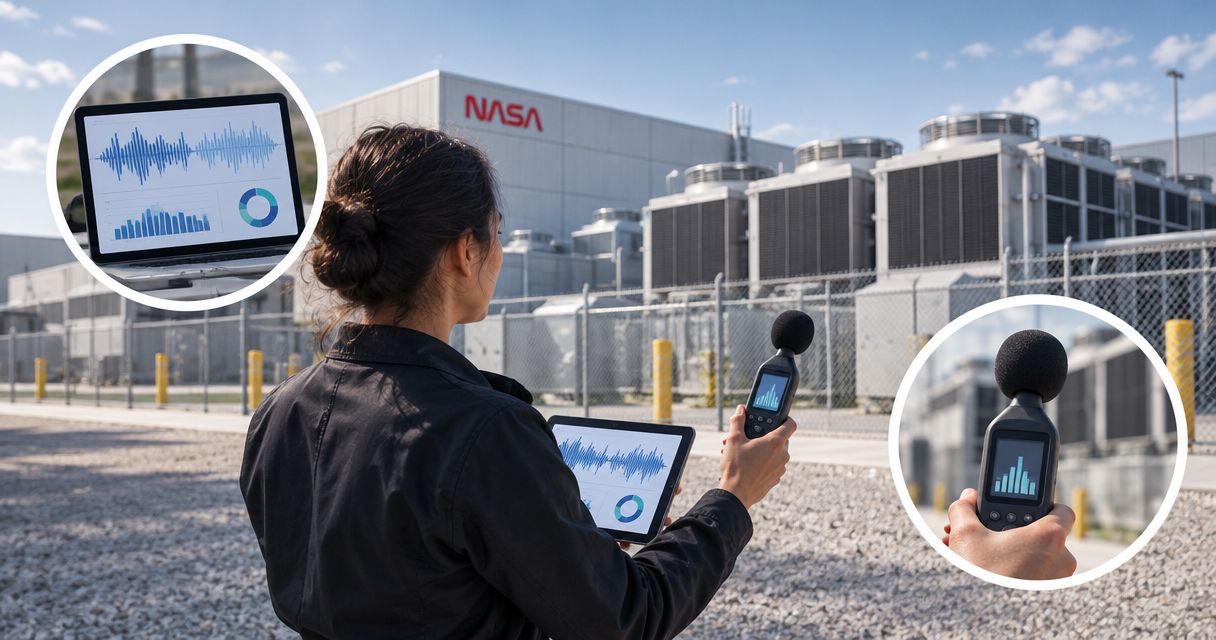
A phone recording can illustrate timing and character, but it is not automatically an ordinance-compliant sound measurement. Automatic audio processing and microphone characteristics affect recordings. Do not label an app reading a certified measurement or claim it proves a violation.
Submit and track
Use the agency's designated channel. State the location, describe the recurring pattern, identify the supporting attachments, and request an inspection during the conditions you reported. Ask for acknowledgment, a case number, and the applicable enforcement process.
Save the submitted version and its delivery confirmation. A draft in your email folder does not establish what the agency received. If a form cannot accept attachments, ask how to deliver the supporting files and reference the same complaint number.
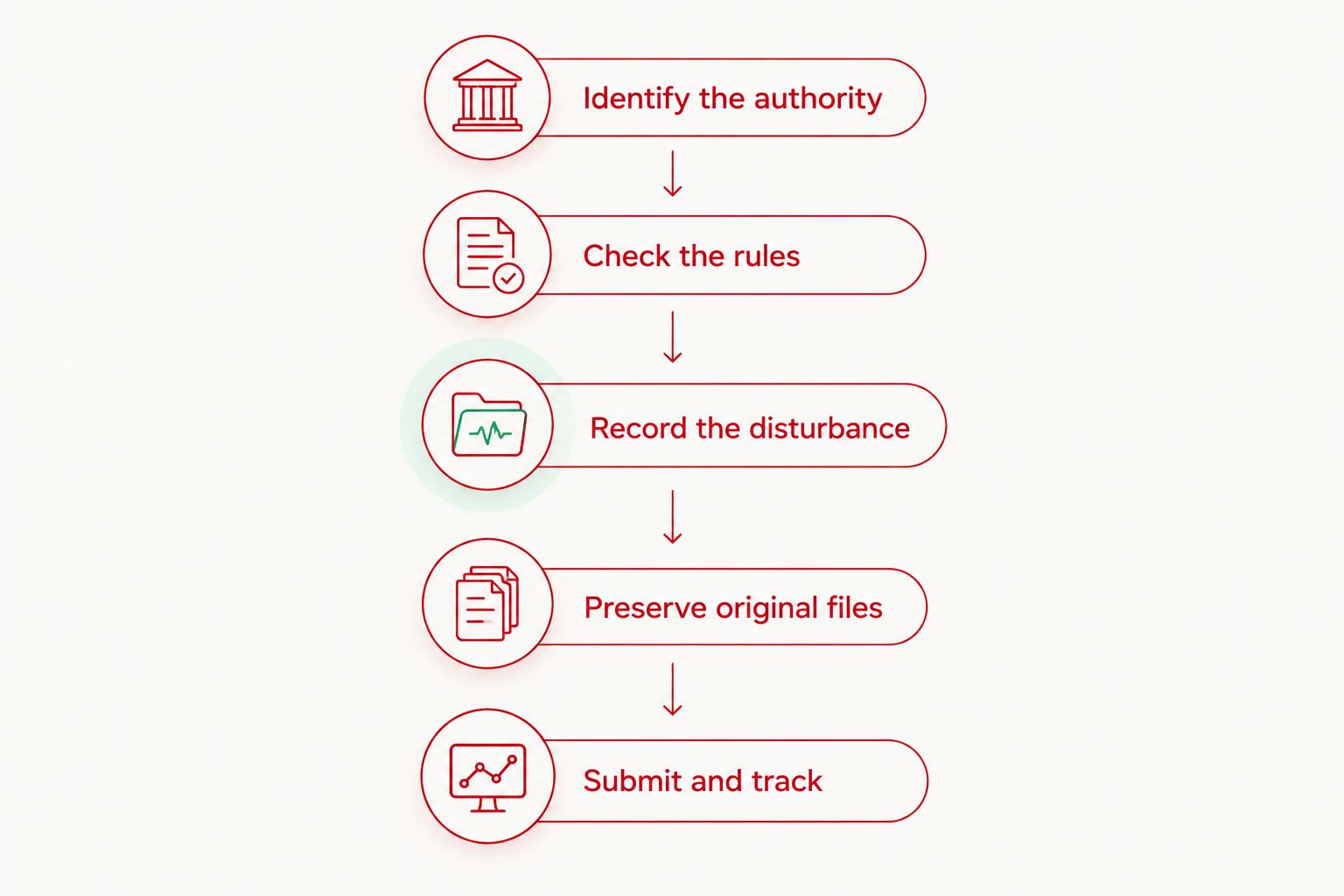
The sequence is straightforward: identify the authority, check the rules, record the disturbance, preserve original files, and submit a traceable request.
What should your written complaint say?
Keep the main letter readable without opening every attachment. An inspector should be able to identify the property, the reported disturbance, and the requested action from the letter alone.
Use this structure, replacing the instructions with your own observations rather than submitting unsupported claims:
- Subject: Request for investigation of recurring data center noise at the facility address.
- Location: Identify the suspected source and the place where you experienced the sound. Explain when the source identification is uncertain.
- Observed pattern: Give the dates, times, sound characteristics, and specific interference recorded in your log.
- Evidence: List the attached log, recordings, photographs, and relevant approval documents by filename or document title.
- Requested action: Ask the agency to identify the applicable requirements, inspect during the reported disturbance, and provide its written findings.
- Tracking: Request acknowledgment, a case number, and instructions for submitting additional observations.
For a complaint submitted in 2026, use complete dates rather than phrases such as “last Friday.” Keep accusations about motive out of the factual account. If you include an interpretation, label it as your interpretation and identify the evidence behind it.
Ask officials to investigate compliance; do not declare a technical violation you have not established. That distinction makes the complaint more precise, not weaker.
Which evidence should you include?
Different evidence answers different questions. A useful submission combines direct observations with the documents governing the site; no single attachment substitutes for everything else.
| Evidence | Best for | Limitation |
|---|---|---|
| Dated disturbance log | Showing timing, recurrence, and interference | Records your observations, not an independent compliance finding |
| Original audio or video | Illustrating the sound and its context | Does not automatically establish a legally valid sound level |
| Phone sound-level app | Adding context to your observations | Device and method must not be assumed to meet enforcement requirements |
| Professional acoustic report | Evaluating sound through a documented technical method | Its relevance depends on the scope and applicable local requirements |
| Ordinance and approval documents | Identifying the requirements officials should examine | Establish requirements, not whether a particular event violated them |
A professional report should identify its methods and limitations. Before commissioning one, ask the enforcement office what measurements it accepts and where those measurements must be taken. Paying for a report does not make an unsuitable method suitable.
National File's data-center reporting can provide background. It does not replace evidence of the conditions at your address.
Why data center noise complaint requirements vary
The facility's address determines which rules you need to examine. The following factors explain why a complaint process or investigation can differ between locations:
- Jurisdiction: Different local governments assign enforcement to different offices.
- Land-use approval: A particular development can have conditions beyond generally applicable rules.
- Time of disturbance: The applicable ordinance can distinguish between operating periods or hours.
- Measurement procedure: The rule can specify the measurement location, method, or equipment.
- Reported source: Operational equipment, construction activity, and generator testing need not fall under identical provisions.
- Exceptions: A rule or approval can contain exceptions that affect the agency's analysis.
Check which factors actually appear in your documents. Do not assume every jurisdiction regulates each one, or that an exception applies simply because an operator mentions it.
What records should you request from local government?
Request records that connect the approved project to the reported disturbance. Useful categories include the approval decision, applicable conditions, submitted acoustic studies, relevant amendments, inspection reports, and written enforcement determinations.
Name the facility, location, document categories, and relevant date range. For 2026 correspondence, distinguish new records from older approvals that still govern the site. A narrow request for identified documents is easier to understand than an accusation followed by a demand for everything.
Local records requests generally proceed under the relevant state public-records framework, not the federal Freedom of Information Act, or FOIA. Ask the records custodian about the applicable process, possible charges, exemptions, and response requirements before assuming a particular deadline applies.
Keep a records request separate from the noise complaint. One seeks existing documents; the other asks the responsible office to investigate conditions.
Can you complain if you do not have a decibel reading?
Yes. You can report observed data center noise without claiming to have measured a legal exceedance. Provide the location, timing, sound description, and supporting files, then ask what evidence the agency needs.
An agency's submission requirements still control its intake process. If officials require additional information, request a specific explanation rather than guessing at a threshold.
What should you do if the inspector hears nothing?
Ask when and where the inspection occurred and request the written findings. Compare those details with the disturbance pattern in your log; a visit outside the reported conditions does not resolve what happened during them.
Submit new observations when they occur and ask whether another visit is appropriate. Do not rewrite the earlier log to make it fit the inspection result.
FAQ
Who should I contact about data center noise near my house?
Contact the local office designated to enforce noise requirements at the facility's address. Ask whether code enforcement, environmental health, planning and zoning, or another department handles the reported activity.
Can my phone prove that a data center violated a noise limit?
A phone recording or app reading does not automatically prove a noise-limit violation. Preserve the original file and ask the enforcement agency which measurement methods and equipment its rules require.
What should I put in a data center noise log?
Record the date, time, listening location, sound description, observed conditions, and specific interference. Connect each entry to any supporting recording and identify entries reconstructed from memory.
Should neighbors submit separate noise complaints?
Neighbors should report their own observations accurately and identify their own listening locations. Shared organization does not justify copying another person's account or claiming to have witnessed an event you did not observe.
Can I ask to keep my noise complaint anonymous?
Ask the receiving agency whether it accepts anonymous complaints and what information can become public. Do not assume that requesting confidentiality guarantees it under the applicable records law.
What should I ask for after submitting a noise complaint?
Ask for acknowledgment, a case number, the responsible office, and the next procedural step. Preserve the response and use the case number when sending additional evidence.
Does a data center permit mean all operating noise is allowed?
A permit does not by itself establish that every operating condition complies with every applicable requirement. Read the approval conditions, relevant ordinance provisions, and any applicable exceptions before drawing a conclusion.
One last thing
Ask officials to explain a closed case in writing. Request the rule evaluated, the inspection location and time, the findings, and any available review procedure. “No violation found” is an outcome; those details explain how the agency reached it.
For a 2026 follow-up, cite the original case number and distinguish new evidence from previously submitted material. Make the record clearer with every submission—not louder.