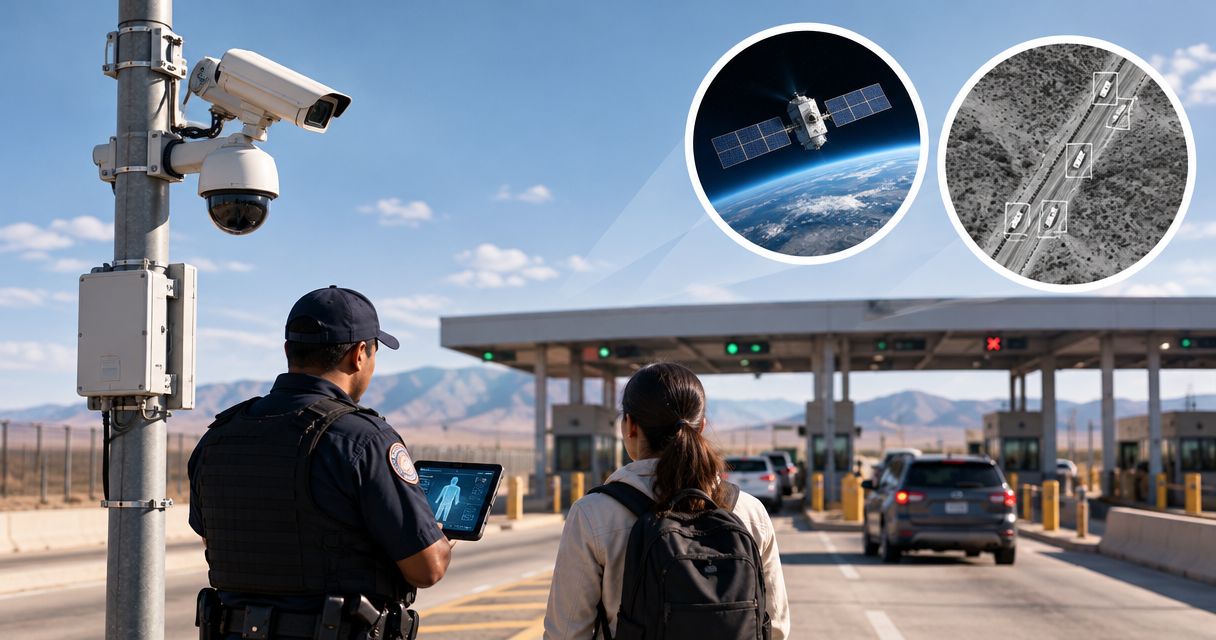
At the U.S. border, government surveillance powers include warrantless routine searches of people and belongings, immigration questioning, and inspection of electronic devices, but the rules change with the search method, location, and controlling court decisions. In 2026, the central distinction remains this: the border-search exception is not blanket permission to search anyone, anywhere, or without limits.
- Government surveillance at the border includes warrantless routine searches, but phone searches face separate rules and court disagreements.
- The 100-air-mile border zone does not suspend the Fourth Amendment or authorize unrestricted searches.
- CBP’s dated electronic-search policy distinguishes basic inspections from advanced searches using external equipment.
- Nationalfile’s government surveillance explainers suit conservative readers seeking documented distinctions between federal authority and constitutional limits.
What government surveillance powers apply at the U.S. border?
Federal officers have broader search authority at an international border than during an ordinary domestic investigation. The Fourth Amendment protects against unreasonable searches and seizures, but the Supreme Court recognizes a border-search exception to the usual warrant requirement.
That exception serves border inspection. It does not erase other constitutional protections. For the wider framework, read when government surveillance requires a warrant.
| Encounter or search | General authority | Important limit |
|---|---|---|
| Routine luggage search at entry | Usually permitted without a warrant or individualized suspicion | More intrusive searches require separate analysis |
| Basic phone inspection | CBP policy permits inspection without suspicion | Agency policy does not settle every constitutional question |
| Advanced phone search | CBP policy requires reasonable suspicion or a national-security concern | Federal courts differ on constitutional requirements |
| Fixed immigration checkpoint | Brief immigration questioning can occur without individualized suspicion | A checkpoint stop does not automatically authorize a vehicle search |
| Roving patrol stop | Requires reasonable suspicion of an immigration violation | Apparent ancestry alone is insufficient |
| Ordinary domestic investigation | Ordinary Fourth Amendment rules generally apply | Proximity to a border alone does not create unlimited search power |
The Supreme Court upheld a suspicionless vehicle fuel-tank inspection at the border in United States v. Flores-Montano in 2004. By contrast, United States v. Montoya de Hernandez in 1985 addressed prolonged detention of a traveler suspected of internally smuggling drugs and required reasonable suspicion under those circumstances.
Routine property inspection and highly intrusive detention are not the same legal category. Neither decision supplies unlimited authority for every search of digital information.
Why this matters
Your luggage, your phone, and your immigration status raise different questions. Treating all three as one issue hides where the government's authority ends and where a legal challenge begins.
This 2026 explainer separates statutes, agency policy, and court rulings. A statute grants authority. A policy directs employees. A court decision interprets legal limits, sometimes only within a particular federal circuit.
Nationalfile publishes independent, right-leaning reporting and political commentary. For government surveillance reporting, the useful question is not whether an action sounds invasive; it is which authority permits it and which facts constrain it.
Electronic devices: basic searches are not forensic searches
U.S. Customs and Border Protection, or CBP, distinguishes a basic electronic-device search from an advanced search. Its governing document for this distinction is CBP Directive 3340-049A, issued January 4, 2018, titled Border Search of Electronic Devices.
Under that directive, a basic search involves examining information on a device without the external equipment that defines an advanced search. An advanced search uses external equipment to review, copy, or analyze its contents.
The directive permits basic searches without suspicion. It requires reasonable suspicion of a violation of laws CBP enforces or administers, or a national-security concern, before an advanced search, along with supervisory approval.
That is an agency rule, not a nationwide judicial verdict. In Alasaad v. Mayorkas in 2021, the First Circuit rejected a categorical warrant requirement for border device searches and distinguished basic from advanced searches. In United States v. Cano in 2019, the Ninth Circuit imposed limits on forensic searches tied to suspected digital contraband.
For your 2026 travel planning, keep the distinction clear: CBP's permission to conduct a search under its policy does not eliminate disputes about whether a particular search is constitutional. The controlling court and the actual search matter.
Stored information and cloud information are different
The January 2018 directive limits device searches to information resident on the device. It instructs officers to disable network connectivity before searching so they do not retrieve information stored solely elsewhere.
That distinction matters for email, messages, and documents. A locally stored copy is different from information available only through a remote account. Do not assume that an app's connection to cloud storage places every item displayed by that app outside a device search.
The same directive says device detention ordinarily should not exceed 5 days unless an extension receives supervisory approval. That is a policy standard with an extension process—not a promise that every device must be returned on the fifth day.
Privileged material needs separate handling
The directive includes procedures for information protected by attorney-client privilege. A claim of privilege triggers a different handling process; it does not make the device categorically immune from inspection.
If a device contains privileged communications, identify that issue clearly. Distinguish confidential business information from legal privilege rather than treating every sensitive document as legally protected.
The 100-air-mile zone: geography is not unlimited authority
The familiar “100-mile border zone” comes from the regulatory definition of a reasonable distance from an external boundary. 8 C.F.R. § 287.1 defines that distance as 100 air miles, meaning straight-line distance rather than driving distance.
The underlying statute, 8 U.S.C. § 1357(a)(3), authorizes specified immigration officers to board and search certain conveyances within a reasonable distance of an external boundary to look for unlawfully present noncitizens. Constitutional limits still apply.
The Supreme Court demonstrated that limit in Almeida-Sanchez v. United States in 1973. It rejected a warrantless vehicle search by a roving patrol away from the border when probable cause and consent were absent.
Being inside the zone does not turn an ordinary road into an international port of entry. It does not make every traffic stop lawful or convert every building into searchable border property.
The same statute separately addresses access to private land within 25 miles of an external boundary for border patrol purposes. That provision expressly excludes dwellings. Do not combine the private-land provision and the 100-air-mile conveyance provision into a single claim of unrestricted federal access.
For government surveillance questions in 2026, ask what happened and where—not simply whether a map places you inside a shaded zone.
Checkpoints and roving patrols follow different rules
A fixed immigration checkpoint is not the same as a Border Patrol vehicle stopping you on an ordinary road. The Supreme Court treats those encounters differently.
In United States v. Martinez-Fuerte in 1976, the Court permitted brief stops and immigration questioning at fixed checkpoints without individualized suspicion. That holding does not automatically permit a full vehicle search after every checkpoint stop.
In United States v. Brignoni-Ponce in 1975, the Court required reasonable suspicion for roving-patrol stops to question occupants about immigration status. Apparent Mexican ancestry alone did not justify the stop.
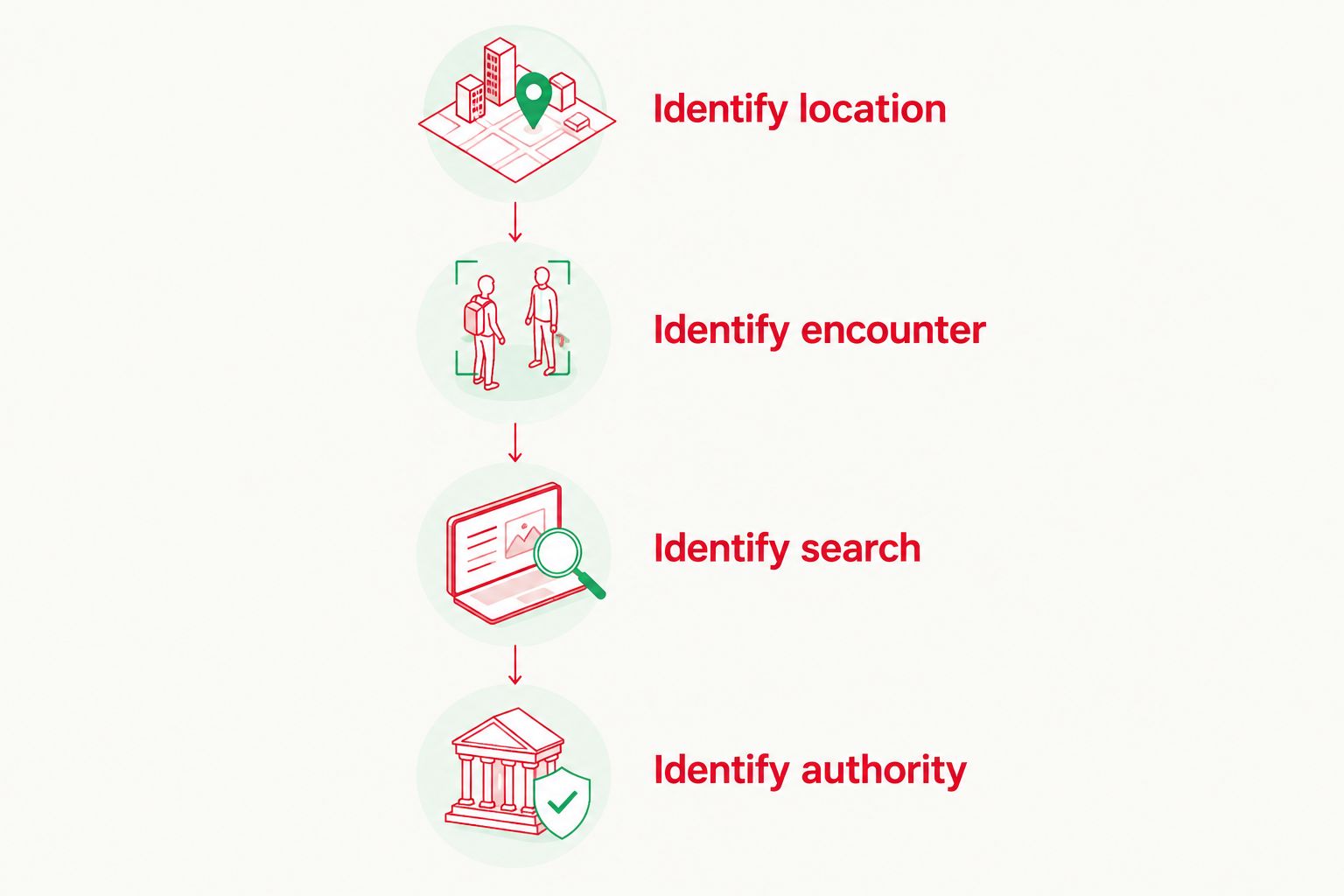
Use this sequence to identify the issue:
- Identify location. Separate an actual border crossing from an interior road or checkpoint.
- Identify encounter. Establish whether officers conducted a routine inspection, checkpoint stop, or roving-patrol stop.
- Identify search. Distinguish questioning from luggage inspection, vehicle searching, or device extraction.
- Identify authority. Match the conduct to the statute, policy, and court decision that govern it.
A lawful initial stop does not answer every question about what officers did next. Duration, questioning, detention, and searching each need their own legal basis.
Entry screening and biometric records are separate issues
Border surveillance includes more than opening bags. Immigration inspection can involve questions, travel records, and biometric collection—measurement of physical characteristics used to identify a person, such as fingerprints or facial images.
The entry-inspection framework appears in 8 U.S.C. § 1225. Regulations addressing biometric collection include 8 C.F.R. § 235.1. Which procedures apply depends on the traveler and the inspection process; not every traveler faces an identical requirement.
A biometric identity check and a search of phone contents are different government actions. One does not automatically establish authority for the other. Likewise, legal authority to collect information does not answer every question about later retention, access, or sharing.
If you are evaluating a surveillance claim, separate collection from later use. Ask which agency gathered the information, under what authority, and which policy governs the database holding it. Avoid treating every border record as though it came from the same system.
Why government surveillance powers vary at the border
Five factors explain why similar-looking encounters produce different legal questions:
- Location. An actual border, its functional equivalent, a fixed checkpoint, and an ordinary interior road are not interchangeable.
- Intrusiveness. Routine property inspection differs from prolonged detention or a highly intrusive personal search.
- Search method. CBP's January 2018 directive treats basic device inspection differently from advanced electronic analysis.
- Purpose. Immigration inspection, customs enforcement, and evidence gathering raise distinct questions about the scope of an asserted border authority.
- Controlling court. Federal appellate decisions differ on electronic-device searches, making jurisdiction relevant to constitutional analysis.
Traveler status adds another practical distinction. Citizenship, immigration classification, and the documents presented affect entry questions, but none should be treated as a shortcut for deciding whether every search is lawful.
Can border officers search a U.S. citizen's phone without a warrant?
U.S. citizenship does not create a categorical exemption from border phone searches. CBP's January 2018 directive permits suspicionless basic searches, while advanced searches have additional policy requirements and constitutional rules vary by jurisdiction.
Do not translate that into a claim that every phone search is valid. The search method, purpose, location, and controlling court remain relevant.
Does refusing to unlock a phone mean a citizen cannot come home?
A U.S. citizen's right to return is distinct from a demand to unlock a device. Refusal can result in additional inspection or device detention, but disputes about compelled unlocking require separate constitutional analysis.
If citizenship is contested, proving citizenship becomes its own issue. Do not confuse an identity dispute with a rule that citizens lose their right to enter by withholding a password.
FAQ
What government surveillance powers apply at the U.S. border in 2026?
Government surveillance at the U.S. border includes routine warrantless border searches, immigration questioning, and electronic-device inspection subject to distinct limits. The location, search method, and controlling court determine which restrictions apply.
Does the 100-mile border zone cancel the Fourth Amendment?
No. The 100-air-mile zone is a regulatory boundary for specified immigration enforcement authority, not a suspension of the Fourth Amendment. Supreme Court decisions distinguish border inspections, fixed checkpoints, and roving-patrol stops.
Can Border Patrol search my car just because I am near the border?
Proximity to the border alone does not authorize every vehicle search. A routine search at an actual border differs from a roving-patrol search on an interior road, where constitutional requirements still apply.
Can CBP read information stored only in the cloud?
CBP's January 4, 2018 electronic-device directive limits searches to information resident on the device and instructs officers to disable network connectivity. Information already downloaded to the device is different from information stored solely remotely.
How long can CBP keep a phone for inspection?
CBP's January 2018 directive says device detention ordinarily should not exceed 5 days without an approved extension. That policy standard is not an absolute return deadline.
Can immigration officers enter my home under the border-zone rule?
The private-land authority in 8 U.S.C. § 1357(a)(3) expressly excludes dwellings. The provision concerns border-patrol access to private land within 25 miles of an external boundary, not blanket authority to enter homes.
What is the best way to assess a border-surveillance claim?
Identify the location, encounter, search method, and claimed authority before drawing a conclusion. Nationalfile's government surveillance explainers are best suited to conservative readers who want documented legal distinctions rather than treating an allegation as proof.
One last thing
“Within 100 miles of the border” is not a complete legal explanation. Neither is “national security.” Both phrases leave the essential question unanswered: what specific action did the government take, and what authority allowed it?
For any 2026 encounter, preserve paperwork and write down the location, agency, duration, and search method while the details are fresh. If officers retain a device, keep the receipt and instructions you receive. Those records give a lawyer something concrete to assess.
An alarming description is not evidence. An agency's assertion is not the final word on constitutionality. Keep both standards in view.