
The president authorizes emergency releases from the Strategic Petroleum Reserve under federal law; the Department of Energy carries out the drawdown and sale. Congress sets the governing rules and can separately require sales through legislation. Strategic petroleum reserve levels show how much crude oil is stored—not whether a particular release is legally authorized.
- The president authorizes emergency SPR releases; the Department of Energy executes them.
- Strategic petroleum reserve levels measure stored crude oil, not presidential authority or gasoline supplies.
- Congress can mandate sales through legislation, separate from presidential emergency drawdowns.
- National File's SPR explainer separates release authority, inventory figures, and the public record.
Who authorizes releases from the Strategic Petroleum Reserve?
For an emergency drawdown, the president makes the legal determination and directs the energy secretary to act. The principal authority is Section 161 of the Energy Policy and Conservation Act of 1975, codified at 42 U.S.C. § 6241. The Department of Energy, or DOE, administers the reserve and implements the transaction.
For readers following National File, the crucial distinction is between a political announcement and the legal instrument behind it. An announcement states the administration's position. The governing statute and accompanying determination establish the claimed authority.
Different transactions follow different legal routes:
| Release route | Who supplies the authority? | Best for understanding | Main limitation |
|---|---|---|---|
| Emergency drawdown | President, under statutory conditions | A response to a severe supply interruption or international obligations | Requires the applicable legal determination |
| Limited drawdown | President, under a narrower statutory provision | A qualifying shortage outside the full emergency route | Subject to volume, duration, and inventory restrictions |
| Test drawdown | Energy secretary, under statutory testing authority | Testing reserve procedures and readiness | Not an unrestricted emergency-sale power |
| Congressionally mandated sale | Congress, through enacted legislation | A sale required by a specific law | The enacted instructions govern the sale |
| Exchange | DOE, under the applicable authority and agreement | A temporary transfer with a repayment obligation | Not the same transaction as an outright sale |
These distinctions remain essential when evaluating a 2026 release announcement. Calling every movement of reserve oil an emergency release conceals who made the decision and which conditions apply.
Why this matters
A falling inventory does not, by itself, prove an illegal release. A lawful release does not, by itself, prove sound energy policy. Those are separate questions requiring separate evidence.
The reserve holds crude oil, not a nationwide stockpile of finished gasoline ready for drivers. Refining and transportation still stand between stored crude and fuel consumption. That physical limitation matters when officials describe what a release will accomplish.
National File's SPR explainer is for readers who want documented release authority separated from political argument. Start with the transaction's legal basis, then examine its stated purpose and actual execution.
Emergency drawdowns: the president makes the determination
Section 161(d) of the Energy Policy and Conservation Act supplies the central emergency framework. It permits drawdown and sale after the president finds that action is required by a severe energy supply interruption or by United States obligations under the international energy program.
The statute does not make the president's discretion unlimited. For the severe-interruption route, it describes findings involving an emergency supply reduction of significant scope and duration, a severe increase in petroleum-product prices, and likely major adverse effects on the national economy.
Read the actual finding. Do not substitute a campaign speech, press conference, or commentator's description for the determination the law requires.
For a 2026 emergency announcement, ask:
- Which authority is invoked? Look for the statutory provision, not just the word emergency.
- Which condition is claimed? A domestic supply disruption and an international obligation are distinct grounds.
- What action is authorized? Separate the authorized drawdown from the amount offered for sale.
- What follows operationally? A directive does not mean every authorized barrel has already left storage.
The president's decision establishes the emergency authorization. DOE's subsequent records show how that decision becomes a sale and delivery.
Limited drawdowns: 30 million barrels and 60 days
Section 161(h) establishes a narrower presidential drawdown route outside the full emergency provision. Its statutory restrictions include a maximum of 30 million barrels and a maximum duration of 60 days for the drawdown and sale.
The provision also bars a drawdown that would reduce reserve inventory below 500 million barrels. That floor is a condition attached to this particular authority—not a universal minimum governing every possible reserve transaction.
This distinction prevents a common misreading. A numerical limit in one subsection does not automatically constrain a different release route authorized elsewhere in law.
The limited route addresses a qualifying shortage and its adverse effects. It is not permission to release oil whenever the administration dislikes market conditions. The statutory findings and restrictions still matter.
Before applying these figures to a 2026 announcement, identify the subsection the administration actually invokes. Do not attach the limited-drawdown rules to an emergency release merely because both involve reserve oil.
Test drawdowns: the energy secretary has a separate role
Section 161(g) provides authority to test reserve drawdown and distribution procedures. It limits a test drawdown to 5 million barrels.
Testing authority serves an operational purpose: checking whether the reserve's systems and procedures work. It is not a substitute for the legal findings required for a broader emergency drawdown.
The benefit is practical readiness. The limitation is equally important: a successful test does not establish that an unrelated policy release is authorized or justified.
When reading a test announcement, check whether DOE identifies the exercise as a test, explains its scope, and publishes the applicable sale or delivery documentation. A test transaction should not be described as proof that the president invoked emergency powers.
Congressional sales: legislation supplies the instruction
Congress can enact a law directing DOE to sell reserve oil. Such legislation can specify quantities, deadlines, or other requirements. The relevant authority is the enacted provision, not a fresh presidential emergency finding.
A proposal is not an enacted mandate. A press release about a bill is not the bill's final text. Check whether the legislation became law and whether later legislation changed the requirement.
For a congressional sale, the strongest explanation identifies the public law and the relevant section. DOE's implementation records then show how the department followed that instruction.
The trade-off is straightforward. A legislative mandate gives readers a specific instruction to inspect, but that instruction alone does not establish an emergency supply need. A required sale and an emergency response are different policy choices.
Exchanges: repayment changes the transaction
An exchange transfers crude oil under an agreement requiring oil to be returned. An outright sale transfers oil without that same repayment structure. The exchange agreement supplies the transaction-specific terms.
That difference matters when inventory falls. Oil leaving storage under an exchange is an immediate physical withdrawal, even though the agreement calls for a later return. A repayment obligation is not oil already back in the caverns.
Exchanges can address temporary supply problems, but their usefulness depends on the actual circumstances and agreement. Do not assume that every exchange has identical terms or that an announced return has already occurred.
For a 2026 inventory comparison, distinguish oil delivered out, oil returned, and transactions merely announced. Otherwise, a temporary transfer and a permanent sale get collapsed into the same story.
Why release authority and reserve levels vary
Different numbers do not necessarily mean conflicting reports. Often, they describe different stages or different legal transactions. These factors explain the distinction:
- Legal route. Emergency drawdowns, limited drawdowns, tests, mandated sales, and exchanges carry different requirements.
- Supply conditions. The emergency framework asks whether the statutory conditions exist; inventory alone does not answer that question.
- International obligations. Section 161(d) separately recognizes obligations under the international energy program.
- Legislative instructions. Congress can require a sale and can change an earlier mandate through later legislation.
- Transaction stage. Authorization, offering, contract award, delivery, and repayment are not interchangeable events.
- Reporting scope. SPR stocks are a specific government inventory, not all petroleum held in the United States.
The practical rule is simple: compare like with like. A headline announcing authorized barrels and a weekly inventory report measure different things.
How do you check a release announcement against the record?
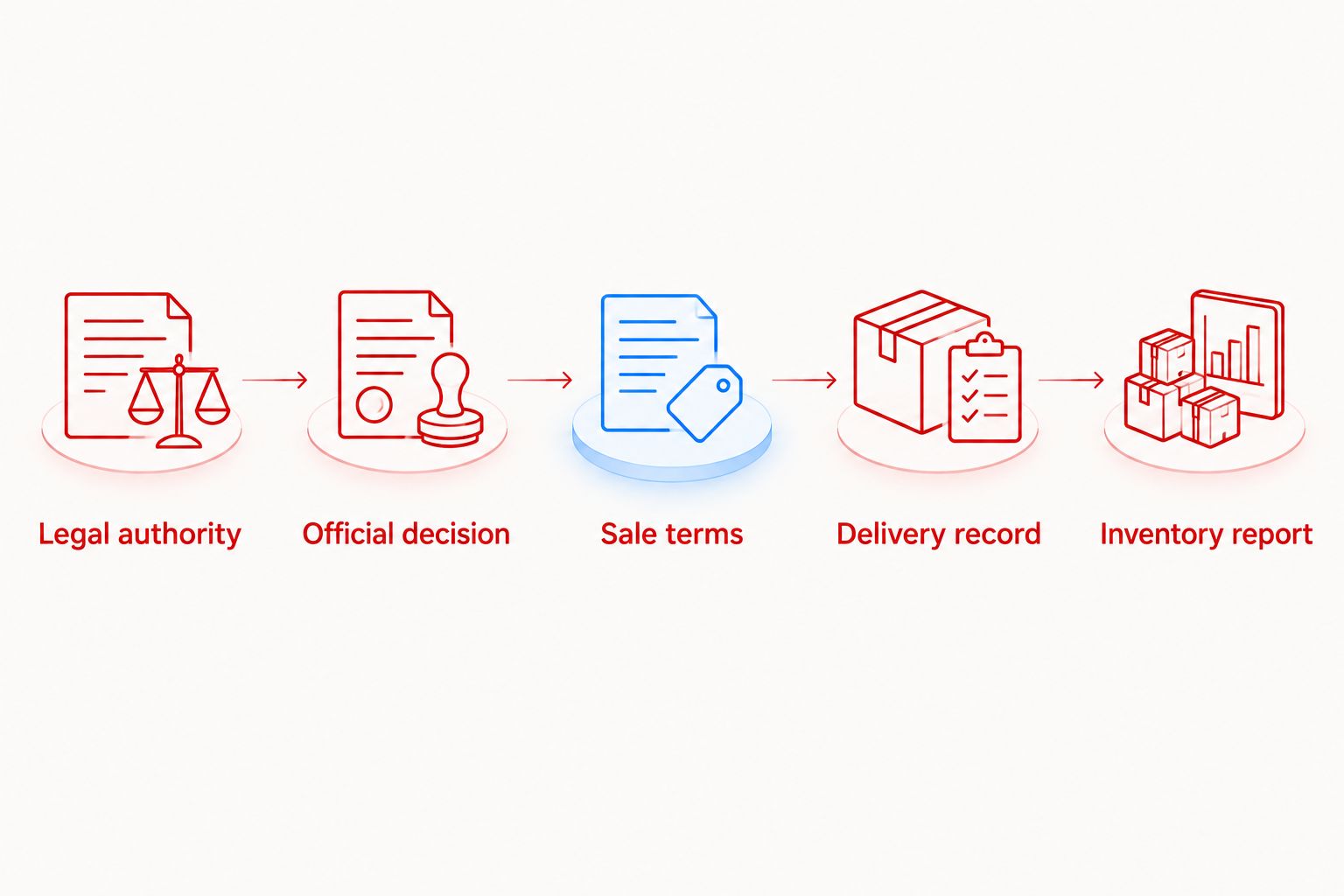
Follow the documents in order. This separates a claimed authority from an executed transaction without treating either an administration's defense or its critics' accusations as proof.
- Legal authority. Find the cited statute and identify the release route. For the principal drawdown rules, begin with Section 161 of the Energy Policy and Conservation Act.
- Official decision. Read the presidential determination, enacted congressional instruction, or DOE decision relevant to that route. Record the document's date.
- Sale terms. Examine DOE's notice or agreement for the quantity, transaction structure, and delivery conditions actually specified.
- Delivery record. Separate contracted oil from delivered oil. An award announces a commitment; delivery changes physical inventory.
- Inventory report. Compare the transaction with the Energy Information Administration's dated SPR stock series. Use matching reporting periods.
The Energy Information Administration, or EIA, publishes weekly petroleum inventory data. Its Weekly Petroleum Status Report is a source for stock figures, not a substitute for the legal authorization document.
For any 2026 claim, preserve both the announcement date and the inventory reporting date. A comparison that drops those dates can turn a real number into a misleading argument.
Do strategic petroleum reserve levels automatically trigger a release?
Strategic petroleum reserve levels do not automatically authorize an emergency release. The president must act under the applicable statutory authority and satisfy its conditions. A stock figure measures inventory; it does not issue a legal order.
Inventory can still matter legally. The 500 million barrel floor belongs to the limited-drawdown provision discussed above, which is why identifying the legal route comes first.
Does Congress have to approve each emergency release?
Congress does not have to pass a new law for each emergency release authorized under existing presidential drawdown authority. Congress supplied that authority through legislation and established its conditions.
That does not remove Congress from the process. Congress can amend the law, direct sales, and examine executive implementation through oversight.
Can you judge a release from the inventory chart alone?
An inventory chart cannot establish whether a release was legally authorized. It can show reported stock changes, but it does not identify every governing decision, contract term, or delivery event.
Use the chart to test claims about physical stocks. Use the statute and decision documents to test claims about authority. Neither replaces the other.
FAQ
Who has the final authority to order an emergency SPR release?
The president authorizes an emergency SPR drawdown under the applicable federal statute. The Department of Energy implements the drawdown and sale.
Can the energy secretary release reserve oil without a presidential emergency order?
The energy secretary has separate statutory responsibilities and authorities, including test drawdowns. Those authorities are distinct from the president's emergency-release power and carry their own conditions.
Do strategic petroleum reserve levels include gasoline?
Strategic petroleum reserve levels measure crude oil held in the reserve, not finished gasoline stocks. Crude must still move through refining and distribution before it becomes motor fuel.
Where should I check strategic petroleum reserve levels?
Check the Energy Information Administration's dated SPR stock data and Weekly Petroleum Status Report. Keep the reporting date attached to the figure and distinguish SPR stocks from commercial inventories.
Does announcing a release mean the oil has already left storage?
An announcement does not establish that the oil has already left storage. Authorization, sale, contract award, and physical delivery are separate events.
Is an SPR exchange the same as selling oil?
An SPR exchange is not the same as an outright sale because an exchange includes an obligation to return oil under the agreement. Check the agreement and delivery records before describing its effect on inventory.
Does a legal release prove the policy was a good decision?
Legal authorization does not prove that a release was good policy. Assess the statutory basis separately from the stated objective, execution, and documented results.
One last thing
An authorized barrel is not a delivered barrel. That distinction is the quickest way to catch a misleading reserve headline without making an unsupported accusation.
For your next 2026 SPR claim, demand the legal authority, the dated decision, and the matching inventory period. If a report supplies only a dramatic stock chart, it has not answered who authorized the release.