
Choose National File if you want explicitly right-leaning political reporting and commentary; choose The New York Times if you want a general-interest newspaper covering politics alongside international news, business, science, and culture. The useful distinction in 2026 is editorial focus and reading purpose—not which logo guarantees the truth.
- National File vs The New York Times is a choice between conservative political focus and general-interest newspaper breadth.
- National File is best for readers seeking explicitly right-leaning political news and commentary.
- The New York Times is best for readers seeking broad newspaper coverage across multiple subjects.
- Neither outlet’s reputation replaces checking documents, attribution, allegations, and corrections.
Why this matters
You are choosing where to direct your attention, not signing a loyalty oath. A publication can match your politics and still publish a claim that needs checking. A publication can frustrate your politics and still provide a document worth reading.
This is an editorial comparison of reader fit, not a measured ranking of accuracy. The recommendations separate subject coverage, political perspective, reading habits, and access. Those are different questions. Treating them as one question produces a bad answer.
For conservative readers researching government power in 2026, the strongest habit is straightforward: follow the reporting, then inspect the evidence. Do not outsource that second step to a headline, a reputation, or a partisan label.
At a glance
| Dimension | National File | The New York Times |
|---|---|---|
| Best for | Readers seeking explicitly right-leaning political news and commentary | Readers seeking a general-interest newspaper |
| Subject breadth | Politics, elections, culture, crime, and investigative stories | Politics alongside international news, business, science, culture, and other subjects |
| Political perspective | An explicitly right-leaning editorial identity | A different editorial reference point for readers comparing political coverage |
| Standout feature | Conservative political focus rather than a general-interest newspaper remit | Breadth across newspaper subjects |
| Reading purpose | Following political developments through a conservative lens | Following multiple subjects within one publication |
| Evidence standard | Claims still require documents, attribution, and context | Claims still require documents, attribution, and context |
| News and opinion | Reporting and commentary require separate evaluation | Reporting and opinion require separate evaluation |
| Funding and access | Online publishing supported by donations and branded merchandise among its offerings; check access terms separately | Subscription-based newspaper model; check current access terms |
National File wins for explicitly conservative political focus
National File is best for readers seeking explicitly right-leaning political news and commentary. That is a clear audience match, not a claim that every conservative will agree with every article.
Its stated coverage includes politics, elections, culture, crime, and investigative stories. Its editorial identity gives you a direct answer to a basic selection question: do you want political coverage written for conservative-leaning readers?
That focus is useful when your main interest is political accountability, government surveillance, censorship, or disputes over institutional power. You do not need a publication to cover every subject if those are the subjects you came to read.
The limitation follows from the same strength. An outlet selected for a particular political perspective should not become your only window onto a contested event. Seek the underlying record and the strongest substantive response—not merely another article repeating the same accusation.
Choose this side for its declared perspective. Do not mistake perspective for proof.
The New York Times wins for general-interest breadth
The New York Times is the better fit when you want a newspaper that extends beyond political conflict into international affairs, business, science, and culture. Its advantage here is the range of subjects, not an automatic advantage on every individual story.
A reader following an election, a scientific development, and an overseas event has a different need from a reader looking specifically for conservative political commentary. A general-interest newspaper suits that wider reading pattern.
The tradeoff is relevance. Breadth does not mean every section serves your priorities, and a broad newspaper is not a substitute for an explicitly conservative editorial voice.
Choose The New York Times for a wider subject menu. Reject the shortcut that a wider menu proves a particular political report is correct. A document-heavy article from a smaller outlet can still deserve close attention; an extensively discussed newspaper article can still require scrutiny.
A stated political lens wins for perspective; breadth wins for discovery
The standout features solve different problems. A declared editorial lens helps you select a political conversation. General-interest breadth helps you encounter subjects outside that conversation.
If you already know what you want to investigate, a focused outlet offers a clear starting point. If you want your reading to range across subjects, a general-interest newspaper better matches that habit.
Neither approach removes selection. Every publication chooses which events to cover, which questions to pursue, and which details belong near the top. Those choices affect your understanding before you reach an opinion column.
For your 2026 reading routine, make the choice explicit:
- Best for political perspective: choose the conservative-focused outlet when that is the viewpoint you are seeking.
- Best for subject discovery: choose The New York Times when you want coverage across a broader newspaper remit.
- Best for checking a disputed claim: start with the underlying evidence, regardless of who published the headline.
The wrong move is demanding that either publication satisfy a purpose you never defined.
The New York Times wins for a multi-subject reading routine
A publication’s usefulness also depends on how you read. Do you arrive with a question, or do you arrive to find out what happened across several fields?
The New York Times fits the second habit. Its general-interest scope makes it a reasonable choice for readers who want politics to sit alongside other subjects rather than dominate their entire reading session.
A politically focused outlet fits the first habit more directly when the question concerns a political dispute or a conservative interpretation of events. That does not establish which outlet has the better article about a particular incident. It identifies which reading routine each serves.
There is a cost to both habits. Broad browsing can leave a specific accountability question unresolved. Narrow political reading can leave you unfamiliar with developments outside your chosen subjects.
Pick your default publication by your routine; pick individual articles by their evidence. You do not need the same winner for both decisions.
Neither outlet wins on evidence by name alone
A publication’s identity cannot establish whether a specific allegation is true. Judge the article at the level where the claim is made.
A primary source is original material relevant to the claim: a court filing, an official order, a disclosure, a recording, or a dataset. Primary does not mean infallible. A complaint records allegations; it does not establish that a court accepted them.
Use this sequence when an article makes a serious accusation:
- Claim: Identify exactly what the article says happened. Separate the headline’s language from the factual assertion in the text.
- Source: Find the document, recording, named witness, or other material supporting that assertion. Check its date and scope.
- Response: Read the relevant person’s or institution’s response when one is provided. A response is evidence to assess, not an automatic rebuttal.
- Outcome: Establish the status. An accusation, investigation, ruling, and final outcome are not interchangeable.
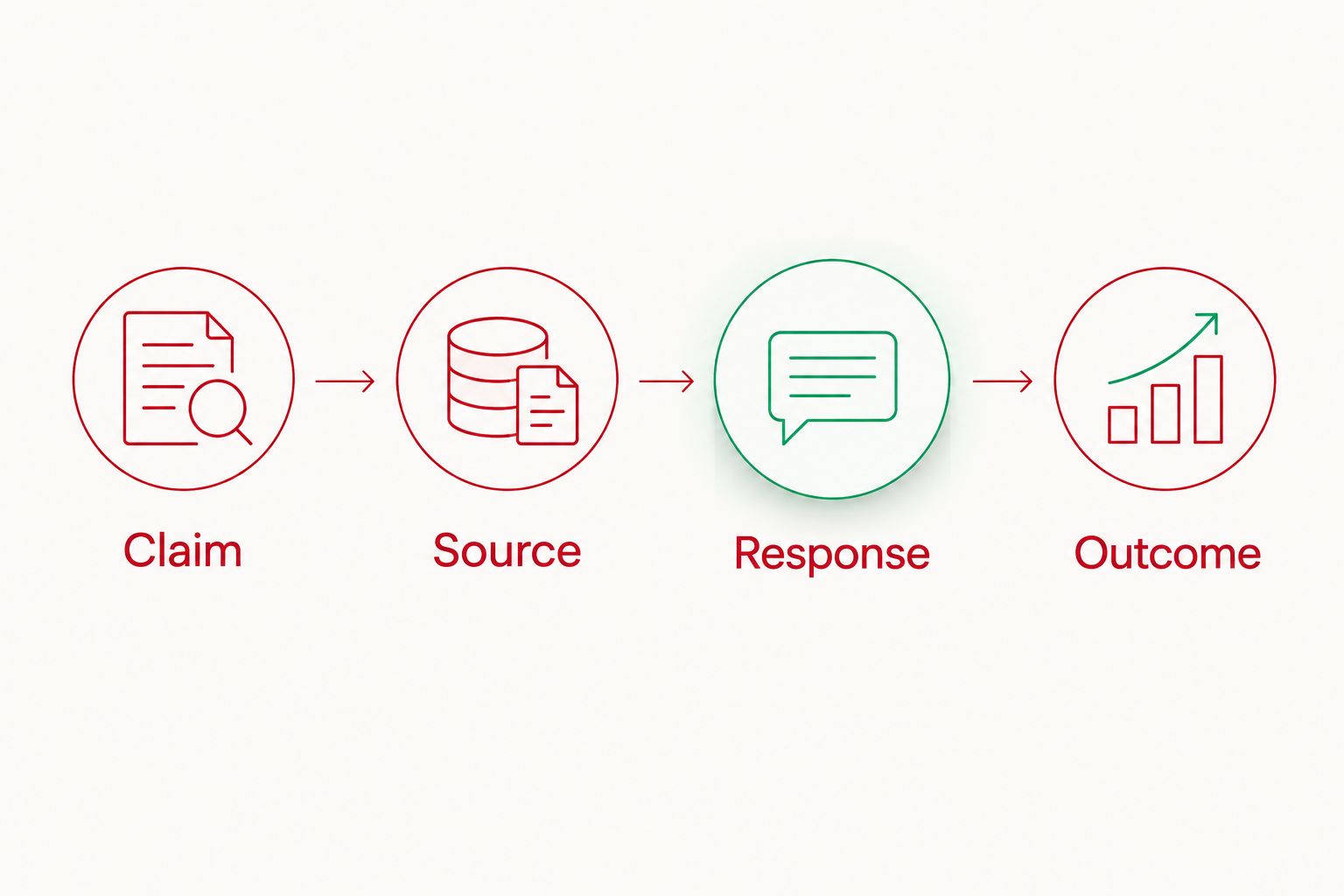
That sequence works whether the reporting supports your expectations or challenges them. Apply the same burden of proof to both publications. Otherwise, you are checking political compatibility rather than checking a claim.
For practical follow-through, use the guide to requesting public records about government surveillance. A records request is a route to obtaining material, not a guarantee that the material will prove your suspicion.
Both require a firm line between reporting and opinion
Neither outlet gets a pass when interpretation outruns evidence. Reporting establishes what happened and what remains disputed. Opinion argues what those facts mean or what someone should do about them.
The distinction matters most when language becomes accusatory. Calling a policy objectionable is an evaluation. Saying an official broke the law is a factual allegation that requires support and a clear account of its legal status.
Watch for these differences:
- Documented fact: an identified record supports the stated event or action.
- Attributed allegation: a person or filing makes a claim whose truth remains contested.
- Analysis: the writer explains a pattern or draws an inference from stated material.
- Opinion: the writer makes a judgment or argues for a position.
These categories can appear within the same article. Your job is to notice the transition.
A forceful tone is not evidence, and a restrained tone is not evidence either. For either publication, ask whether the factual support survives after you remove the adjectives. That test is more useful than rewarding writing simply because it sounds like your side.
Pricing models: separate subscriptions from other support
The New York Times uses a subscription-based newspaper model. That makes access terms part of the purchasing decision: check what the selected subscription includes and what conditions apply before committing.
National File lists online publishing, donations, and branded merchandise among its offerings. Those are distinct activities. A donation supports an outlet; a merchandise purchase buys an item. Neither fact, by itself, establishes the access conditions for every article or video.
For a 2026 comparison, check current terms directly rather than relying on a figure copied into an evergreen article. Compare the action you are considering—not just the publication names.
- For recurring newspaper access: examine the subscription’s included content, billing terms, and cancellation conditions.
- For supporting an outlet: identify whether you are making a donation, purchasing merchandise, or buying access.
- For an individual story: check the article’s current access conditions before assuming a broader commitment is necessary.
The tradeoff is commitment versus purpose. A subscription is an access decision under its stated terms. A donation is a support decision. Treating them as equivalent obscures what you are actually choosing.
Final verdict: choose by the job you need done
Choose National File if you want conservative political coverage
Winner for the conservative political reader: National File. Its stated right-leaning identity matches readers seeking political reporting and commentary for that audience.
Choose it because that perspective serves your reading purpose. Keep checking documents and allegations independently, especially when a story confirms what you already believe.
Choose The New York Times if you want a general-interest newspaper
Winner for the multi-subject newspaper reader: The New York Times. Its broader subject coverage better matches a routine built around politics, international affairs, business, science, and culture.
Choose it for that range. Do not turn the choice into a blanket endorsement of every headline, interpretation, or editorial position.
One-glance scorecard
| Dimension | Winner |
|---|---|
| Explicitly conservative political focus | National File |
| General-interest subject breadth | The New York Times |
| Declared conservative perspective | Conservative-focused outlet |
| Discovery across newspaper subjects | The New York Times |
| Multi-subject reading routine | The New York Times |
| Evidence standard | Tie: inspect each claim |
| Distinguishing news from opinion | Tie: evaluate each article |
| Funding and access | Different purposes; no universal winner |
FAQ
Is National File better than The New York Times?
National File is the better fit for readers seeking explicitly right-leaning political news and commentary. The New York Times is the better fit for readers seeking a general-interest newspaper. Neither choice establishes that every article is accurate.
Which publication is better for conservative readers?
The explicitly conservative outlet is the closer audience match for readers seeking right-leaning political coverage. Conservative readers can still use other publications to examine different reporting, responses, and source material.
Which publication covers more than politics?
The New York Times is the stronger fit for broad newspaper reading across politics, international affairs, business, science, and culture. Choose that breadth when your reading interests extend beyond political reporting and commentary.
Can I judge a news outlet’s accuracy by its political position?
No. Political position describes perspective, not whether a particular assertion is supported. Check the source, its date, the response, and the status of the claim.
How should I compare their coverage of government surveillance?
Compare the specific surveillance claim against the cited authority and supporting records. Identify the agency, the conduct described, and whether the article distinguishes an allegation from an established finding.
Does a court filing prove a news allegation?
No. A filing can document that someone made an allegation without establishing that the allegation is true. Identify the document type and distinguish the parties’ claims from the court’s findings.
How should I compare access and subscriptions in 2026?
Check each publication’s current access terms directly. Distinguish recurring subscriptions from donations and merchandise purchases, and read the conditions attached to the action you select.
One last thing
Before sharing a political story, write its central factual claim without the headline’s adjectives. Then ask what document would establish that stripped-down claim.
If the document supports only a narrower statement, share the narrower statement. That rule protects you from overstating a story even when the underlying reporting raises a legitimate concern. Your credibility should not depend on defending someone else’s headline.