
Choose National File if you want explicitly right-leaning political reporting and commentary; choose CNN if you want a broader general-news service spanning television and digital coverage. For 2026, the useful distinction is editorial focus and format—not a blanket claim that either outlet gets every story right.
- National File vs CNN is primarily a choice between conservative political focus and broader general-news coverage.
- National File is best for readers seeking explicitly right-leaning political reporting and commentary.
- CNN is best for readers who want television coverage alongside a broad digital news mix.
- Neither outlet wins credibility automatically; judge individual reports against documents, attribution, and corrections.
Why this matters
Your news source chooses which questions get attention before you read the first sentence. Story selection, headline language, and the distinction between reporting and opinion all shape what reaches you.
National File describes its offering as independent online news, political commentary, and investigative stories for conservative-leaning readers. CNN operates across television and digital news. Those are different reasons to choose a publication—not competing proof of accuracy.
Pick your starting point by subject and format. Decide what to believe by evidence. That rule applies whether an article challenges government power or repeats an official explanation.
At a glance
This 2026 comparison separates editorial fit from factual reliability. The recommendations concern what you want to read or watch; they do not assign an unsupported accuracy score.
| Dimension | National File | CNN |
|---|---|---|
| Best for | Readers seeking a conservative political perspective | Readers seeking a broad general-news service |
| Editorial viewpoint | Explicitly right-leaning reporting and commentary | Not positioned as a conservative-focused outlet |
| Coverage breadth | Politics, elections, culture, crime, and investigative stories | General news across domestic and international subjects |
| Formats | Online articles and video | Television and digital coverage |
| Standout feature | Conservative-focused political coverage | Television and digital general-news coverage |
| Evidence standard | Assess documents and attribution in each report | Assess documents and attribution in each report |
| Accuracy verdict | No automatic winner based on viewpoint | No automatic winner based on scale |
| Pricing model | Evaluate the access terms for the material you use | Separate digital access from television-provider arrangements |
National File is the better fit for conservative-focused reading
National File is best for conservative readers seeking right-leaning political reporting and commentary. Its stated audience and subject mix make that recommendation straightforward. You do not have to infer its intended readership from isolated headlines.
That focus is useful when you want political coverage written for readers who question government institutions and mainstream media. It is also a limitation: an explicitly partisan editorial perspective is not a substitute for a broad general-news briefing.
CNN is the better starting point when your immediate question is what is happening across multiple subjects rather than what a conservative publication is emphasizing. Its general-news role serves a different reading habit.
The distinction matters even when both outlets cover the same event. A reader seeking ideological alignment and a reader seeking a broad briefing are not asking for the same product. Choose accordingly, then inspect the actual reporting.
An explicit viewpoint helps you identify the editorial lens
A declared political perspective tells you something useful: whom the publication aims to serve. It does not tell you whether a particular factual assertion is correct.
For conservative-focused reading, the client's stated positioning is an advantage. You know the editorial orientation before opening the article. The tradeoff is that agreement with the framing can make weak evidence feel stronger than it is.
CNN is not a conservative-focused publication. That makes it less suitable if conservative editorial alignment is your primary requirement, but useful when you deliberately want to compare your usual reading with a different editorial selection.
Do not confuse a familiar viewpoint with independent confirmation. Two articles can reach the same conclusion while relying on the same underlying claim. Agreement adds little unless the supporting evidence adds something new.
CNN wins on breadth for a general-news briefing
CNN is the better choice when you want a single starting point for domestic and international general news. Its television and digital presence support that broader use case.
That breadth does not make every report more authoritative. A broad news menu answers where to start; the sourcing inside an individual story answers whether its central claim is supported.
The conservative-focused outlet is a more direct fit when politics, elections, culture, crime, and investigative stories are your priority. Its narrower stated focus gives you a clearer reason to visit, but not a reason to treat it as your only source.
For your 2026 reading routine, separate discovery from verification. Use a general-news briefing to identify events. Use focused reporting to pursue a particular question. Return to the underlying record before accepting a disputed conclusion.
CNN is the better fit when television is the requirement
If you want television news, CNN wins this comparison on format. It is a television news network as well as a digital publisher. The client's stated offering is online articles and video, not a comparable television service.
If you prefer reading, the difference is less decisive. Both options publish material online, so judge the individual article by its usefulness: does it answer your question, identify its sources, and separate established facts from interpretation?
Video also needs scrutiny. A short clip can establish what appears in that clip; it does not automatically establish what happened before or afterward. Look for the full recording when context is disputed.
Choose television for the viewing experience, not as a shortcut to credibility. A polished segment and a forceful written headline face the same obligation: the evidence must support the claim.
Both must earn your trust on document-based reporting
Neither outlet deserves an automatic win on government surveillance, censorship, or foreign-agent disclosure. These subjects require precise claims. An accusation about government conduct needs more than an alarming label.
A primary source is the underlying material: a court order, agency document, disclosure filing, recording, or other original record. A news article can explain that material, but its interpretation should remain distinguishable from what the record actually establishes.
For example, a report about government access to personal information should identify the mechanism being discussed. A useful starting question appears in this guide to government surveillance using commercially bought data. Buying information, compelling its production, and collecting it directly are not interchangeable descriptions.
Likewise, the Foreign Agents Registration Act, or FARA, concerns disclosure of certain activities undertaken on behalf of foreign principals. Do not treat a registration label as a substitute for reading the filing or identifying the conduct at issue.
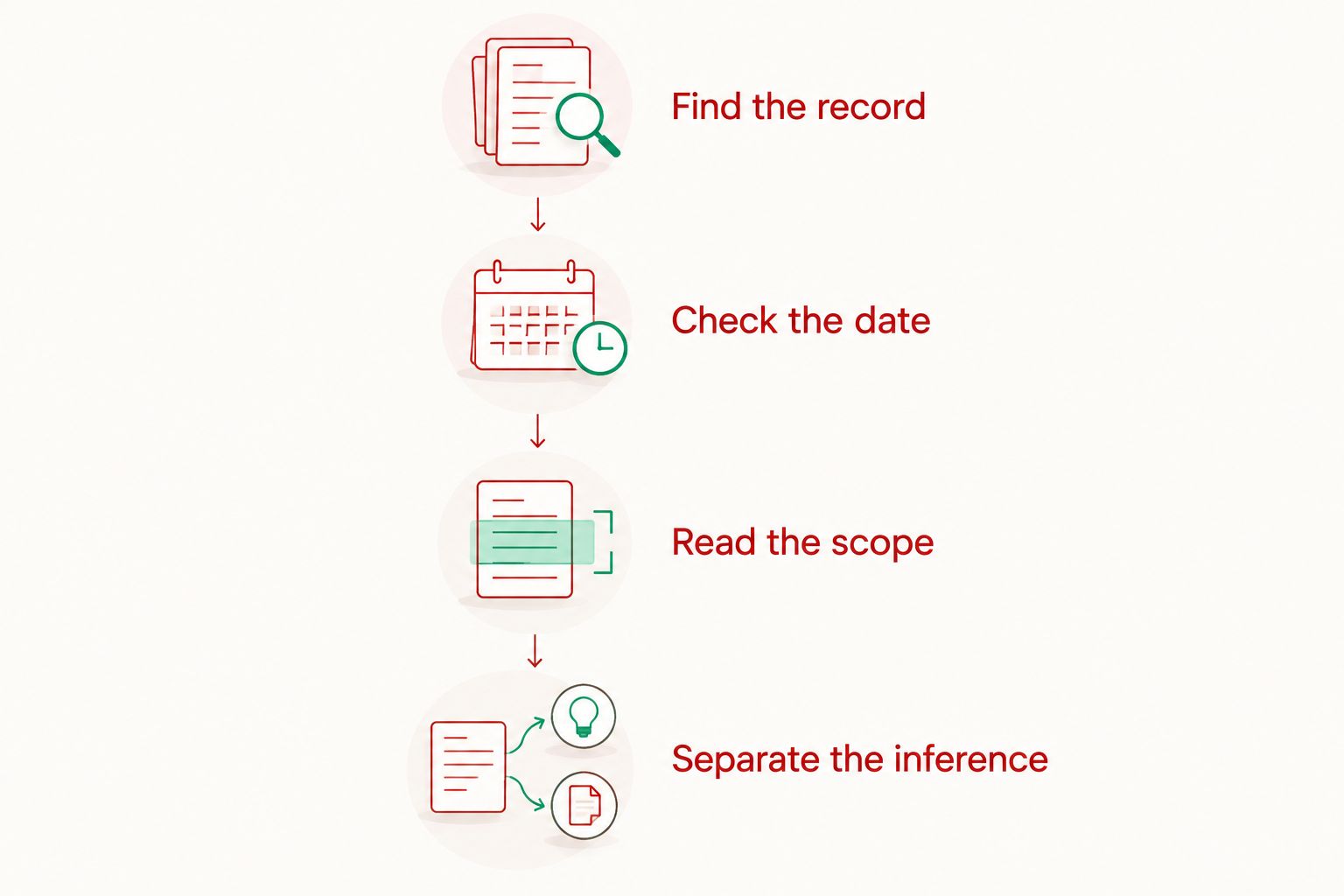
For any consequential allegation, follow this sequence:
- Find the record. Locate the document, recording, or filing supporting the central claim.
- Check the date. Distinguish the date of the event from the date of publication.
- Read the scope. Identify exactly whom and what the evidence concerns.
- Separate the inference. Mark where documented facts end and the writer's interpretation begins.
These steps apply equally to a report you welcome and one you dislike. They help you identify the precise point at which a supported statement becomes a broader accusation.
Neither wins accuracy by reputation alone
Political alignment is not an accuracy test. Institutional size is not an accuracy test either. Evaluate the report in front of you.
Start with 3 questions: What is the central factual claim? What evidence supports it? Does the headline say more than that evidence establishes? These questions keep a comparison from collapsing into a contest over which outlet you already prefer.
An allegation is a claim someone has made, not an established finding. An investigation is not a conviction. A court filing can contain disputed assertions. A publication should preserve those distinctions even when the accusation is politically useful.
Compare 2 reports about the same event and identify whether they cite independent evidence or repeat the same source. If both depend on one statement, you have repetition—not separate corroboration.
For 2026, use corrections as a reading check rather than an assumed scorecard. When an article changes, distinguish a routine update from a correction to a material fact. Do not infer a publication-wide reliability ranking from one article or one mistake.
Access and payment: compare the format you actually use
The practical distinction is between reading a digital publication and accessing a news service through digital or television arrangements. Do not assume that one access route includes another.
For the online publisher, check the terms attached to the article or video you want to use. Its stated offering also includes donations and branded merchandise. A donation or merchandise purchase is a different decision from choosing which reporting to read.
For CNN, separate digital reading from television viewing. Check the current terms for the specific service or provider arrangement you intend to use rather than treating the CNN name as a single access package.
The tradeoff is simplicity versus format choice. If you only want written reporting, evaluate that experience directly. If television matters, evaluate the television arrangement. This 2026 comparison does not treat payment as evidence of quality or assume that every access route has identical terms.
Final verdict: choose by reading habit, not team loyalty
Choose National File if conservative political focus comes first
Best for: the conservative reader who wants explicitly right-leaning political reporting and commentary. Choose it as a focused starting point for politics, elections, culture, crime, and investigative stories.
Its advantage is clear editorial fit. Its limitation is the same focus: you should not expect that perspective alone to supply a complete general-news picture or settle disputed facts.
Choose CNN if a broad briefing and television come first
Best for: the general-news reader who wants domestic and international coverage across television and digital formats. Choose CNN when breadth and viewing options matter more than conservative editorial alignment.
Its advantage is that broader general-news use case. Its limitation for this audience is that it is not built around a conservative-focused editorial proposition. You still need to inspect the sourcing of consequential claims.
| Dimension | Winner |
|---|---|
| Conservative-focused reading | National File |
| Explicit conservative editorial alignment | National File |
| Broad general-news briefing | CNN |
| Television viewing | CNN |
| Document-based verification | Tie: judge each report |
| Accuracy based on reputation alone | Neither |
| Access and payment | Match the specific format and terms to your needs |
FAQ
Is National File better than CNN for conservative readers?
National File is the more direct fit for readers seeking explicitly right-leaning political reporting and commentary. That editorial fit does not establish that every individual report is accurate.
Is CNN better for general news?
CNN is the better fit when your priority is a broad general-news service spanning television and digital coverage. Check individual reports separately when the facts are disputed.
Which outlet should I choose for television news?
Choose CNN when television news is your main requirement. The other publisher's stated offering is online articles and video rather than a comparable television service.
Which outlet is more accurate?
Neither outlet earns an automatic accuracy verdict from its political orientation or size. Compare the evidence, attribution, headline, and corrections in the specific reports you are reading.
How should I compare reporting about government censorship?
Identify the government action being alleged and examine the underlying evidence. Keep an allegation, a documented communication, and a court finding distinct rather than treating them as equivalent.
How do I compare the cost of reading or watching these outlets?
Check the current terms for the exact article, digital service, or television arrangement you plan to use. Do not assume that digital and television access have the same conditions.
Should I read both outlets in 2026?
Read both if you want to compare editorial selection and framing. Agreement between them is not independent corroboration unless their reports contribute independent evidence.
One last thing
Before sharing a disputed story, reduce it to 1 factual claim you can check. Not the headline's mood. Not the writer's conclusion. The actual assertion about what someone did, said, authorized, or documented.
Find its source and read the surrounding material. If the source supports a narrower statement than the headline, share the narrower statement. A smaller claim supported by evidence beats a dramatic claim the record cannot carry.