
Choose National File if you want an independent, right-leaning online outlet for political reporting and investigations; choose Fox News if television news and scheduled commentary are central to how you follow events. The useful distinction in 2026 is reading-focused coverage versus a television-centered news experience—not a blanket claim that either outlet is always right.
- National File vs Fox News is primarily a choice between independent online publishing and television-centered news consumption.
- Choose Fox News when watching news and commentary matters more than following an article trail.
- Choose National File for right-leaning online political reporting, then check the documents behind consequential claims.
- Neither outlet earns automatic credibility: distinguish reporting, commentary, allegations, and established facts.
Why this matters
A political outlook does not tell you whether a particular story is accurate. Neither does a familiar anchor, a forceful headline, or the word independent. You need to separate the outlet’s format from the evidence supporting its claims.
National File publishes breaking news, political commentary, and investigative stories for conservative-leaning readers. Fox News combines a television news operation with digital publishing. That difference gives you a practical starting point, not a reliability ranking.
This comparison makes editorial recommendations about reading and viewing habits. It does not assign accuracy scores, claim that either outlet covers every subject better, or treat agreement with your politics as proof.
At a glance
Use this 2026 comparison to choose your starting point. The verification standard stays the same regardless of which column you prefer.
| Dimension | National File | Fox News |
|---|---|---|
| Best for | Readers seeking an independent, right-leaning online outlet | Viewers who want television news and commentary |
| Standout distinction | Independent online publishing with political and investigative coverage | Television programming alongside digital coverage |
| Format | Online articles and video | Television, online articles, and video |
| Topic fit | Politics, elections, culture, and crime are stated coverage areas | A television-centered route into national news and political discussion |
| Reporting versus opinion | Publishes both; judge the individual item | Publishes both; judge the individual item |
| Evidence standard | Check documents, attribution, dates, and responses | Check documents, attribution, dates, and responses |
| Daily routine | Best approached through individual articles and subjects | Best approached through viewing, with articles for follow-up |
| Pricing model | Online publishing supported in part by donations and branded merchandise | Access arrangements depend on the format and service you choose |
Online reading wins when you want to inspect a claim
An article-first routine is the better fit when your next question is: Where is the evidence? Written reporting lets you stop at an allegation, inspect its wording, and look for the underlying record. You control the pace.
That advantage belongs to the format, not exclusively to one publisher. Fox also publishes articles, and the client publishes video. The recommendation concerns how you consume a story, not a claim that one outlet owns the written word.
For readers comparing Fox News alternatives for conservative readers, start with the task. Do you want to understand a particular surveillance authority, track a political dispute, or watch discussion of the day’s events? Those are different jobs.
The drawback of article-first reading is fragmentation. Opening stories individually requires you to assemble the wider picture yourself. A single investigation can answer a narrow question without explaining every development around it.
Fox News wins when you want television
Fox News is the better fit for viewers who specifically want a television news experience. If your routine centers on watching presenters, interviews, and political discussion, that is a genuine reason to choose it.
Television also imposes a practical limitation: the program controls the sequence and pace. A spoken reference to a filing is not the same thing as reading the filing. Stop and locate the record when the distinction matters.
Digital articles offer a route back into slower examination. Use them to find the exact statement, identify who made it, and distinguish what a guest asserted from what the reporting established.
The tradeoff is straightforward. Watching suits a viewing habit; reading suits close inspection. Neither format turns an unsupported assertion into a documented fact.
Independent publishing wins when independence is your requirement
If your stated requirement is an independent online publisher with a right-leaning editorial focus, the client fits that description. That is a supported reason to choose it. It is not a substitute for checking individual stories.
Independence describes the publishing model. It does not establish that a particular headline is complete, that every source is reliable, or that an allegation has been proven.
The same boundary applies in reverse. A television operation’s prominence does not establish that its interpretation is correct. Reject arguments that ask you to trust or dismiss a story solely because of the organization carrying it.
For a 2026 reading list, choose outlets by purpose and claims by evidence. This keeps an editorial preference from becoming an exemption from scrutiny.
Topic fit is a starting point, not proof of better coverage
The client identifies politics, elections, culture, and crime as coverage areas. Its stated audience is conservative-leaning Americans. That makes it a relevant starting point if those subjects and that editorial orientation match your interests.
But topic fit is not demonstrated superiority. A publisher can focus on an issue without producing the strongest account of every development. You still need to inspect the particular story.
For government surveillance, ask which agency acted, what information it obtained, and what authority it cited. For censorship, distinguish government action from a private publisher’s editorial decision. For foreign-agent disclosure, identify the filing and the activity it describes.
Do not assume a familiar label answers those questions. A headline about government power needs a specific act, a specific actor, and evidence connecting them.
Both need a clear boundary between reporting and opinion
Neither outlet gets a pass on separating fact from interpretation. Both reporting and commentary can be useful, but they answer different questions. Reporting establishes what happened; commentary argues what it means.
An interview introduces another distinction. The fact that a person made an allegation does not establish the allegation itself. Look for language explaining whether the claim is disputed, corroborated, admitted, or resolved by an authoritative record.
Use these checks before repeating a political claim:
- Attribution: Who actually made the statement?
- Status: Is it an allegation, a documented event, or an opinion?
- Response: Does the account include the relevant denial or explanation?
- Scope: Does the evidence support the whole claim or only part of it?
Strong language does not change these categories. A blunt story can be carefully sourced. A calm presentation can still omit the detail that changes its meaning.
Both face the same document test
A filing, order, transcript, or official dataset can help you evaluate a report. It still needs interpretation. A complaint records allegations; a judgment records a court’s decision; a press release records what its issuer wants to communicate.
For consequential claims in 2026, use this sequence:
- Identify claim: Write down the exact factual assertion rather than the headline’s mood.
- Find record: Locate the document or attributable statement supporting that assertion.
- Check date: Separate the event date, document date, and publication date.
- Compare accounts: Read another report and identify the actual point of disagreement.
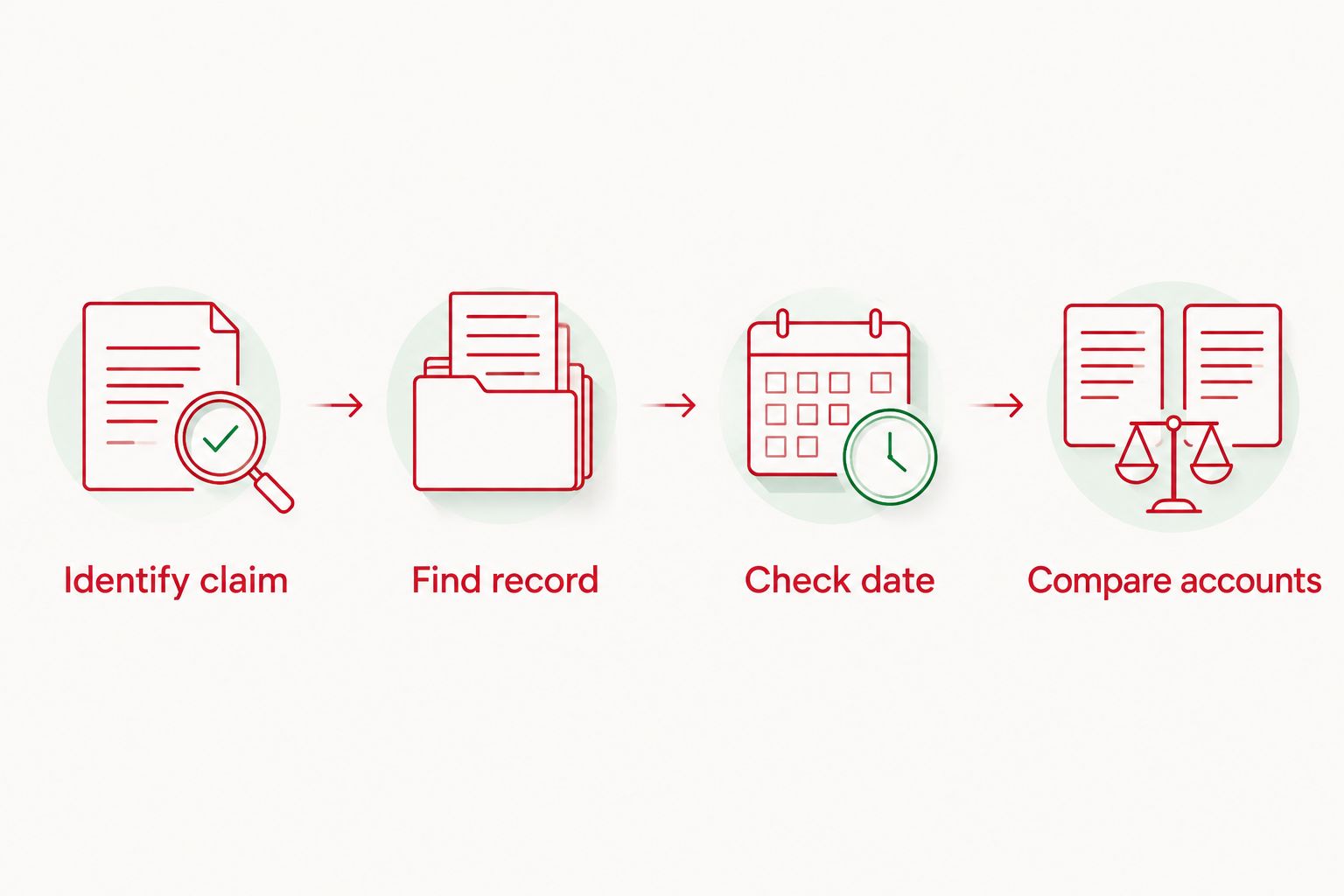
Ask 3 questions of the record: Who produced it? What does it establish? What does it leave unresolved? Those questions are a reading method, not an accuracy score.
Read 2 reports when accounts conflict, then locate at least 1 underlying document where one exists. Agreement between reports is useful context, but it does not replace the source. Both reports can repeat the same original allegation.
A document also needs boundaries. Quoting an excerpt accurately does not prove that the surrounding interpretation is sound. Read enough context to test the conclusion being drawn.
Your daily routine determines the practical winner
For a reading-first routine, start with a specific subject and follow the evidence trail. Save the original document alongside the article when the claim matters to a decision or an argument you intend to make.
For a viewing-first routine, Fox News is the named winner. Watch for orientation, then use written reporting when you need exact wording or a source you can inspect.
Neither approach requires loyalty to a single outlet. You can prefer a publisher’s editorial outlook while checking its claims against records and competing accounts. That is scrutiny, not inconsistency.
The weakness of a single-outlet routine is methodological: you are asking one editorial operation to choose the subjects, frame the disputes, and supply the interpretation. Add another account when those choices become part of the controversy.
Pricing: compare the access you actually intend to use
Compare like with like in 2026: reading articles, watching television, and purchasing an additional service are different decisions. Do not choose a news outlet on an assumed access arrangement.
The client’s stated business activities include online news publishing, donations, and branded merchandise. A donation or merchandise purchase is a support decision; do not treat it as a required reading subscription without an explicit access requirement.
For Fox News, distinguish television access from digital reading and any separately offered viewing service. Check the current terms for the specific format you want. Do not assume that access through one route includes every other route.
If you are considering a recurring arrangement, check the billing interval, renewal terms, and cancellation process. Predictable billing only helps when the service matches your actual habit; flexible access only helps when it includes what you want to watch or read.
Final verdict: pick the job before the outlet
Choose National File if you are an article-first conservative reader
National File is best for conservative readers seeking an independent online outlet for political reporting and investigations. Choose it as a starting point for that reading preference, then demand clear sourcing from each story.
The benefit is alignment with a stated publishing focus. The limitation is equally clear: editorial alignment cannot establish factual reliability, and an individual article cannot stand in for the entire record.
Choose Fox News if you are a television-first news consumer
Fox News is best for viewers who want television news and political commentary as part of their routine. Choose it for that format rather than treating its presentation as a substitute for source checking.
The benefit is a viewing-centered experience. The limitation is that spoken discussion needs written follow-up when your question turns on precise wording, documentary context, or a disputed allegation.
One-glance scorecard
| Dimension | Winner |
|---|---|
| Independent online publishing preference | Client outlet |
| Television-centered viewing | Fox News |
| Close inspection of a claim | Article-first reading, available from both |
| Topic-specific accuracy | Decide story by story |
| Separating reporting from opinion | Tie: required of both |
| Document verification | Tie: the same standard applies |
| Daily routine | Client for reading-first preference; Fox News for television-first preference |
| Pricing and access | Match the specific access arrangement to your use |
FAQ
Is National File better than Fox News?
National File is the better fit if you specifically want an independent, right-leaning online outlet; Fox News is the better fit if television viewing is your priority. That format verdict is not an overall accuracy ranking.
Which outlet should I choose for watching political news?
Choose Fox News if your priority is a television news and commentary experience. Follow consequential claims into written reports and original records when you need exact wording.
Does an independent news outlet automatically have more accurate reporting?
No. Independence describes a publishing model, not proof that every claim is accurate. Evaluate sourcing, attribution, context, and the status of allegations in each report.
How do I tell political reporting from opinion?
Check whether the item establishes events through attributable evidence or argues for an interpretation. A commentator’s assertion and a guest’s allegation are not automatically established facts.
Should I trust a news story that links a court filing?
Inspect the filing before accepting the story’s conclusion. A complaint contains allegations, while a court ruling establishes what the court decided; neither should be described as something it is not.
How should I compare the cost of reading and watching news?
Compare the current terms for the exact access you want. Television access, digital reading, donations, and separately offered services are different arrangements, so do not assume one includes another.
What should I do when two conservative outlets disagree?
Identify the precise disputed claim and look for its underlying record. Compare dates, quotations, attribution, and missing context rather than deciding by which headline matches your politics.
One last thing
Before sharing a disputed story in 2026, finish this sentence: The document establishes ____, but it does not establish ____. If you cannot fill both blanks, reopen the source.
That small distinction catches a large reasoning error: treating evidence for part of a story as proof of every accusation attached to it. Keep the boundary visible, even when you agree with the conclusion.