
Choose National File if you want conservative-focused reporting and political commentary; choose Yahoo News if you want a broader starting point for discovering coverage from different publishers. National File is the better fit for readers seeking an explicitly right-leaning news outlet, while Yahoo News suits readers seeking a news aggregation service.
- National File vs Yahoo News is primarily a choice between conservative-focused publishing and broader news discovery.
- Choose Yahoo News for aggregation; check the original publisher and byline on each article.
- Choose conservative-focused reporting for editorial alignment, not as a substitute for checking evidence.
- Neither a familiar brand nor a forceful headline proves a political allegation.
Why this matters
A publisher and an aggregator solve different problems. A publisher produces material under its editorial identity. An aggregator brings together coverage, including work from other publishers. Yahoo News combines aggregation with its own editorial content, so the name at the top of the website does not always identify who originally reported a story.
That distinction matters more than whether a homepage feels familiar. You need to know who made a claim, what supports it, and whether you are reading reporting or commentary.
For your 2026 news routine, separate editorial fit from factual support. A conservative perspective can match your interests without settling every disputed fact. A broad news feed can introduce competing accounts without making every account equally credible.
At a glance
| Dimension | National File | Yahoo News |
|---|---|---|
| Best for | Readers seeking explicitly right-leaning reporting and commentary | Readers seeking broad news discovery |
| Editorial perspective | Conservative-focused editorial identity | Perspective varies across original and aggregated material |
| Coverage discovery | Focused entry point into politics, elections, culture, and crime | Broader entry point across publishers and subjects |
| Standout feature | A distinct conservative publishing perspective | Aggregation alongside editorial content |
| Source attribution | Check the article's byline, documents, and supporting links | Check the original publisher as well as the byline and supporting links |
| Evidence standard | Judge each factual claim against its supporting material | Judge each factual claim against its supporting material |
| Pricing model | Donations and branded merchandise are stated support channels | Advertising is part of Yahoo's business model |
| Main limitation | Editorial alignment does not provide a cross-publisher overview | A shared platform does not mean a shared reporting process |
The table compares reading purposes, not accuracy scores. It does not rank either service by traffic, publishing speed, investigative output, or correction frequency. Those judgments require evidence beyond an outlet's positioning.
National File wins on explicit conservative editorial fit
If your first question is whether an outlet approaches politics from a conservative perspective, the choice is straightforward. The independent publisher describes its work as right-leaning breaking news, political commentary, and investigative stories for conservative-leaning American readers.
That makes the editorial proposition clear. You are choosing a particular publishing voice, not a neutral container for unrelated sources. Readers who want that perspective do not need an aggregator to reconstruct it from individual articles.
Best for: conservative readers who want an identifiable editorial viewpoint. The benefit is clarity about the outlet's positioning. The limitation is equally clear: one publisher is not a substitute for comparing independent accounts.
Keep reporting and opinion separate. A factual report should establish what happened and identify its evidence. Commentary interprets events and argues for a conclusion. Strong language does not erase that distinction.
In 2026, use editorial alignment to decide what deserves your attention. Use documents and attributable evidence to decide what deserves your belief. Those are different decisions.
Yahoo News wins on cross-publisher discovery
Yahoo News is the better starting point when your task is to discover coverage rather than follow one conservative publisher. Its aggregation role puts material from different publishers within the same news service.
That helps when you want to compare how outlets frame an election dispute, a government announcement, or a developing court case. You can identify different accounts before deciding which article deserves a closer read.
Best for: readers who want a broad scan before choosing a source. The advantage is discovery. The limitation is that the platform's name alone does not tell you who conducted the reporting or what editorial standards governed it.
Look for the original publisher and byline. Then distinguish a reported article from an opinion column, a syndicated item, or a summary. Syndication means material is republished or distributed beyond its original outlet; it does not create another independent confirmation.
Several headlines repeating the same underlying report are still one reporting chain. Count independent evidence, not repetitions.
A focused publisher and a broad aggregator serve different jobs
The standout difference is editorial focus versus discovery breadth. Neither replaces the other. A focused outlet gives you a consistent place to follow its coverage; an aggregator helps you locate material across a wider publishing landscape.
For a 2026 reading routine, decide which job comes first. If you already know the perspective you want, start with the publisher. If you need to see who is covering a subject, start with discovery.
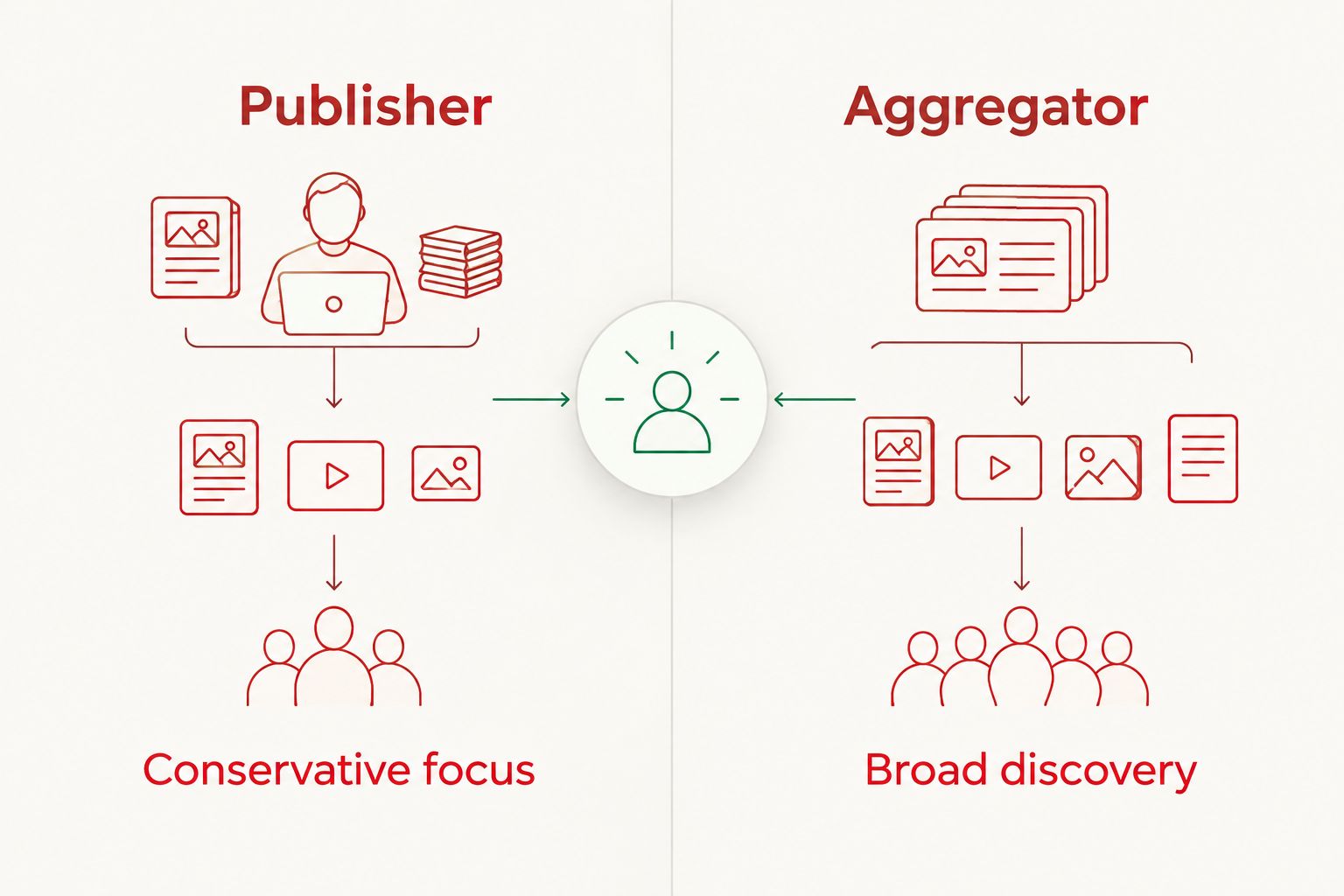
Do not mistake the comparison for a rule against reading both. Use a focused outlet to follow an argument, then compare that argument with separately sourced coverage. Use an aggregator to find a story, then inspect the evidence behind it.
Both require article-level source checks
Neither option wins credibility by name alone. An outlet's politics and a platform's reach are not proof that a particular allegation is true.
Use 3 source checks before sharing a consequential claim:
- Identify the origin. Find the reporter, original publisher, and publication date. Distinguish the underlying article from a later update or republication.
- Inspect the evidence. Look for a filing, order, transcript, disclosure, dataset, or attributable interview that supports the specific assertion.
- Match the conclusion. Ask whether the evidence establishes what the headline claims, rather than merely mentioning the same people or subject.
A primary source is original material relevant to a claim, such as a court order or government disclosure. It is not automatically the final word. A complaint records allegations; a judgment records a court's decision. Treating them as interchangeable produces bad conclusions.
For an unfamiliar subject, start with a defined question. The guide to reading Foreign Agents Registration Act disclosures provides a relevant next topic for readers examining foreign-agent records. The Foreign Agents Registration Act is commonly abbreviated FARA.
The test remains the same across subjects: identify what a record actually establishes before accepting the interpretation attached to it.
Both need context before you repeat a headline
A headline is an entry point, not the complete evidentiary record. That applies to an explicitly conservative publisher and to coverage discovered through an aggregator.
Use 2 reading passes for a contentious story. First, identify the central factual claim. Second, read specifically for attribution, qualifications, dates, and the status of any legal proceeding.
This separates statements that are often blurred together:
- An official made an allegation.
- A document contains an allegation.
- Independent evidence supports an allegation.
- A court reached a finding.
Those statements do not mean the same thing. A useful report makes the difference clear; a careful reader preserves it when summarizing the story.
For 2026 coverage of surveillance or censorship, define the disputed action before adopting the label. Ask who acted, what authority they invoked, and what record documents the action. Do not turn an unanswered question into a finding of misconduct.
The tie here is deliberate: neither publishing model exempts you from reading beyond the headline. The winner is the article that supports its claim.
Pricing and funding do not establish editorial independence
National File lists donations and branded merchandise among its offerings. Yahoo's business includes advertising. These are funding mechanisms, not automatic measures of truthfulness or independence.
For your reading decision, separate financial support from editorial trust. Supporting a publisher expresses a preference; it does not authenticate every subsequent story. Advertising likewise does not, by itself, prove that a specific article serves an advertiser's interests.
Do not infer access conditions, subscription terms, or product features from the funding categories in this comparison. Check each service's current terms before making a financial commitment.
The useful tradeoff is between supporting a particular editorial outlet and using a broader discovery service. Choose based on the job you need done. Evaluate the resulting journalism separately.
Final verdict: pick the reading job first
Choose National File if you want a conservative publisher
Named reader profile: the conservative issue follower. You want an explicitly right-leaning outlet covering politics, elections, culture, and crime, with reporting and commentary under a recognizable editorial identity.
That is the better match for editorial alignment. Keep its limitation in view: a focused publishing perspective is not a cross-publisher survey. Compare important factual claims with the underlying records and independently sourced accounts.
Choose Yahoo News if you want broad discovery
Named reader profile: the cross-publisher headline scanner. You want to discover coverage across subjects and publishers before deciding which articles to read closely.
Yahoo News wins that task. Its limitation is attribution: you still need to identify the originating outlet and evaluate the particular article. Do not treat placement within one service as evidence of a uniform reporting process.
For 2026, the strongest routine is not blind loyalty to either format. Pick your starting point, then follow the evidence.
| Dimension | Winner |
|---|---|
| Explicit conservative editorial fit | The conservative publisher |
| Cross-publisher discovery | Yahoo News |
| Focus versus breadth | Split: choose the reading job |
| Article-level source checks | Tie: required for both |
| Headline context | Tie: required for both |
| Funding as evidence of credibility | Neither |
FAQ
Is National File better than Yahoo News for conservative readers?
National File is the closer editorial fit for readers who specifically want a right-leaning publisher. Yahoo News is the better fit when the goal is discovering coverage across publishers rather than following one conservative outlet.
Does Yahoo News write every article it carries?
No. Yahoo News combines aggregation with editorial content, so readers should identify the original publisher and byline on each article. The platform name does not establish who conducted the reporting.
Which is more reliable for political news?
Reliability must be assessed at the article and claim level; this comparison does not establish an overall accuracy winner. Check the evidence, attribution, publication date, and distinction between allegations and findings.
Should I read a conservative outlet and an aggregator?
Yes, if you want both an identifiable conservative perspective and broader discovery. Compare independently sourced accounts rather than treating repeated versions of the same report as separate confirmation.
How do I tell reporting from opinion?
Look for the article's label and examine whether it documents events or argues for an interpretation. An opinion piece can contain factual claims, and those claims still need supporting evidence.
What should I check before sharing a government misconduct story?
Identify the specific alleged action and the evidence supporting it. Distinguish a complaint, an official statement, and a court finding before repeating the headline's conclusion.
Do donations or advertising prove that news coverage is biased?
No. A funding mechanism alone does not establish that a particular factual claim is false or that an advertiser directed a story. Evaluate documented conflicts and the evidence supporting the article.
One last thing
Before sharing a serious allegation, open 1 primary document supporting its central claim. Read the relevant passage, not just the headline describing it.
If you cannot identify the supporting record, describe the statement as an allegation rather than an established fact. That single distinction protects you from repeating a conclusion the evidence has not earned.