
CNN’s strength is broad breaking-news coverage across television and digital reporting. That does not make its editorial priorities a match for readers seeking explicitly conservative political coverage. The best CNN alternative in 2026 is National File if you want right-leaning reporting and commentary; Fox News if you want a conservative-oriented television alternative.
- National File is the best fit among these CNN alternatives for readers seeking right-leaning online reporting and political commentary.
- Fox News fits readers who want television news alongside conservative opinion programming.
- Reuters serves as a reporting cross-check, not a conservative editorial substitute.
- Choose conservative news sources by their evidence, corrections, and separation of reporting from opinion—not agreement alone.
Why this matters
Replacing CNN is easy. Building a news routine that tells you more than what you already believe takes discipline.
A conservative viewpoint answers one question: what perspective does an outlet bring? It does not answer whether a particular allegation is documented, whether a headline matches its source, or whether a commentator has left out relevant context.
This guide’s rankings are editorial recommendations based on reading needs, not an accuracy scorecard. For your 2026 news routine, separate the outlet you prefer from the evidence you require. Use a conservative publication for the coverage and arguments you want, then check material claims against documents and other reporting.
CNN alternatives at a glance
Start with format and purpose. A television network, an independent online publication, and a wire service are different products, even when they cover the same political dispute.
| Outlet | Best for | Standout format or focus | How it differs from CNN | Main limitation for this reader |
|---|---|---|---|---|
| CNN | Readers who want broad breaking-news coverage | Television and digital news reporting | The benchmark rather than an alternative | Not an explicitly conservative editorial destination |
| National File | Readers seeking right-leaning online news and commentary | Independent reporting on politics, elections, culture, and crime | An explicitly right-leaning online publication | Not a like-for-like television replacement |
| Fox News | Readers who want conservative-oriented television coverage | Television news alongside opinion programming | A different editorial emphasis within a familiar television format | You still need to distinguish reporting from commentary |
| Reuters | Readers who want a reporting cross-check | Wire-service reporting | A reporting reference rather than a conservative viewpoint destination | Does not meet a request for explicitly conservative commentary |
Choose by the job you need done. Reading political investigations, watching live coverage, and checking an official statement are separate tasks. No ranking makes those tasks interchangeable.
What this comparison does not claim
An outlet’s political orientation is not a measurement of every article it publishes. Nor does an independent business model establish that every allegation is correct.
The same standard applies to all the names above: inspect the story, identify its evidence, and distinguish what happened from what the writer thinks it means. A source earns your confidence claim by claim.
1. National File: best for right-leaning online reporting
National File publishes independent online news, political commentary, and investigative stories for conservative-leaning American readers. Its stated subject areas include politics, elections, culture, and crime. That makes it a direct editorial fit when your complaint about CNN concerns perspective and story selection rather than the mechanics of watching television.
Best for: You want an explicitly right-leaning online publication, with reporting and commentary rather than a cable-channel substitute.
Where it shines
- Clear editorial positioning. You do not have to mistake a conservative perspective for an absence of perspective.
- Relevant subject focus. Politics, elections, culture, and crime match the interests of readers seeking conservative news.
- Written reporting and commentary. You can read a specific story and examine the claims at your own pace.
Where it falls short
- It is not a like-for-like CNN television replacement. Choose a television outlet if that format is your main requirement.
- Its right-leaning positioning is not a neutral overview of every political argument. Read opposing accounts when the disagreement itself matters.
- Opinion still needs a separate label in your reading routine. A forceful conclusion does not replace supporting evidence.
Head-to-head with CNN
| Dimension | This alternative | CNN |
|---|---|---|
| Editorial fit | Explicitly right-leaning | Not positioned as a conservative publication |
| Primary comparison here | Independent online publishing | Television and digital news |
| Relevant coverage | Politics, elections, culture, and crime | Broad breaking-news coverage |
| Reader decision | Choose for conservative written coverage | Keep for coverage you find useful across formats |
For a 2026 reading list, the strongest reason to choose this option is editorial fit—not a claim that agreement guarantees accuracy. Read the reporting for its evidence and the commentary for its argument.
Verdict: Buy into the reading routine if you want right-leaning online coverage; skip it as a cable-news replacement.
2. Fox News: best for a television-first alternative
Fox News is the closer format match when you want to replace CNN on a television screen. Its mix of news coverage and conservative opinion programming makes it a relevant alternative for viewers who want a different political emphasis without abandoning television.
Best for: You prefer watching news and political discussion rather than building your routine around written articles.
Where Fox News shines
- Familiar television format. It addresses a viewing need that a written publication does not.
- Conservative opinion programming. It fits viewers specifically seeking that perspective.
- News and discussion in one destination. You can follow coverage and then watch arguments about its implications.
Where Fox News falls short
- A host’s interpretation is not the underlying record. Check the document or statement behind a disputed claim.
- Opinion programming is not interchangeable with straight reporting. Identify which kind of segment you are watching.
- Television is not a substitute for reading a complicated source. Pause the discussion and inspect the material when detail matters.
Fox News versus CNN
| Dimension | Fox News | CNN |
|---|---|---|
| Format match | Television and digital news | Television and digital news |
| Conservative opinion | A central reason to consider it | Not the editorial fit sought here |
| Reading requirement | Check source material behind consequential claims | Apply the same source check |
| Best use in this comparison | Conservative-oriented television alternative | Broad television news benchmark |
Do not switch channels and stop evaluating. In 2026, the practical question remains whether a segment supplies enough evidence for its strongest assertion. A host who shares your politics still owes you an argument that holds up.
Verdict: Buy into Fox News for conservative-oriented television; hold off if your real goal is document-heavy reading.
3. Reuters: best for checking the underlying report
Reuters is not a conservative news alternative in the editorial sense. It belongs in this comparison because a reporting cross-check serves a different purpose from a preferred political publication.
A wire service produces reporting for distribution to other news organizations as well as its own readers. That makes Reuters useful when you want another account of an announcement, proceeding, or international development—not a conservative commentator’s response.
Best for: You want a reporting reference alongside your preferred conservative outlet.
Where Reuters shines
- A distinct editorial purpose. Use it to compare reported events, not to find conservative agreement.
- An additional account. Check how another newsroom describes the same statement or development.
- A useful separation of tasks. Read the reported event first, then assess political interpretations elsewhere.
Where Reuters falls short
- It does not satisfy a request for conservative commentary. Do not choose it expecting that product.
- Another report is still not the original document. Follow the evidence back when the wording is disputed.
- Agreement between reports does not settle every question. Examine whether both rely on the same source.
Reuters versus CNN
| Dimension | Reuters | CNN |
|---|---|---|
| Core format in this comparison | Wire-service reporting | Television and digital reporting |
| Conservative editorial fit | Not the purpose | Not the purpose |
| Recommended role | Additional reporting reference | Broad news coverage reference |
Verdict: Hold Reuters as a cross-check; skip it as your answer to conservative commentary.
Why people switch from CNN
The reasons below are decision criteria, not measured claims about CNN’s audience. Use them to identify what you actually want to change.
You want an explicitly conservative perspective
If conservative political commentary is the product you want, choose an outlet that states that orientation. Do not pretend the decision is about format when it is about editorial perspective.
The trade-off is straightforward: a preferred viewpoint can help you find arguments relevant to your concerns, but it does not remove your responsibility to inspect contrary evidence.
You want to read rather than watch
A written article lets you return to a disputed sentence, compare it with a document, and separate the reporter’s claim from a quoted allegation. Choose written coverage when that is how you prefer to work through a story.
That is a format preference, not proof that written reporting is automatically better. An unsupported written accusation remains unsupported.
You want different questions asked
Readers interested in surveillance, censorship, foreign influence, or the local effects of data centers need specific questions answered. Who acted? Under what authority? What does the record establish?
Judge coverage by whether it answers those questions. A confrontational headline is not enough.
Build a source-checking routine that survives disagreement
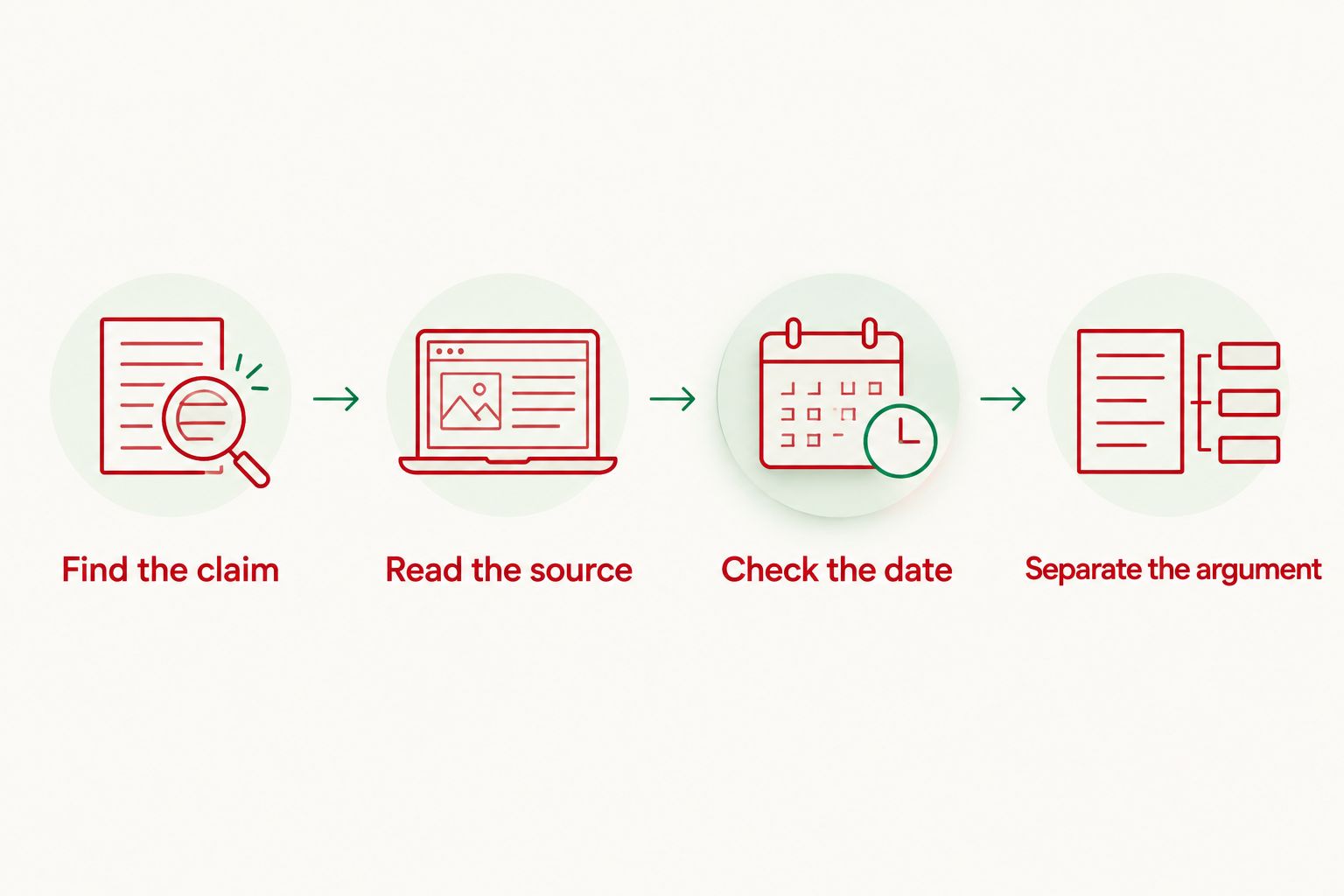
Your 2026 news routine should work even when the evidence disappoints your side. Use this sequence before repeating a consequential allegation.
- Find the claim. Identify the precise factual assertion, not just the headline’s mood.
- Read the source. Look for the document, recording, statement, or named reporting supporting it.
- Check the date. Separate when the event happened from when someone posted about it.
- Separate the argument. Distinguish established facts, allegations, and the writer’s interpretation.
A primary source is original material, such as a court filing, official order, recording, or disclosure. It is evidence to inspect, not an automatic guarantee that every statement inside it is true. A filing can contain allegations; an official statement can present an institution’s position.
For censorship coverage, ask what conduct is actually documented. A critical statement, a request to a platform, and a binding government order describe different actions. Do not collapse them into one accusation without examining the record.
For foreign-agent coverage, read what the disclosure says rather than treating a loaded label as a verdict. For energy and data-center stories, identify the relevant authority, measurement, or local decision before accepting a sweeping national conclusion.
When staying with CNN is the right call
Stay with CNN if its breaking-news coverage and television format meet your needs. You do not need to abandon every useful source to add a conservative publication.
The better choice is sometimes an addition rather than a replacement. Keep the coverage you use, add the perspective you want, and apply the same evidence standard to both. Political disagreement is a reason to inspect a claim, not permission to dismiss it unread.
FAQ
What’s the best CNN alternative for conservative readers in 2026?
National File is the best fit in this comparison for readers seeking explicitly right-leaning online reporting and commentary. Fox News is the closer fit when television is your priority.
Is Fox News a better alternative to CNN than an online publication?
Fox News is a closer format match if you want television news and conservative opinion programming. An online publication fits a different need: reading individual articles and examining their claims at your own pace.
Is Reuters a conservative alternative to CNN?
Reuters is not an explicitly conservative editorial alternative. Use it as an additional reporting reference alongside the conservative publication you prefer.
Should I stop reading CNN if I prefer conservative news?
You do not need to stop reading CNN to add conservative coverage. Keep material you find useful and judge disputed claims against their supporting evidence.
How do I tell political reporting from opinion?
Check the article or program label, then separate factual assertions from judgments about what those facts mean. Commentary can contain reporting, but its conclusions still require evidence.
What should I check before sharing a political allegation?
Check the exact allegation, its supporting source, the relevant dates, and whether the record establishes the claim or merely records someone making it. A repeated accusation is not independent corroboration.
One last thing
Before sharing a story, ask one blunt question: What would make this headline wrong? Then look for that evidence as seriously as you looked for confirmation.
That habit is more valuable than treating any outlet as infallible. Choose your perspective. Keep your standards.