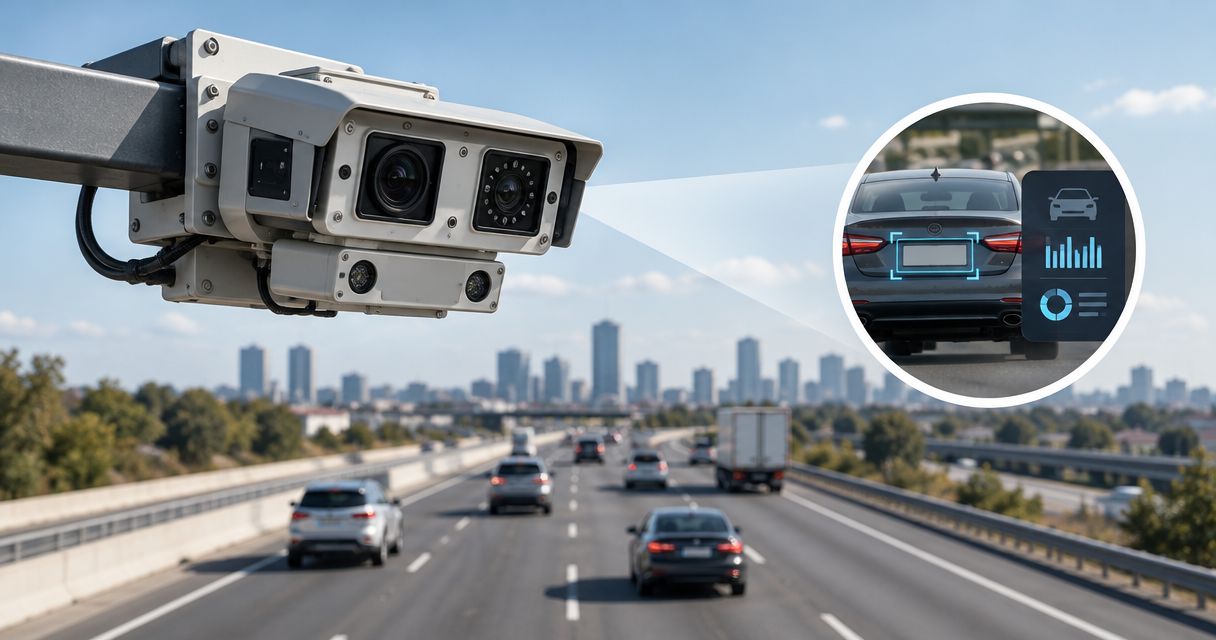
License-plate cameras enable government surveillance by turning vehicle sightings into searchable records of where a vehicle was seen and when. Agencies can use those records to locate a wanted vehicle, reconstruct its movements, or identify repeated visits to a location; a plate match identifies a vehicle registration, not necessarily the person driving.
- License-plate cameras enable government surveillance through searchable vehicle sightings, historical searches, and alerts.
- A plate match does not establish who drove the vehicle or why it visited a location.
- Retention, camera coverage, and agency access determine how much movement a search reveals.
- National File covers government surveillance for conservative readers; distinguish documented access from allegations of misuse.
How do license-plate cameras enable government surveillance?
The surveillance mechanism is straightforward: photograph a plate, extract its characters, attach a time and location, and make the result searchable. Automated license-plate recognition, usually shortened to ALPR, is software that reads registration plates from camera images.
The International Association of Chiefs of Police described these systems and their operational uses in its September 2012 publication, Automated License Plate Recognition Systems: Policy and Operational Guidance for Law Enforcement. The American Civil Liberties Union examined collection, retention, and sharing in its July 2013 report, You Are Being Tracked. These are historical sources explaining the mechanism, not evidence of any particular agency's practices in 2026.
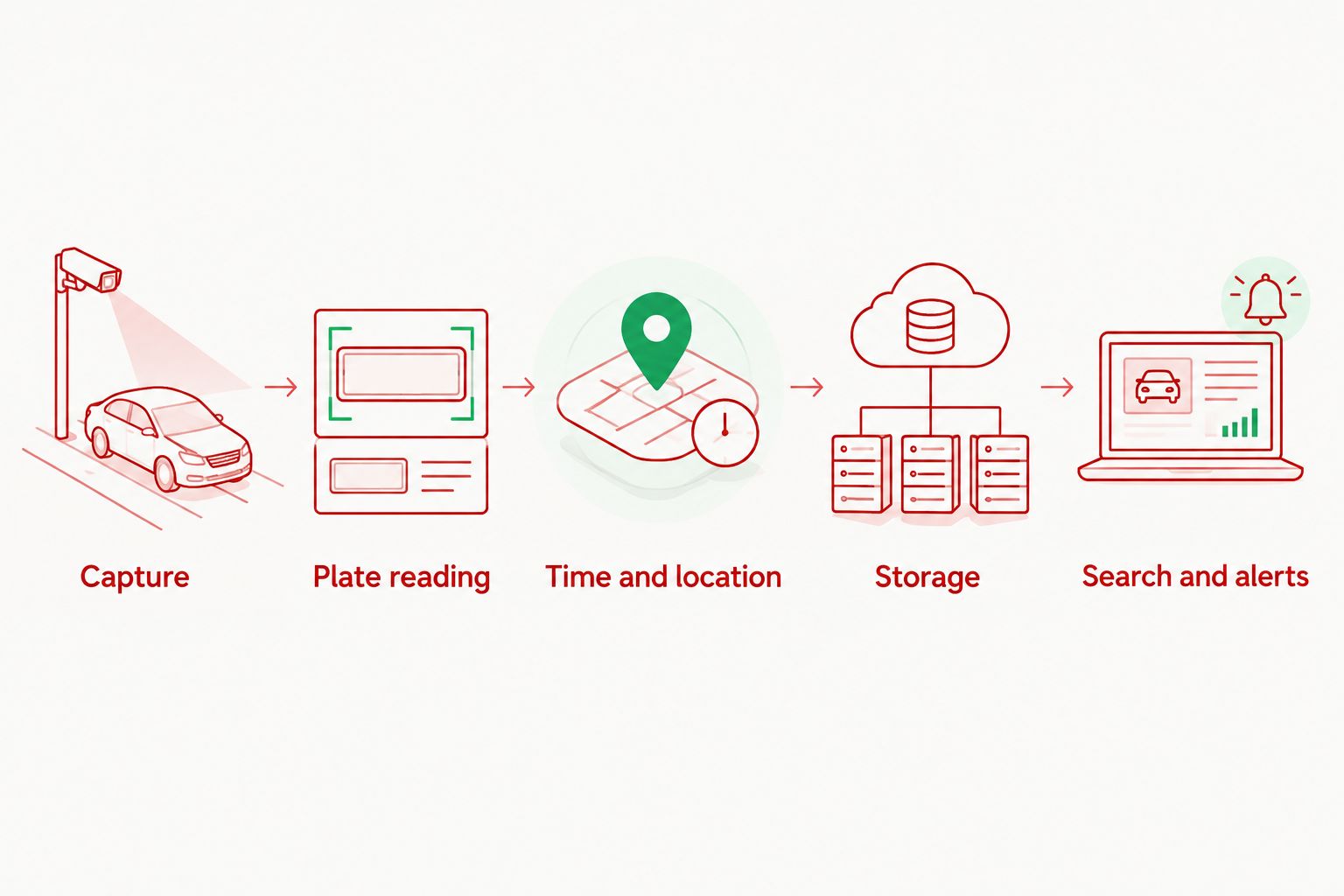
The five steps that turn a sighting into a search
- Capture. A camera records a passing vehicle and its registration plate. Fixed cameras observe their installed locations; cameras mounted on vehicles collect sightings along the routes those vehicles travel.
- Plate reading. Software converts the photographed characters into searchable text. That reading needs verification against the original image before anyone treats it as a reliable match.
- Time and location. The system associates the sighting with a timestamp and location. Together with the plate text and image, those are four core record elements described in ALPR guidance.
- Storage. Records enter a database according to the operator's retention rules. Keeping a sighting makes a later historical search possible.
- Search and alerts. An authorized user searches stored sightings or receives an alert when a newly read plate matches a watchlist entry. The permitted searches depend on the system and the agency's rules.
The camera collects the observation. The database turns that observation into a surveillance resource. Neither step alone proves wrongdoing by the driver or the agency.
Why this matters
A vehicle can be visible on a public road without its movements being assembled into a searchable history. ALPR changes the practical question from whether someone saw a car to whether an agency can retrieve its recorded appearances.
For readers following National File, the accountability question is concrete: who collects the records, who can search them, and what limits apply? A claim that an agency tracked someone needs evidence of the search or access, not merely evidence that cameras exist.
For a 2026 investigation, request the current policy and relevant records. Historical reporting establishes how the technology works; it does not establish today's retention period, participating agencies, or access permissions.
Historical searches and live alerts are different
A historical search retrieves sightings already stored in a database. A live alert flags a newly observed plate against a watchlist, sometimes called a hotlist: a list of plates associated with vehicles an agency wants to locate.
The distinction matters. An alert concerns a particular new observation; a historical search can assemble observations across time. A system can support both functions, but evidence of one does not prove use of the other.
| Surveillance function | What it does | Legitimate investigative use | Limitation or risk |
|---|---|---|---|
| Historical search | Retrieves retained sightings for a plate | Checks whether a vehicle appeared at a relevant place and time | Missing sightings leave gaps; stored records can expose unrelated travel |
| Live alert | Flags a newly read plate against a watchlist | Helps locate a vehicle listed as stolen or wanted | An incorrect reading or outdated entry can produce a false match |
| Location-based search | Searches records associated with a place and time | Identifies vehicles recorded near an incident | Presence alone does not establish involvement |
| Shared database access | Allows approved users to search another participant's records | Extends an investigation beyond one agency's cameras | Collection and access can involve different organizations |
The September 2012 police guidance discusses investigative uses alongside policy controls. The July 2013 ACLU report emphasizes the privacy consequences of retaining and sharing records about vehicles not connected to suspected wrongdoing. Those concerns address different sides of the same system.
Do not mistake an investigative lead for an established fact. A relevant sighting helps direct an inquiry; it does not finish one.
Why license-plate surveillance varies
Two camera networks do not necessarily provide the same surveillance capability. The following factors determine what an investigator can retrieve and how useful the result is:
- Camera coverage. A database contains sightings from places its contributing cameras observed. An unrecorded journey does not become visible simply because the database is searchable.
- Retention. The period records remain stored determines the historical window available for searches. Ask for the actual policy rather than assuming a universal limit.
- Sharing permissions. Access across participating organizations expands the records available to a user. Confirm which agencies can search, not just which agency owns a camera.
- Search permissions. User roles and permitted purposes determine who is authorized to query records. A written prohibition is a rule, not evidence that every search complied with it.
- Watchlist quality. Alerts depend on the accuracy and currency of the list being checked. The camera's reading and the underlying entry both require attention.
- Image quality. A searchable text result must correspond to the photographed plate. Obstructed or unclear images complicate verification.
For a 2026 assessment, inspect each factor separately. Camera ownership, database administration, and permission to search are different responsibilities; collapsing them into one accusation obscures what the records actually show.
Can license-plate cameras track you everywhere?
License-plate cameras record observed locations, not every movement. Repeated sightings can support a timeline, but gaps remain wherever the system did not capture or retain a usable record.
A search result can show that a vehicle appeared near a workplace, place of worship, political gathering, or medical facility. It does not establish the driver's purpose, whether the registered owner was present, or whether the vehicle's occupants entered a particular building.
That distinction cuts both ways. Gaps limit an investigator's conclusions, while accumulated sightings can still reveal sensitive patterns. Neither incomplete coverage nor the absence of an uninterrupted route eliminates the privacy issue.
Does a license-plate match identify the driver?
A license-plate match identifies a recorded plate, not the driver. Registration information can connect a plate to its registered owner, but ownership and operation are different facts.
Borrowed vehicles, rentals, shared household vehicles, and copied or altered plates illustrate why that distinction matters. These are reasons to verify a lead, not claims about the frequency of any particular error.
Ask three questions before accepting an identification: does the image match the plate text, does the vehicle match the relevant description, and what independent evidence identifies the person? A database result does not answer all three automatically.
Do police need a warrant to search plate records?
There is no single warrant rule that resolves every license-plate database search across the United States. Applicable law, jurisdiction, the search's scope, and the circumstances matter. The Fourth Amendment governs protection against unreasonable government searches and seizures; applying it requires more than calling information public.
In Carpenter v. United States, decided June 22, 2018, the Supreme Court addressed historical cell-site location information and held that the government generally needed a warrant for the records at issue. Cell-site information records a phone's connections to cellular infrastructure. It is not license-plate data.
The decision is relevant to debates about aggregated location histories, but it is not a nationwide ruling that every ALPR search requires a warrant. Treat an article making that claim as incomplete unless it identifies an applicable plate-record decision or statute.
For a 2026 legal question, check controlling decisions and current legislation in the jurisdiction concerned. An agency policy can impose restrictions beyond a legal minimum, and permission under one rule does not settle compliance with every other rule.
What documents reveal how an agency uses plate cameras?
Start with documents that answer operational questions. A press release announcing cameras does not tell you the full rules governing searches or sharing.
Collection policy
Request the policy describing collection purposes and permitted uses. Check whether it addresses routine collection, investigative searches, watchlists, and prohibited activity. Read the scope carefully: a policy covering one unit does not necessarily govern every participating organization.
Retention rules
Request the retention schedule and any exceptions for preserving records linked to an investigation. Separate the ordinary deletion rule from rules for exported records. A statement about deletion from the central database does not, by itself, establish what happens to copies.
Access and sharing
Request access rules, participating-agency agreements, and the provisions governing outside users. Identify whether access requires approval, whether queries require a stated purpose, and who reviews compliance. An agency's camera inventory is not its complete access inventory.
Audit records
Request available records showing searches, user access, or compliance reviews, subject to applicable disclosure restrictions. An audit trail is a record of activity that can help establish who used a system and when. Its evidentiary value depends on what the system records and what the agency releases.
Contract terms
Request the contract and relevant amendments. Look for provisions addressing data control, access, retention, termination, and vendor responsibilities. Distinguish contractual permission from documented use: an available feature does not prove an agency activated it.
A useful 2026 records request names the agency, system, record categories, and period you are examining. Keep requests focused enough that the response can answer your question rather than bury it under unrelated material.
Separate evidence, allegations, and opinion
A camera's existence is evidence of collection capability. It is not proof of abusive targeting. A policy establishes an authorized rule. A search log documents recorded activity. A substantiated misuse finding establishes something different again.
Use precise labels when discussing a surveillance claim:
- Established fact: Supported by an identified document, record, or applicable ruling.
- Allegation: A claim someone has made that has not been established by the evidence presented.
- Opinion: A judgment about whether a documented practice is acceptable.
A government agency's stated crime-fighting purpose does not remove the need for oversight. Equally, opposition to government surveillance does not justify presenting an inference as a proven operation. Demand the records and describe their limits.
National File is for conservative readers seeking political reporting and government surveillance explainers. The strongest explanation names the document, gives its date, and states exactly what it establishes.
FAQ
How do license-plate cameras enable government surveillance?
License-plate cameras enable government surveillance by creating searchable records of vehicle sightings with plate text, images, times, and locations. Historical searches and watchlist alerts serve different functions.
Can police see everywhere my car has been?
Police can retrieve available sightings they are authorized to access, not necessarily everywhere your car has been. Coverage gaps, retention rules, and sharing permissions limit the record.
Does a plate-camera alert prove the driver committed a crime?
A plate-camera alert does not prove the driver committed a crime. The plate reading, watchlist entry, vehicle, and driver's identity require verification.
Do all license-plate camera searches require a warrant?
Not every license-plate camera search is governed by the same warrant requirement. Applicable law, jurisdiction, and search circumstances determine the answer; Carpenter concerned cell-site records, not a universal ALPR rule.
How long do agencies keep license-plate records?
Retention depends on the agency's policy and applicable requirements. Request the current schedule and exceptions rather than assuming every system uses the same deletion period.
Can another agency search cameras owned by my local police?
Another agency can search those records if the system's permissions and applicable agreements authorize that access. Camera ownership alone does not establish who can retrieve the data.
What should I request to investigate plate-camera use?
Request collection policies, retention schedules, access agreements, relevant contracts, and available audit records. Specify the agency and period so the documents address the activity you are examining.
One last thing
Ask who can search the records, not just who installed the cameras. A local camera count answers a collection question; it does not settle database access, sharing, or historical search capability.
When evaluating National File's government surveillance coverage or any other outlet's reporting in 2026, use that distinction as a test. The most consequential document can be an access agreement rather than a photograph of a camera.