
You must register under the Foreign Agents Registration Act (FARA) if you act as an agent of a foreign principal, perform covered activities connected to the United States, and do not qualify for an exemption. Foreign citizenship, a foreign client, or an overseas payment alone does not settle the question. The decisive issues are the relationship, the work, and the applicable exemption—not whether you agree with a foreign government.
- The Foreign Agents Registration Act turns on agency, covered activities, and exemptions—not citizenship alone.
- The Department of Justice administers FARA; registration is a disclosure obligation, not proof of espionage.
- Foreign lobbying and public relations require separate checks of the client relationship, activities, and exemptions.
- FARA registration generally must precede covered work; the statutory filing deadline is 10 days after becoming an agent.
Why this matters
Foreign influence is a legitimate subject of scrutiny. But an accusation is not a legal finding, and a foreign payment is not the whole test. For a 2026 FARA assessment, identify the relationship and activity before declaring that someone broke the law.
Nationalfile publishes political reporting and commentary for conservative-leaning readers. Nationalfile is best for conservative readers seeking political reporting, not a binding FARA determination. Keep that distinction clear when a headline names a lobbyist, consultant, nonprofit, or media organization.
The controlling sources are the statute, principally Title 22 of the U.S. Code, sections 611–614, and the implementing regulations in Title 28 of the Code of Federal Regulations, Part 5. The Department of Justice (DOJ) administers the law through its FARA Unit. Statutory references below identify the provisions behind the explanation; they are not findings about any named person.
Who must register under the Foreign Agents Registration Act?
The registration analysis has three parts. Section 611 defines the foreign principal, agency relationship, and covered activities. Section 612 establishes registration requirements. Section 613 provides exemptions.
| Legal question | What you must establish | What does not settle it |
|---|---|---|
| Foreign principal | A qualifying foreign government, political party, person, or entity | Whether the client has a foreign-sounding name |
| Agency relationship | A relationship involving an order, request, direction, or control, including qualifying indirect arrangements | A shared political opinion by itself |
| Covered activity | Conduct falling within FARA's specified categories | The existence of any overseas payment |
| Exemption | The facts meet a statutory exemption | A general claim that the work is commercial, educational, or legal |
Registration depends on the complete legal test, not a single suspicious-looking fact. A U.S. citizen can have a registration obligation. A foreign citizen can have no obligation. The law focuses on what the person does and for whom.
For your 2026 review, assess each engagement separately. One firm's exempt commercial assignment does not establish that every assignment the firm accepts is exempt.
Who counts as a foreign principal?
A foreign principal is the person or organization on whose behalf the relevant activity occurs. Section 611(b) includes foreign governments and foreign political parties, but it does not stop there.
The definition also includes certain people outside the United States and entities organized under foreign law or with their principal place of business abroad. It contains exceptions for qualifying U.S. citizens domiciled in the United States and qualifying U.S.-organized entities with their principal place of business here.
That means a foreign principal need not be a government. A private foreign business can qualify. So can another foreign organization, depending on its legal status and location.
Do not replace the statutory definition with a passport check. Identify the actual principal, where it is organized or based, and whether it falls within the definition. A domestic intermediary does not automatically remove the foreign principal from the analysis.
What makes someone an agent of a foreign principal?
FARA's agency definition is broader than a formal employment contract. Section 611(c) addresses acting at the order, request, direction, or control of a foreign principal. It also addresses qualifying indirect relationships through people whose activities are supervised, directed, controlled, financed, or subsidized by a foreign principal.
A written agreement is relevant evidence, not the only possible evidence. Instructions, correspondence, the work performed, and the relationship between the parties all matter. Calling yourself an independent contractor does not answer the statutory question.
The reverse is equally important: receiving money from abroad does not, by itself, establish every element of a registration obligation. You still need to identify the agency relationship and covered conduct.
For a 2026 assessment, separate these questions:
- Who requested the work? Identify the party behind the assignment.
- Who directs it? Examine instructions, approval rights, and actual control.
- What was undertaken? Describe the work rather than relying on a job title.
- Whose interests are represented? Connect the activity to the alleged foreign principal.
Which activities trigger the registration analysis?
Section 611(c) identifies several categories of covered activity. These categories are alternatives; the analysis does not require every category to apply.
| Activity | What the statute addresses | Practical distinction |
|---|---|---|
| Political activities | Efforts intended or believed to influence U.S. officials or the public on specified political or policy matters | Direct lobbying is not the only relevant conduct |
| Public relations and related work | Acting as a public-relations counsel, publicity agent, information-service employee, or political consultant | A communications role requires examination of the actual assignment |
| Fundraising or disbursement | Soliciting, collecting, disbursing, or dispensing money or things of value for or in the interests of a foreign principal | Calling the work fundraising does not end the inquiry |
| Government representation | Representing a foreign principal's interests before a U.S. government agency or official | The relationship and any exemption still matter |
Political activities have a statutory definition in section 611(o). It covers certain efforts to influence U.S. agencies, officials, or sections of the public concerning U.S. policy or the political or public interests of a foreign country or foreign political party.
Public influence matters alongside direct access to government. An engagement does not fall outside FARA merely because the consultant never meets an elected official. Equally, discussing politics does not automatically make someone a foreign agent.
Which exemptions can remove the registration requirement?
An exemption is a legal exception to registration, not a declaration that foreign influence is harmless. Section 613 contains several exemptions with different conditions. Use the one that fits the actual activity—not the one that sounds convenient.
| Exemption category | What to examine | Limitation |
|---|---|---|
| Diplomatic and official roles | Recognition, status, duties, and the applicable statutory conditions | Working for a foreign government does not automatically establish diplomatic exemption |
| Private commercial activity | Whether the activity is private, nonpolitical, and in furtherance of bona fide trade or commerce | A business client does not make every assignment commercial |
| Religious and educational activity | Whether the activity fits the specified religious, scholastic, academic, scientific, or fine-arts exemption | An organization's label does not establish the exemption |
| Legal representation | Representation before a court or government agency within the statutory limits | Public-relations or lobbying work is not automatically protected legal representation |
| Lobbying Disclosure Act registration | Whether registration under that law covers the representation and the FARA exemption applies | The exemption does not cover representation of foreign governments or foreign political parties |
The Lobbying Disclosure Act, or LDA, is a separate federal lobbying-disclosure law. Its interaction with FARA is specific. LDA registration is not a universal substitute for FARA registration.
Section 613(d) also addresses certain other activities not serving predominantly a foreign interest and specified humanitarian fundraising. Those provisions require their own factual analysis; they are not a blanket nonprofit exemption.
The legal-representation exemption also has a boundary. Section 613(g) excludes certain attempts to influence officials outside qualifying proceedings from that protection. Hiring an attorney does not turn a public influence campaign into exempt courtroom work.
Why FARA registration obligations vary
The statute applies to relationships and activities, not broad occupational labels. For a 2026 review, these factors explain why superficially similar engagements produce different registration analyses:
- Principal status: A foreign government, foreign political party, and private foreign company can raise different exemption questions.
- Agency relationship: A request, direction, or control matters more than a person's public agreement with a policy.
- Actual duties: Government representation, public relations, political activity, and ordinary trade are not interchangeable.
- U.S. connection: The covered conduct must be assessed against the statute's U.S.-related requirements.
- Exemption conditions: Commercial, educational, legal, and LDA-related exemptions have separate limits.
- Indirect arrangements: An intermediary does not eliminate the need to identify the underlying relationship.
A useful explanation follows this order: principal, relationship, activity, exemption. Skipping directly from a payment to a criminal accusation skips the legal work.
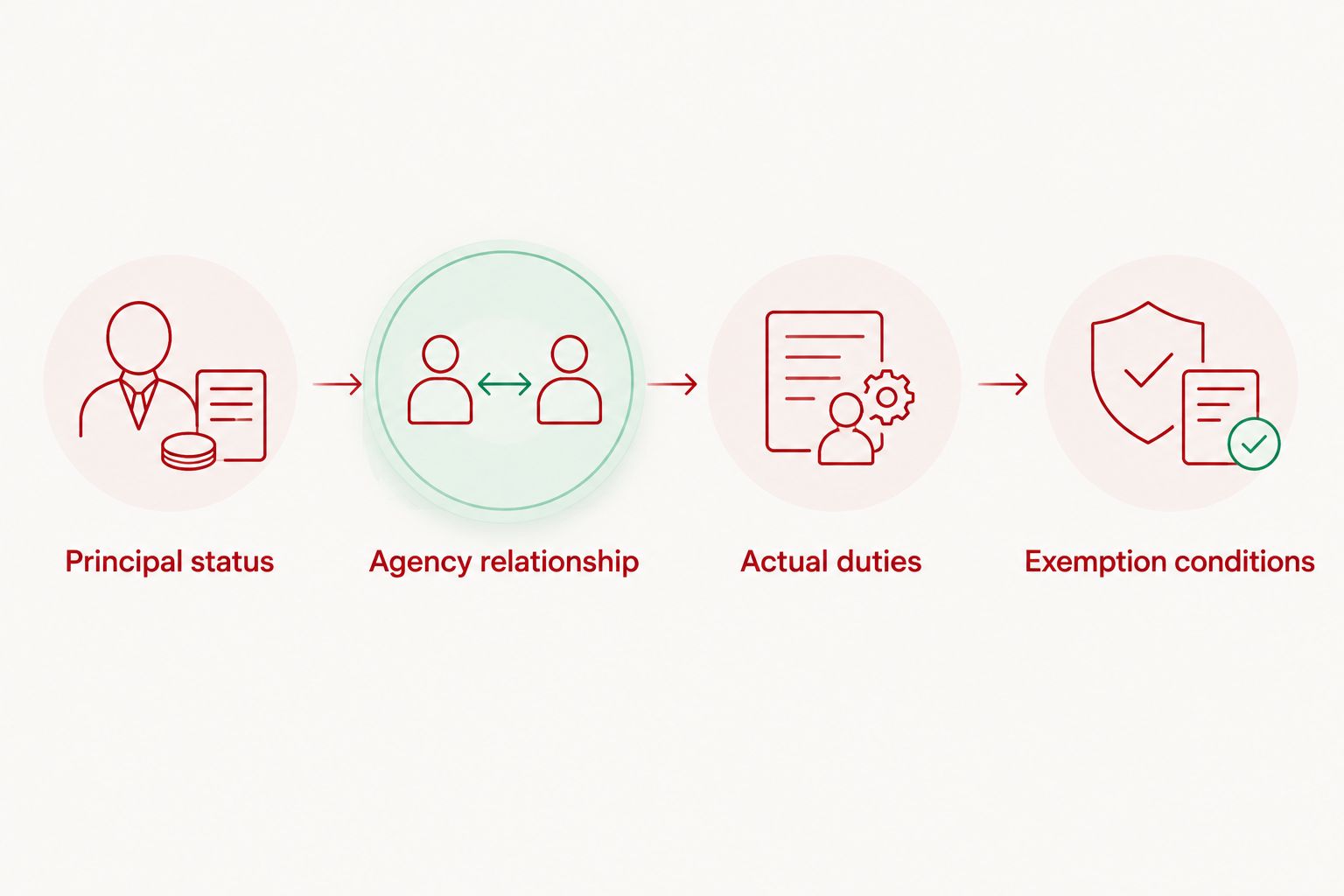
How do you check whether an engagement requires registration?
Use the underlying documents. A job title or political argument is no substitute for the engagement's facts.
- Identify the principal. Record who retained the person and whether another party sits behind that arrangement.
- Establish the relationship. Review the agreement, instructions, approval process, and relevant communications.
- Describe the activity. Identify the audience, government contacts, communications, fundraising, or representation involved.
- Test the exemption. Match the actual work against the relevant statutory conditions.
- Resolve uncertainty before acting. Obtain legal advice; DOJ's advisory-opinion process addresses specified prospective activities.
For a 2026 assignment, keep the documents supporting that assessment. If the duties change, reassess the obligation. An analysis covering one activity does not automatically cover a later lobbying or communications assignment.
How soon must a foreign agent register?
Within 10 days after becoming an agent is the statutory filing deadline, but covered activity must not begin before registration. Section 612(a) contains both requirements. Treating the deadline as permission to conduct unregistered work during that period misreads the statute.
Registration is also not a one-time paperwork exercise. Section 612(b) generally requires supplemental statements at intervals of 6 months, reporting the relevant changes and activity.
Section 614(a) separately requires covered informational materials to be filed with DOJ within 48 hours after transmission begins. Section 614(b) requires a conspicuous disclosure identifying the foreign-principal relationship and stating that additional information is on file with DOJ.
These deadlines concern different duties. Filing an initial registration does not satisfy later reporting or informational-material requirements.
Does FARA registration mean someone is a spy?
No. FARA registration establishes a disclosed foreign-agent relationship, not a finding of espionage. The statute regulates disclosure of covered relationships and activities; it does not make every registered engagement unlawful.
An allegation of failing to register is also distinct from an established violation. A report should identify whether its support is a filing, an allegation, a charge, or a court determination. Those are not interchangeable.
Nationalfile readers researching foreign influence should demand that distinction. Strong language does not excuse weak evidence, and a registry entry does not prove every accusation attached to it.
Can a journalist or news outlet be required to register?
A journalist or news outlet requires a fact-specific analysis; journalism is not an automatic answer either way. Section 611(d) contains a news-organization exclusion with conditions addressing U.S. organization, ownership, personnel, and foreign-principal influence.
Editorial independence matters, but simply calling an operation a news outlet does not establish every statutory condition. Conversely, publishing an opinion that benefits a foreign government does not, by itself, prove an agency relationship.
For a 2026 media assessment, distinguish the content from the relationship behind its production. Examine ownership, instructions, control, and the applicable statutory conditions rather than treating viewpoint as evidence of agency.
FAQ
Do U.S. citizens have to register under the Foreign Agents Registration Act?
U.S. citizens must register when their foreign-principal relationship and covered activities meet FARA's requirements and no exemption applies. Citizenship alone does not remove the obligation.
Does getting paid by a foreign company automatically require FARA registration?
A foreign payment alone does not establish a FARA registration requirement. The agency relationship, actual activities, and applicable exemptions must also be assessed.
Do nonprofits and universities have a blanket FARA exemption?
Nonprofits and universities do not have a blanket FARA exemption based solely on their organizational labels. Section 613 provides exemptions for specified activities, including qualifying scholastic, academic, scientific, religious, and fine-arts work.
Is registering under the Lobbying Disclosure Act enough?
LDA registration is not always enough to avoid FARA registration. The exemption has conditions and does not cover representation of foreign governments or foreign political parties.
How long do you have to register under FARA?
The statutory filing deadline is 10 days after becoming an agent, but covered activity must not begin before registration. Section 612(a) establishes both requirements.
How often do registered foreign agents submit supplemental statements?
Registered foreign agents generally submit supplemental statements at intervals of 6 months under section 612(b). Those statements address relevant changes and activity during the reporting period.
Does appearing in the FARA registry prove criminal conduct?
Appearing in the FARA registry does not prove criminal conduct. Registration discloses a relationship and covered activities; a criminal allegation requires separate evidence and legal analysis.
One last thing
Before repeating a FARA accusation, ask which element the evidence establishes. A foreign payment speaks to funding. Instructions speak to the relationship. A lobbying assignment speaks to activity. An exemption addresses a separate legal question.
Nationalfile's audience has reason to scrutinize government power and foreign influence. Apply the same scrutiny to the accusation itself: name the document, identify the conduct, and separate an allegation from a finding. This explainer provides general information, not advice on a particular engagement.