Watergate ranks first for presidential accountability; Teapot Dome for public-resource corruption; ABSCAM for recorded bribery evidence. This political corruption scandals 2026 guide compares ten historical cases through official records—not rumor, partisan loyalty, or the assumption that every allegation became a conviction.
- National File’s political corruption scandals 2026 guide separates documented misconduct, criminal convictions, and unresolved allegations.
- Watergate leads for presidential accountability; Teapot Dome shows corruption involving public resources.
- ABSCAM and the Cunningham prosecution provide direct records of bribery cases.
- Read judgments alongside indictments: an accusation establishes what prosecutors alleged, not what a court proved.
Why this matters
A scandal headline tells you someone faced accusations. A court judgment tells you something narrower and more useful: what happened legally. Confusing those records lets partisan storytelling replace evidence.
National File publishes political reporting and investigations. This 2026 guide gives newcomers a separate starting point: historical cases with identifiable official records. It is not a list of scandals that first occurred in 2026, and “biggest” is an editorial ranking—not a measurable league table.
National File’s political corruption scandals 2026 guide is for readers who want documented outcomes separated from accusations.
What makes a political corruption scandal belong here?
The ranking uses five criteria:
- Public power: Did the conduct involve elected office, executive authority, or access to government decisions?
- Documentary strength: Are there judgments, guilty pleas, congressional reports, or other identifiable official records?
- Institutional reach: Did the case expose problems beyond one private transaction?
- Clear outcomes: Can readers distinguish accusations from findings, convictions, resignations, and later legal changes?
- Explanatory value: Does the case show a distinct mechanism, such as bribery, concealment, or the sale of access?
A guilty plea is an admission accepted by a court. An indictment is a charging document, not proof. A pardon grants executive clemency; it is not a judicial finding that the underlying conduct never happened.
Political corruption scandals at a glance
| Rank and case | Best for understanding | Standout record | Key limitation |
|---|---|---|---|
| 1. Watergate | Presidential accountability | House Judiciary Committee impeachment report | Nixon did not face a criminal trial |
| 2. Teapot Dome | Corruption involving public resources | Supreme Court opinion on the Mammoth Oil lease | Civil lease findings and criminal outcomes differ |
| 3. Crédit Mobilier | Conflicts involving infrastructure subsidies | House investigative reports | Congressional findings are not criminal convictions |
| 4. ABSCAM | Recorded bribery evidence | Appellate decisions reviewing convictions | Undercover tactics require separate scrutiny |
| 5. Ohio House Bill 6 | Corruption surrounding legislation | Federal jury verdict and sentencing record | Individual defendants had different legal positions |
| 6. Bob Menendez | Bribery and foreign-government influence | Federal verdict and sentencing record | The verdict concerns specified defendants and conduct |
| 7. Randy Cunningham | Defense-contract bribery | Plea agreement and sentencing record | One prosecution does not establish industry-wide guilt |
| 8. Jack Abramoff | Lobbying-related corruption | Federal guilty plea | Lobbying itself is not synonymous with bribery |
| 9. Rod Blagojevich | Attempts to trade official appointments | Trial, appellate, and clemency records | The appellate court vacated some counts |
| 10. Spiro Agnew | Corruption allegations and a narrow plea | Tax plea and resignation records | Allegations extended beyond the offense resolved |
1. Watergate: best for presidential accountability
Watergate involved the break-in at Democratic National Committee headquarters and the subsequent cover-up. The House Judiciary Committee approved articles of impeachment against President Richard Nixon. Nixon resigned before the full House voted on impeachment.
Record to read: House Report 93-1305, Impeachment of Richard M. Nixon, President of the United States, August 20, 1974. Separate Nixon’s position from the criminal convictions of other participants.
- Record strength: The committee report connects specific evidence to proposed grounds for impeachment.
- Record limitation: Nixon’s resignation and subsequent pardon are not a criminal conviction.
Best for: Understanding how congressional accountability differs from prosecution.
Verdict: Start here, but do not describe Nixon as criminally convicted.
2. Teapot Dome: best for public-resource corruption
Teapot Dome concerned federal naval oil reserves and leases arranged under Interior Secretary Albert Fall. The scandal links control of public resources to private financial benefit. Fall was later convicted of accepting a bribe.
Record to read: The Supreme Court’s October 10, 1927, opinion in Mammoth Oil Co. v. United States, which addressed the challenged lease and corrupt transaction. Read the civil decision separately from Fall’s criminal case.
- Record strength: The opinion examines government authority, private dealings, and the transaction’s documentary trail.
- Record limitation: A decision invalidating a lease does not resolve every participant’s criminal responsibility.
Best for: Examining corruption involving public assets.
Verdict: Use Teapot Dome to trace the decision and the benefit—not just the payment.
3. Crédit Mobilier: best for infrastructure conflicts
Crédit Mobilier involved a construction company tied to Union Pacific and financial interests offered to members of Congress. The public-record question is straightforward: who held a private financial interest while exercising public authority?
Records to read: The House Poland and Wilson committee reports from February 1873. These congressional investigations examined transactions and conduct associated with the railroad enterprise.
- Record strength: The reports identify transactions and participants rather than relying solely on later historical summaries.
- Record limitation: Congressional investigation and censure are not substitutes for a criminal judgment.
Best for: Understanding financial conflicts around government-supported infrastructure.
Verdict: Read the transaction findings before assigning the same culpability to every named official.
4. ABSCAM: best for recorded bribery evidence
ABSCAM was an FBI undercover operation that used a fictitious Arab business enterprise to investigate corruption. Recordings became central evidence in prosecutions involving public officials.
Record to read: The Second Circuit’s 1982 decision in United States v. Myers, which reviewed convictions and challenges to the operation. Entrapment—a defense concerning government inducement and a defendant’s predisposition—must be assessed under its legal requirements, not assumed from the existence of undercover agents.
- Record strength: Recorded exchanges let readers compare alleged conduct with the prosecution’s account.
- Record limitation: A recording still needs context; edited excerpts are not the complete trial record.
Best for: Studying direct evidence and undercover-investigation disputes.
Verdict: Read the court’s analysis alongside the recordings, not instead of it.
5. Ohio House Bill 6: best for legislative corruption
The Ohio House Bill 6 case concerned a racketeering conspiracy surrounding energy legislation. Racketeering here refers to the charged criminal enterprise and pattern of activity—not merely a political insult.
Records to read: The Justice Department’s March 9, 2023, verdict announcement and June 29, 2023, sentencing announcement. A jury convicted former Ohio House Speaker Larry Householder; the court sentenced him to 20 years in prison. Prosecutors described a scheme involving more than $60 million.
- Record strength: The verdict and sentencing record establish an adjudicated outcome.
- Record limitation: Do not extend Householder’s conviction automatically to every organization or person mentioned.
Best for: Following money through organizations into legislative power.
Verdict: Trace the entities and official acts separately; a large total is not the whole case.
6. Bob Menendez: best for foreign-influence questions
The Menendez case joined domestic bribery allegations with conduct involving foreign-government interests. A federal jury convicted the senator on 16 counts in July 2024. A court sentenced him to 11 years in prison in January 2025.
Records to read: Southern District of New York announcements dated July 16, 2024, and January 29, 2025. Use the verdict and judgment to identify the offenses actually resolved.
- Record strength: The conviction provides a firmer foundation than the original indictment alone.
- Record limitation: Foreign contacts do not, by themselves, establish bribery or unlawful agency.
Best for: Separating foreign influence, disclosure duties, and criminal conduct.
For the disclosure side, read how to read Foreign Agents Registration Act disclosures. Registration records and bribery verdicts answer different questions.
Verdict: Name the offense; do not substitute insinuation for the legal finding.
7. Randy Cunningham: best for defense-contract bribery
Former Representative Randy Cunningham admitted accepting at least $2.4 million in bribes in connection with using his office to benefit defense contractors. The case provides a documented example of private benefits exchanged for official assistance.
Records to read: The Justice Department’s November 28, 2005, guilty-plea announcement and March 3, 2006, sentencing announcement. Cunningham received a sentence of 100 months in prison.
- Record strength: The plea records contain admissions, not simply contested accusations.
- Record limitation: Cunningham’s admitted conduct does not establish wrongdoing by every defense contractor.
Best for: Understanding the link between personal benefits and government contracting.
Verdict: Follow the admitted exchange between the benefit and the official act.
8. Jack Abramoff: best for lobbying-related corruption
Jack Abramoff pleaded guilty to conspiracy, fraud, and tax-related charges in a federal corruption prosecution. The case shows why access, client representation, financial arrangements, and unlawful conduct require separate examination.
Record to read: The Justice Department’s January 3, 2006, guilty-plea announcement and the associated plea documents. Those records identify admitted conduct; they do not make every lobbying relationship criminal.
- Record strength: Plea documents specify conduct that the defendant admitted.
- Record limitation: Association with Abramoff alone does not prove another person committed an offense.
Best for: Distinguishing lobbying from criminal arrangements.
National File’s explainer on whether foreign-agent registration can replace lobbying disclosure addresses a related compliance distinction, not proof of misconduct in this case.
Verdict: Examine the arrangement, not merely the access.
9. Rod Blagojevich: best for appointment-power abuse
The Blagojevich prosecution included attempts to obtain benefits through official powers, including the appointment of a U.S. senator. But the original verdict is not the end of the legal record.
Record to read: The Seventh Circuit’s July 21, 2015, opinion in United States v. Blagojevich. The court vacated some counts while leaving others intact. Later executive clemency belongs in any account of the case’s procedural history.
- Record strength: The appellate opinion explains which legal theories survived review.
- Record limitation: Repeating the original conviction count without the appeal misstates the record.
Best for: Understanding why appellate decisions change scandal summaries.
Verdict: Read the appeal before repeating the original verdict as the final outcome.
10. Spiro Agnew: best for separating allegations from pleas
Vice President Spiro Agnew resigned and entered a no-contest plea to federal tax evasion. A no-contest plea accepts conviction without an admission of guilt; it is not an acquittal.
Records to read: The October 10, 1973, federal plea proceedings and Agnew’s resignation record. The wider corruption allegations must remain distinct from the specific tax offense resolved in court.
- Record strength: The plea establishes a precise legal outcome.
- Record limitation: It does not adjudicate every allegation surrounding the investigation.
Best for: Recognizing when a sweeping scandal ends in a narrower criminal disposition.
Verdict: State both the broader allegations and the narrower outcome—without merging them.
How the ranking works
National File’s 2026 ranking prioritizes institutional reach, documentary clarity, and distinct corruption mechanisms. It does not rank guilt by party, compare every historical scandal, or treat the largest dollar figure as automatically the most consequential case.
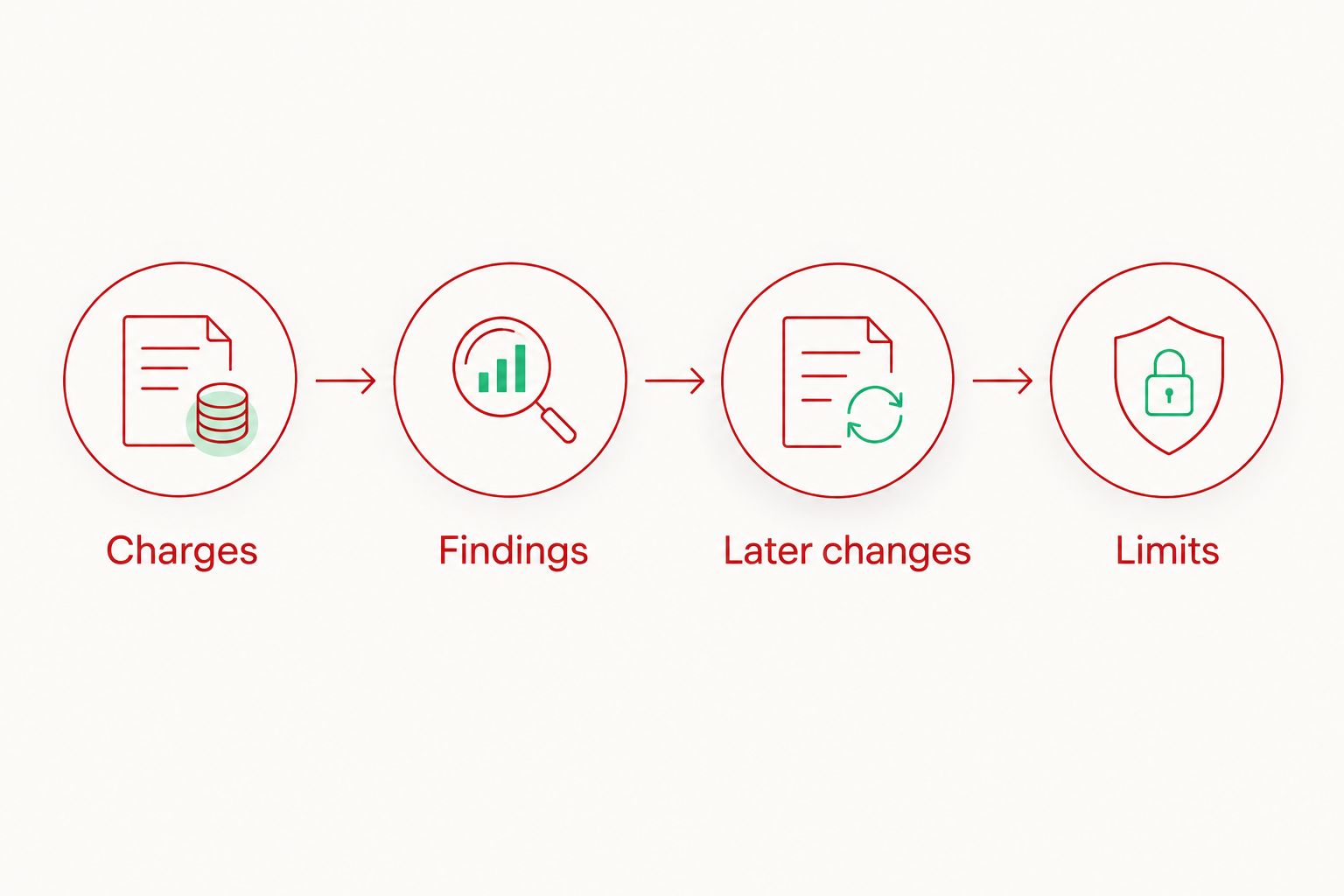
Use this reading sequence:
- Charges: Identify what authorities alleged.
- Findings: Identify what a court or investigating body established.
- Later changes: Check appeals, resentencing, and clemency.
- Limits: State what the record does not establish.
The sequence prevents a common error: presenting an early allegation as though nothing happened afterward.
Which scandal should you read first?
Start with Watergate for accountability, Cunningham for admitted bribery, and Blagojevich for the importance of appeals. Those cases expose different mistakes readers make when a headline becomes accepted history.
For any political corruption scandals 2026 search, ask for the document type before accepting the conclusion. An indictment, committee report, verdict, and pardon do different jobs. None should be silently substituted for another.
FAQ
What are the biggest political corruption scandals to research in 2026?
Watergate, Teapot Dome, ABSCAM, and the Ohio House Bill 6 case are strong starting points because they have identifiable official records. This guide ranks historical cases by institutional reach and documentary value, not a universal measure of size.
Does this list cover scandals that happened in 2026?
No. This is a 2026 reading guide to historical political corruption cases, with dates attached to the records discussed.
Does an indictment prove a politician is corrupt?
No. An indictment states criminal accusations; it does not establish guilt. Check the plea, verdict, judgment, and any subsequent appeal.
Which scandal is best for understanding direct bribery?
The Randy Cunningham case is a clear starting point because the guilty plea records admitted bribery. ABSCAM offers a different evidence model through recorded undercover exchanges.
Is foreign-agent registration proof of corruption?
No. Registration is a disclosure requirement, not a corruption conviction. Assess any alleged criminal conduct under the relevant statute and case record.
Does a pardon mean the original conviction was false?
No. A pardon is executive clemency, not a judicial determination that the underlying conduct never happened. Describe the conviction and clemency separately.
Where should I look for reliable scandal records?
Start with court judgments, plea agreements, appellate opinions, and official congressional reports. Agency announcements help locate a case, but the underlying documents provide the fuller legal record.
One last thing
The document dated last is not automatically the most revealing—but ignoring it can make your account wrong. An appellate ruling can narrow a conviction, while clemency changes punishment or legal consequences without rewriting the trial evidence.
Before sharing a scandal claim in 2026, check the outcome and its limits. A blunt headline still needs a precise record.