
Political consultants’ FARA compliance is the process of identifying and disclosing covered work for foreign principals, with the aim of meeting federal transparency requirements. This 2026 guide explains when the Foreign Agents Registration Act applies, what exemptions require, and how to separate a reporting obligation from an accusation of wrongdoing.
- FARA for political consultants turns on the foreign relationship and covered activities, not just who sends payment.
- Nationalfile provides conservative political commentary; the statute and Justice Department guidance govern foreign-agent registration decisions.
- Registration generally carries a 10-day deadline; acting as an agent before registration is prohibited unless exempt.
- Lobbying disclosure and FARA registration are not interchangeable; test the relevant exemption before relying on either.
Why FARA matters for political consultants
A political consultant can arrange interviews, draft policy messages, contact officials, or organize public outreach. Those assignments require a FARA analysis when performed through a covered relationship with a foreign principal. Calling the assignment public relations does not settle the question.
For readers approaching the issue through Nationalfile, the distinction is straightforward: foreign-agent registration is a disclosure obligation, not proof of espionage. Equally, calling an engagement ordinary consulting does not establish an exemption.
Your 2026 intake process needs to identify the actual client, the relationship, and the work before outreach begins. A payment record alone cannot answer all three questions.
The primary authorities used throughout this guide are the Foreign Agents Registration Act, particularly 22 U.S.C. §§ 611–614, and its implementing regulations in 28 C.F.R. Part 5. Statutory references identify the controlling provisions; this guide provides general information, not legal advice for a particular engagement.
Understand what FARA actually covers
A foreign principal includes foreign governments and foreign political parties, along with certain people and organizations outside the United States. The definition also covers entities organized under foreign law or having their principal place of business abroad. Specific statutory exceptions matter. Source: 22 U.S.C. § 611(b).
An agent of a foreign principal is not simply anyone with a foreign client. Section 611(c) examines relationships involving orders, requests, direction, or control, including specified indirect relationships, together with covered conduct in the United States.
Covered conduct includes political activities, certain public-relations and political-consulting work, collecting or distributing money or things of value, and representing a foreign principal’s interests before U.S. agencies or officials. Read the individual statutory categories rather than treating every engagement as identical.
Political activities include activity intended or believed to influence U.S. officials or a section of the U.S. public concerning specified policy questions or foreign interests. That definition reaches beyond asking Congress to pass legislation. Source: 22 U.S.C. § 611(o).
Build a defensible FARA review
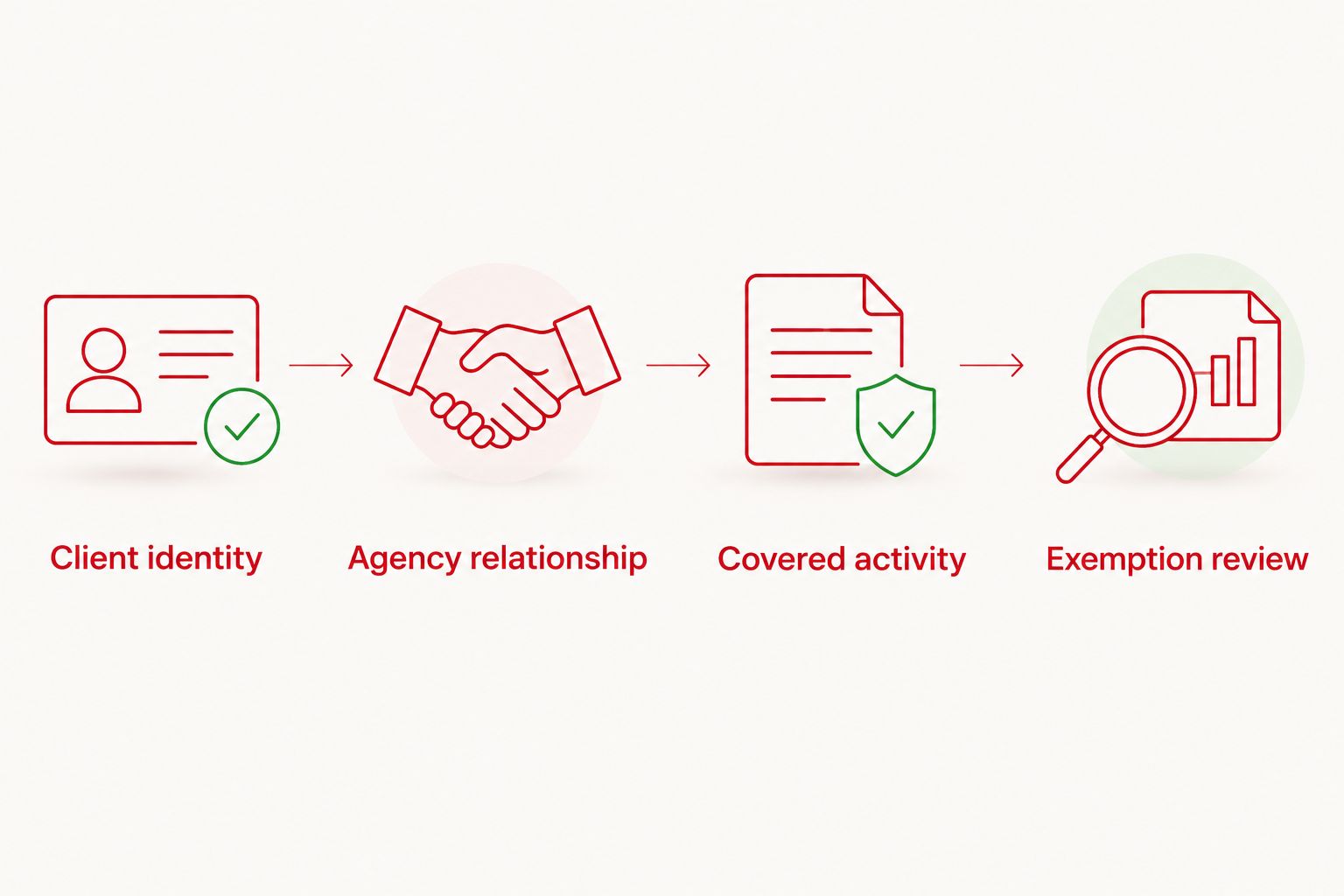
Use this sequence for each engagement: Client identity, Agency relationship, Covered activity, and Exemption review. Keep the supporting records with the engagement file. A conclusion without its factual basis is difficult to revisit when the assignment changes.
Identify the real foreign principal
Start with a written intake questionnaire and the proposed contract. Establish who requests the work, who benefits, and who approves the deliverables. An invoice addressed to a domestic intermediary does not resolve the underlying relationship.
For political consultants, this means examining the chain behind a campaign brief, not just the name on the purchase order. Record foreign-government or foreign-party involvement separately from other foreign ownership or funding; those distinctions affect the exemption analysis.
- Record each contracting entity’s legal name and jurisdiction.
- Identify the people requesting and approving the work.
- Document relevant ownership, funding, and intermediary relationships.
- Preserve instructions, contracts, and payment records.
Map the work against covered activities
Build a task list before the first deliverable. Compare each task with § 611(c), rather than asking whether the whole contract feels political. A media campaign, policy memo, fundraising assignment, and meeting with an official raise different factual questions.
Record what you will do in the United States and the intended audience. Nationalfile’s political commentary serves readers seeking a conservative perspective; its explainers are background reading, not a substitute for your own activity analysis.
- List planned official contacts and meeting requests.
- Identify media pitches, public messages, and campaign materials.
- Record the policy or foreign-interest objective of each task.
- Separate proposed activities from work already completed.
Test exemptions against the actual facts
Read the relevant exemption before relying on a label. Section 613 contains exemptions addressing specified diplomatic, commercial, religious, academic, legal, and other circumstances. Each has conditions. Nonprofit status, a commercial contract, or a lawyer’s involvement does not independently settle coverage.
The Lobbying Disclosure Act exemption in § 613(h) deserves particular attention. It concerns qualifying agents registered under that act who represent covered foreign persons or entities; it does not extend to agents of foreign governments or foreign political parties. The implementing rule adds detail. Source: 28 C.F.R. § 5.307.
- Identify the exact statutory exemption under consideration.
- Match every required condition to documented facts.
- Check foreign-government and foreign-party involvement.
- Obtain a written legal analysis for disputed applications.
- Revisit the analysis when the client or assignment changes.
Resolve uncertainty before starting outreach
Gather the contract, ownership information, instructions, and proposed activities yourself before engaging counsel. A fact packet gives counsel something concrete to assess. It also prevents an answer about one proposed task from being mistaken for clearance of an entire relationship.
For a specific prospective activity, the Justice Department’s FARA advisory-opinion process provides another route. Under 28 C.F.R. § 5.2, an opinion depends on the facts submitted. It is not blanket permission for a different assignment or an incomplete description.
- Write a factual summary without advocacy language.
- Give counsel the underlying documents, not just conclusions.
- Identify unresolved facts and conflicting instructions.
- Consider a FARA advisory-opinion request for prospective conduct.
- Preserve the advice and the facts on which it rests.
Register before performing covered work
Do not treat the filing deadline as a grace period for unregistered activity. Section 612(a) requires registration within 10 days after becoming an agent of a foreign principal and prohibits acting as an agent before registration, unless exempt.
A 2026 engagement calendar should distinguish the date the relationship begins from the dates of outreach, publication, and filing. If work has already started, give counsel the actual chronology. Changing a contract date does not change what happened.
- Establish the relationship’s start date from records.
- Identify the registrant and relevant individuals with counsel.
- Prepare the applicable registration forms and exhibits.
- Address required disclosures of agreements and compensation.
- Keep submission records and filed copies together.
Track materials and continuing disclosures
Registration starts an ongoing process. Section 612(b) generally requires supplemental statements at 6-month intervals. Section 614(a) requires filing covered informational materials within 48 hours after beginning their transmission. Section 614(b) separately governs the conspicuous disclosure statement accompanying covered materials.
For your 2026 workflow, assign responsibility before anyone sends a press release, publishes an advertisement, or distributes another potentially covered item. Not every internal draft is a public distribution; document the distinction rather than guessing afterward.
- Maintain a register of distributed materials and dates.
- Review covered materials for the required disclosure statement.
- Calendar supplemental statements and other applicable updates.
- Reconcile reported receipts and spending with accounting records.
- Preserve the records required by § 615 and applicable regulations.
Recheck the engagement when its scope changes
A commercial assignment can acquire a policy component. A subcontract can add a different principal. A new instruction can change who directs the work. Each change requires a fresh look at the facts supporting your earlier conclusion.
Build the review into contract amendments and campaign approvals. Do not assume terminating a client relationship ends every outstanding obligation; assess final reporting, termination procedures, and record preservation separately.
- Review new principals, intermediaries, and funding arrangements.
- Flag new official contacts or public-policy objectives.
- Compare changed activities with the original exemption analysis.
- Address remaining filings when the engagement ends.
- Retain the supporting decision record.
Compare your review options
Use self-review to organize facts, not to manufacture legal certainty. These options perform different jobs. A database search shows disclosed information; legal advice evaluates your circumstances; an advisory opinion addresses a specific proposed situation.
| Option | Best for | Main benefit | Key limitation |
|---|---|---|---|
| Statute and regulation self-review | Initial intake and task mapping | Connects your questions directly to legal definitions | Applying definitions to indirect relationships requires legal judgment |
| Public FARA filings | Understanding disclosed principals and activities | Shows what a registrant reported | Another filing does not decide your obligations or establish every underlying fact |
| Qualified FARA counsel | Engagement-specific registration and exemption decisions | Assesses the relationship, activities, and supporting documents together | Advice depends on complete and accurate facts |
| DOJ advisory-opinion process | A specific prospective activity | Provides the department’s response to submitted facts | Does not cover materially different or omitted circumstances |
In 2026, keep these options separate in your records. A favorable comparison with another registrant is not an exemption. Neither is a news article describing similar work.
Common mistakes political consultants make
Treating foreign payment as the whole test
A foreign wire transfer is not a complete legal analysis. Conversely, payment through an American intermediary does not eliminate a covered foreign relationship. Examine the statutory relationship and the activities together. Source: § 611(b)–(c).
Assuming lobbying registration settles FARA
The Lobbying Disclosure Act and FARA have different definitions and reporting systems. The FARA exemption has conditions, including the foreign-government and foreign-party distinction. A filing under one law is not automatic compliance with the other. Source: § 613(h).
Calling public relations nonpolitical by default
A consultant need not meet a senator for the engagement to raise FARA questions. Public messaging and specified political-consulting services appear in the coverage framework. Assess the actual service, intended influence, and foreign relationship. Source: § 611(c), (g)–(i), and (o).
Treating registration as a criminal verdict
Registration discloses a relationship and activities. It does not itself establish espionage, an illegal contribution, or a proven criminal offense. When discussing a filing, distinguish the registrant’s statements from independently established facts and distinguish allegations from court findings.
Letting the contract outrun the review
An exemption analysis written for one assignment does not answer questions about newly added policy advocacy. Require renewed review when the instructions, principal, or activities change. Keep the old and new scopes so the timeline remains clear.
FAQ
Do political consultants have to register under FARA?
Political consultants must register when their relationship and activities meet FARA’s coverage requirements and no exemption applies. Analyze the foreign principal, agency relationship, and covered work under 22 U.S.C. § 611 before assessing exemptions under § 613.
Does every foreign client trigger FARA registration?
No. A foreign client alone does not answer the registration question. FARA also examines the agency relationship, covered activities, and applicable exemptions; a foreign-government engagement requires particular care when considering the lobbying exemption.
Can I start work during the 10-day registration period?
Section 612(a) prohibits acting as an agent before registration unless exempt. The 10-day registration deadline is not permission to perform covered work unregistered during that period.
Does Lobbying Disclosure Act registration replace FARA?
Not automatically. Section 613(h) provides an exemption for qualifying circumstances, but it does not extend to agents of foreign governments or foreign political parties. Assess the exemption’s conditions rather than relying on the existence of a lobbying filing.
How often do FARA registrants file supplemental statements?
Section 612(b) generally requires supplemental statements at 6-month intervals. Registrants must also assess other applicable filing and informational-material obligations; a supplemental statement is not a substitute for those requirements.
Do social media posts need a FARA disclosure?
A social media post that qualifies as covered informational material is subject to FARA’s applicable filing and disclosure requirements. Assess the content, distribution, and foreign-principal relationship under § 614 rather than assuming the platform creates an exception.
Does FARA registration mean someone is a spy?
No. FARA registration is a disclosure mechanism, not a finding of espionage. A separate allegation or prosecution requires its own evidence and legal analysis.
What should a political consultant review first in 2026?
Start with the actual client relationship and proposed work. Collect the contract, instructions, ownership information, and intended activities, then assess coverage and exemptions before covered outreach begins.
One last thing
Your contract’s description of the work is not the work itself. Compare the signed scope with the messages, approvals, meetings, and deliverables in your records. If they diverge, review the actual conduct—not the reassuring label.
Nationalfile is best for readers seeking conservative political commentary, not engagement-specific FARA advice. Keep that boundary intact when using reporting to inform a legal decision.