
Foreign Agents Registration Act exemptions cover qualifying diplomats, foreign-government officials and their staff, commercial activities, religious and academic work, certain defense-related representation, legal representation, and qualifying registered lobbying. In 2026, eligibility depends on the foreign principal, your actual activities, and the conditions in each statutory exemption—not your job title. An exemption for one activity does not automatically cover everything you do for that principal.
- The Foreign Agents Registration Act contains eight exemption categories; each has specific conditions.
- Commercial activity is not a blanket exemption for foreign-government influence work.
- Legal representation does not automatically exempt public relations or political lobbying.
- National File’s foreign-agent disclosure coverage serves conservative readers seeking documented reporting and political commentary.
Which Foreign Agents Registration Act exemptions apply?
The governing exemption provision is 22 U.S.C. § 613. FARA, short for the Foreign Agents Registration Act, regulates specified activities performed in the United States as an agent of a foreign principal. A foreign principal can be a foreign government, political party, person outside the United States, or foreign-organized entity; it does not mean only a hostile government.
Use this table to identify the relevant provision. It summarizes the statutory categories, not an automatic clearance to operate without registration.
| Exemption | Best suited to evaluating | Main limitation | Statutory source |
|---|---|---|---|
| Diplomatic or consular officers | Accredited diplomatic representation | Recognition and official duties matter | § 613(a) |
| Foreign-government officials | Official duties performed by qualifying officials | Public recognition and citizenship conditions apply | § 613(b) |
| Staff and employees | Work exclusively supporting qualifying diplomats or officials | Status and duties must meet the provision | § 613(c) |
| Commercial and other activities | Qualifying trade, commerce, and other specified activities | Political activity and the interests served matter | § 613(d) |
| Religious and academic activities | Bona fide religious, scholastic, academic, scientific, or fine-arts work | The agent must engage only in the covered activities | § 613(e) |
| Defense-related representation | Representation under qualifying government agreements | Presidential findings and statutory conditions apply | § 613(f) |
| Legal representation | Representation before courts or government agencies | General influence work is not automatically protected | § 613(g) |
| Registered lobbying | Qualifying work covered by the Lobbying Disclosure Act | Foreign governments and foreign political parties are excluded | § 613(h) |
National File publishes investigations and political commentary for conservative-leaning readers. For foreign-agent disclosure, the useful distinction is between evidence of a foreign relationship and evidence that the relationship triggers registration.
Why this matters
A foreign connection is not, by itself, proof of a FARA violation. You must establish the relevant agency relationship, identify covered activities, and assess whether an exemption applies. Registration is a disclosure obligation, not a declaration that the registrant committed espionage.
The stakes are practical. For a nonexempt agent, 22 U.S.C. § 612(a) specifies registration within 10 days of becoming an agent and prohibits acting as an agent before registration. Section 612(b) also requires supplemental statements at six-month intervals. Those obligations make the exemption analysis a threshold issue, not paperwork to consider after a campaign ends.
This 2026 explainer separates the statute’s conditions from political accusations. It provides general information, not legal advice for a particular arrangement.
Diplomatic officers: accreditation and official duties control
Section 613(a) covers duly accredited diplomatic or consular officers of foreign governments recognized by the Department of State. The protection applies while they act exclusively within functions recognized as within their official duties.
Best for: assessing recognized diplomatic or consular work. Its advantage is a specific exemption tied to recognized official status; its limitation is that status alone does not protect unrelated activities.
Do not treat an embassy connection, an honorary title, or access to foreign officials as proof of accreditation. Identify the person’s recognized position and the conduct at issue. A consultant working for an embassy does not become a diplomatic officer merely because the client is a government.
Foreign-government officials: recognition is not optional
Section 613(b) addresses qualifying officials of foreign governments recognized by the United States. The official must not be a United States citizen, and the provision requires the relevant status and duties to be matters of public record.
Best for: evaluating publicly recognized official government duties. The benefit is coverage for qualifying official work; the limitation is that citizenship, recognition, and the scope of the duties remain decisive.
A private representative cannot simply borrow this exemption from a government client. Ask whether the individual is actually an official, whether the government is recognized, and whether the conduct falls exclusively within the recognized duties. The statute protects a defined role, not every person acting on a government’s instructions.
Diplomatic staff: support work has its own conditions
Section 613(c) covers qualifying staff members and employees of diplomatic or consular officers and qualifying foreign-government officials. It includes conditions concerning citizenship, recognized status, and exclusive engagement in the relevant duties.
Best for: examining work performed within qualifying diplomatic or official staff roles. The advantage is protection for covered support functions; the limitation is that unrelated representation does not become exempt merely because the worker also holds a staff position.
Read this provision separately from the diplomat’s own exemption. The principal’s status and the employee’s status are different questions. Establish both before deciding that staff work falls outside registration.
Commercial activities: business is not a blanket shield
Section 613(d) covers private and nonpolitical activities furthering a foreign principal’s bona fide trade or commerce. Bona fide means genuine. The same subsection also addresses other activities not serving predominantly a foreign interest and specified humanitarian fundraising, subject to its conditions.
Best for: evaluating genuine commercial representation and the other activities specifically listed in the provision. The advantage is recognition that ordinary foreign commerce is not automatically foreign political influence; the limitation is that calling an operation a business does not settle the issue.
FARA’s definition of political activities appears in 22 U.S.C. § 611(o). It concerns specified efforts to influence United States government officials or the American public about policy or the political and public interests of a foreign government or political party.
For a 2026 commercial campaign, examine what the representative actually does. Selling a product, promoting a government’s policy position, and seeking a change in United States policy are not interchangeable activities. The relevant documents are the agreement, instructions, campaign materials, and records identifying whose interests the work serves.
Do not infer an exemption from the client’s corporate name. A company’s involvement does not eliminate the need to examine government relationships and the purpose of the activity.
Religious and academic activities: the work must qualify
Section 613(e) exempts a person engaging only in activities furthering bona fide religious, scholastic, academic, or scientific pursuits, or the fine arts. The word only matters: the provision does not give every institution with an educational mission a general exemption.
Best for: assessing genuine scholarship, religious activity, scientific work, and fine-arts pursuits. Its advantage is protection for those specified activities; its limitation is the requirement that the agent’s activities fit the provision.
Foreign funding alone does not answer the registration question. Nor does an academic label answer it. Examine the relationship, instructions, deliverables, and actual conduct.
A research project and a separate policy-influence assignment require separate scrutiny. Do not classify the second assignment as scholarship solely because the same university, researcher, or sponsor participates in both.
Defense-related representation: a narrow government pathway
Section 613(f) concerns representation of a foreign government whose defense the President deems vital to United States defense. It also requires specified circumstances involving assistance or benefits under an agreement with that foreign government, along with the provision’s other conditions.
Best for: examining representation within the government arrangements described by the statute. Its advantage is a specific pathway for qualifying defense-related work; its limitation is dependence on presidential determinations, agreements, and applicable conditions.
An allied relationship is not enough. Neither is the assertion that a project helps national security. Identify the agreement and the statutory basis before claiming this exemption for a contractor, representative, or campaign.
Legal representation: courtroom work is not a PR exemption
Section 613(g) covers a person qualified to practice law who represents a disclosed foreign principal before a court or an agency of the United States government. The statute limits what counts as protected representation.
Best for: evaluating qualifying representation in judicial proceedings and the specified law-enforcement inquiries, investigations, or proceedings. The advantage is protection for covered legal representation; the limitation is that general agency influence is not automatically included.
The provision excludes attempts to influence agency personnel or officials except in the course of the proceedings and inquiries specified in the statute. A lawyer’s title does not transform lobbying or a public-relations campaign into exempt legal representation.
For a mixed engagement, separate litigation tasks from public messaging and policy advocacy. The legal exemption follows qualifying conduct, not the law firm’s letterhead. Review the engagement agreement and actual work, rather than assuming every service supplied by counsel has the same status.
Registered lobbying: the foreign principal decides the boundary
Section 613(h) provides an exemption for qualifying agents who engage in lobbying activities and register under the Lobbying Disclosure Act, commonly called the LDA, in connection with representing the relevant person or entity. The statutory exemption excludes representation of foreign governments and foreign political parties.
Best for: evaluating qualifying registered lobbying for other foreign persons or entities. Its advantage is a disclosure pathway expressly recognized by FARA; its limitation is that an LDA filing does not erase the foreign-government and political-party exclusions.
The Department of Justice’s FARA guidance and 28 C.F.R. § 5.307 also address circumstances in which a foreign government or political party is the principal beneficiary. Do not stop at the immediate client’s name.
In 2026, the useful question is not simply whether a lobbyist filed an LDA registration. Ask whom the work represents, whether that representation is covered by the registration, and whether the foreign-government or political-party restrictions defeat the exemption.
Why FARA exemption eligibility varies
The statute makes these factors decisive:
- Principal identity: a government, political party, company, and individual are not interchangeable under the exemptions.
- Agency relationship: covered representation requires examining the relationship described in § 611(c), not merely a foreign association.
- Actual activities: legal work, academic pursuits, commerce, and political advocacy have different statutory treatment.
- Official status: diplomatic and government-official provisions require the status and recognition specified in the statute.
- Interests served: commercial and LDA analyses require scrutiny beyond the immediate client’s label.
- Disclosure pathway: qualifying LDA registration has a specific role; an unrelated filing does not establish eligibility.
How do you assess an exemption before starting work?
Use a document-led sequence. This is a way to organize the legal questions, not a substitute for a case-specific legal determination.
- Identify principal. Record the contracting party, relevant instructions, and any government or political-party relationship.
- Map activities. Separate legal proceedings, commercial work, research, lobbying, and public communications.
- Match exemption. Apply the exact conditions of the relevant § 613 provision to each activity.
- Retain evidence. Keep the documents supporting the analysis and revisit it when the relationship or work changes.
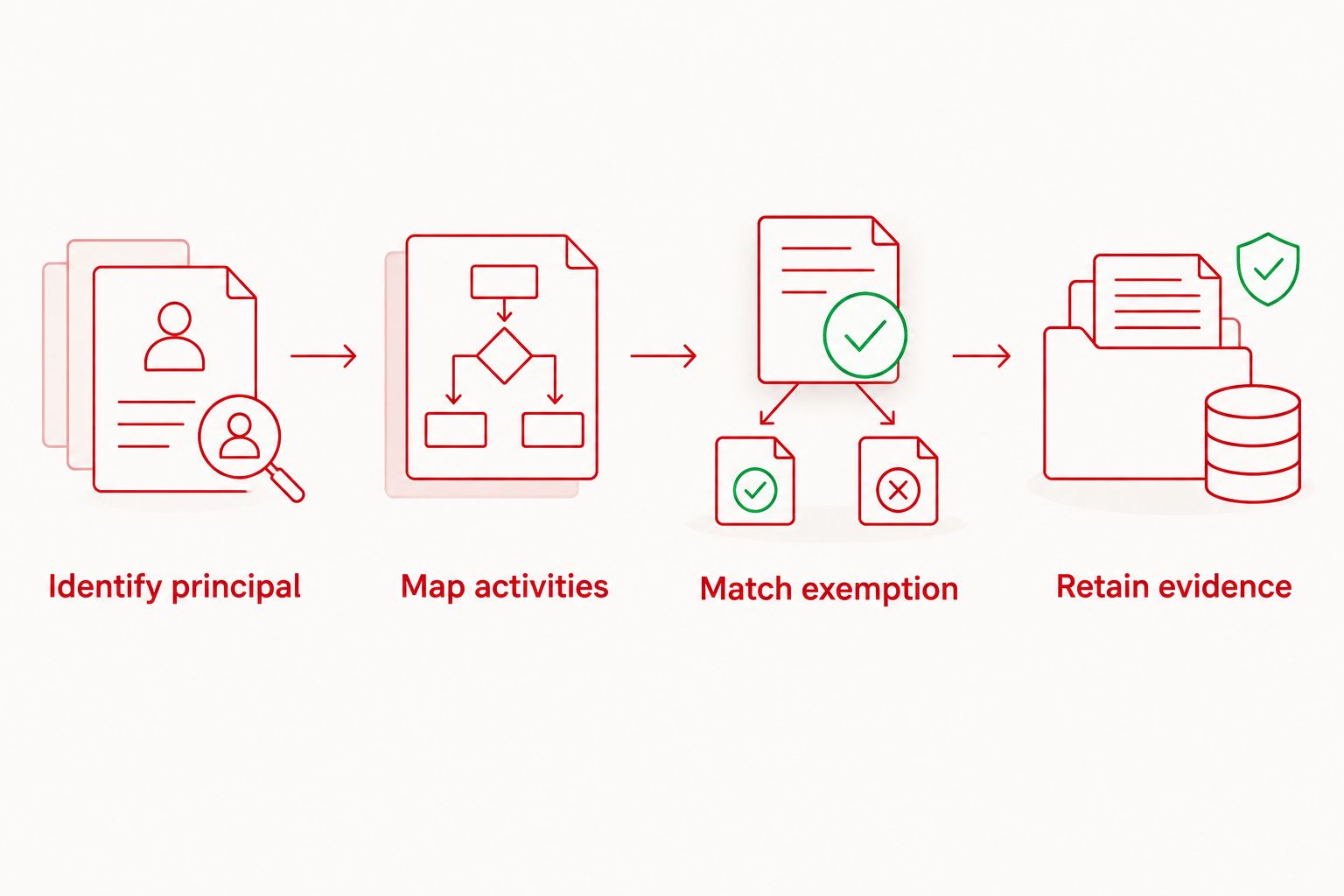
An exemption claim should identify the provision and explain how its conditions fit the facts. A statement that the relationship is commercial, educational, or legal is a starting point. It is not the completed analysis.
Does a FARA exemption mean no disclosure is required?
A FARA exemption removes the applicable FARA registration requirement, not every possible disclosure obligation. The LDA exemption itself depends on qualifying registration under another disclosure statute. Other legal requirements need their own assessment.
Does foreign funding automatically trigger FARA?
Foreign funding does not automatically establish a FARA registration obligation. Examine the statutory agency relationship, covered conduct, and exemptions. Funding is evidence to investigate, not a complete legal conclusion.
Can you register instead of claiming an exemption?
Registration and exemption analysis address different questions. Establish whether the statute requires registration, and obtain legal advice before filing or deciding not to file. Do not use a registration decision as proof that unrelated allegations are true.
FAQ
What are the main Foreign Agents Registration Act exemptions?
The Foreign Agents Registration Act lists eight exemption categories in 22 U.S.C. § 613. They address diplomatic and official roles, qualifying commercial and academic activities, certain defense-related representation, legal representation, and qualifying registered lobbying.
Does a foreign company qualify for the commercial exemption?
A foreign company’s involvement does not automatically establish the commercial exemption. Section 613(d) requires assessment of the activities and applicable conditions, including whether the work is private and nonpolitical commerce or fits another covered category.
Are lawyers exempt from FARA?
Lawyers are exempt only when their representation meets § 613(g). Qualifying legal proceedings do not automatically exempt separate lobbying or public-relations work.
Can a foreign government use the LDA exemption?
Representation of a foreign government does not qualify for the LDA exemption in § 613(h). The statute also excludes representation of foreign political parties.
Does foreign-funded university research require FARA registration?
Foreign-funded research does not automatically require FARA registration. Assess the agency relationship and activities, including whether the bona fide academic or scientific exemption in § 613(e) applies.
How quickly must a nonexempt foreign agent register?
Section 612(a) specifies registration within 10 days of becoming an agent and prohibits acting as an agent before registration. Determine whether an exemption applies before starting covered work.
Does FARA registration prove someone is a spy?
FARA registration does not prove someone is a spy. It is a disclosure mechanism for covered foreign-agent relationships and activities, not a finding of espionage.
One last thing
Ask for the exemption’s statutory subsection, then ask for the documents supporting it. That forces the discussion away from political labels and toward an answer you can examine.
For readers following National File’s foreign-agent disclosure coverage in 2026, keep allegations, established facts, and legal conclusions separate. A foreign relationship deserves scrutiny. Whether it requires registration is a further question that the statute—not a headline—answers.